
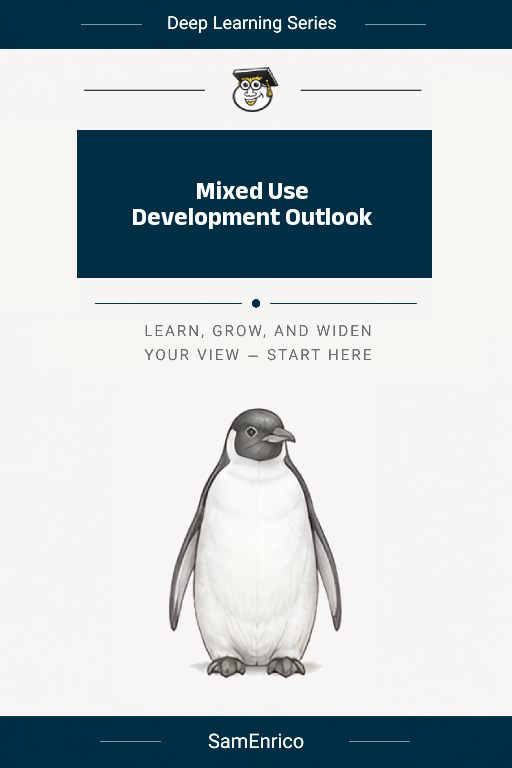
Mixed Use Development Outlook
Project live-work-play projects, retail-residentia
Project live-work-play projects, retail-residential integration, and transit-oriented development.
Formats
About this book
Free sample
Chapter 1: The Buried Blueprint--–- Before the skyscraper, before the suburb, before the zoning map that painted entire cities in shades of red (commercial), yellow (residential), and blue (industrial), there was the street. And on that street, the baker lived above his shop, the blacksmith worked beside the stable, and the merchant’s family slept in rooms behind the ledger. This was not a design philosophy. It was simply how humans built places to live. For 99% of human history, mixed-use was not a niche product or a “trend” to be analyzed in real estate conferences.
It was the default setting of urban civilization. The single-use zoning that dominates modern American development is a historical aberration—a radical experiment barely a century old—and by every measurable metric, it is failing. The purpose of this chapter is to unearth the blueprint that was buried beneath a century of parking minimums, Euclidian zoning codes, and the seductive promise of the automobile. Only by understanding how we lost mixed-use can we understand how to rebuild it.The Agora's Legacy: Mixed-Use as the Human Default Walk into the ruins of any pre-industrial city—from the narrow alleyways of Fes el-Bali in Morocco to the courtyard apartments of Rome’s Trastevere to the shop-house typology of Singapore’s Chinatown—and you will find the same spatial logic. Ground floors faced the street with doors that opened outward, inviting commerce.
Upper floors receded behind balconies or shuttered windows, offering privacy for sleeping, cooking, and family life. The alley was not a thoroughfare for cars but an outdoor room where children played, merchants shouted prices, and neighbors leaned from windows to pass gossip and baskets of bread.The Greek agora was not a “shopping center.” It was the physical manifestation of democracy—a civic, commercial, and social intersection where citizens debated philosophy, bought olives and pottery, watched theatrical performances, and worshipped at temples, all within a five-minute walk of their homes. The Roman forum added law courts and administrative buildings, creating the first true “civic center” mixed-use district. The medieval European town square was a multi-use platform: market days…
This is the end of the free sample. Get the eBook to keep going. Buy now
Contents
- Chapter 1
- Chapter 2
- Chapter 3
- Chapter 4
- Chapter 5
- Chapter 6
- Chapter 7
- Chapter 8
- Chapter 9
- Chapter 10
- Chapter 11
- Chapter 12
Details
- Author
- Jeter Reynalda
- Publisher
- SamEnrico
- Language
- English
- Genre
- Non-Fiction, Forecast & Outlook, Mixed-Use
- Released
- 2026-05-30
- Pages (approx.)
- 154
- Available as
- eBook, Audiobook

Read better in the ZLOADR app
Your eBooks on your phone or tablet. Sign in with your SamEnrico account and start reading.
More by Jeter Reynalda
 Talent Migration and Wage ConvergenceJeter Reynalda$11.99
 DNA Evidence Contamination ScandalJeter Reynalda$11.99
 Blue Zones Sleep HabitsJeter Reynalda$11.99
 Suicide Loss Survival GuideJeter Reynalda$11.99
 Receiving Compliments WorkbookJeter Reynalda$11.99
 The Fire Letters: A Victorian-Era Scam That Burned the Heart of CairoJeter Reynalda$11.99
 Understanding Leukocyte Adhesion Deficiency SyndromeJeter Reynalda$17.99
 One Page Video Marketing PrimerJeter Reynalda$12.99
 Cucumber HarvestingJeter Reynalda$11.99
 How to Become a Coke InspectorJeter Reynalda$11.99