
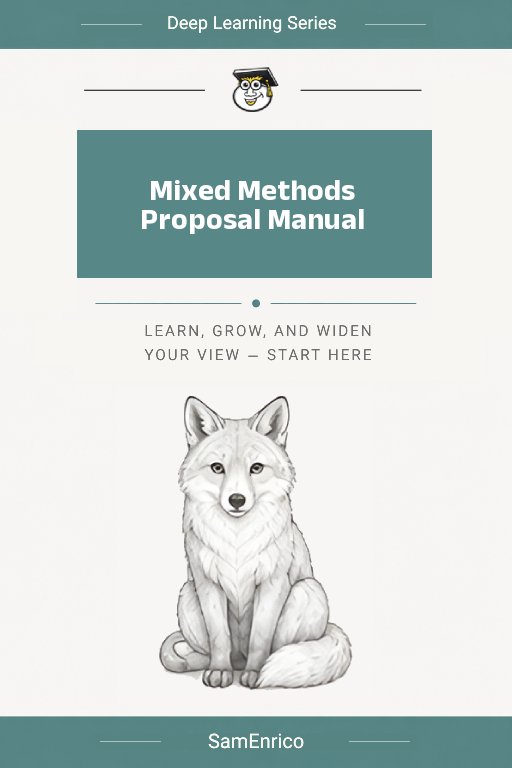
Non-FictionStudent's ShortcutMixed Methods
Mixed Methods Proposal Manual eBook
Integrate qualitative and quantitative approaches
by Kirk Jeneva
Integrate qualitative and quantitative approaches in grad school proposals. Explain sequential, concurrent, or transformative designs with clear justifications.
Formats
Free sample
Chapter 1: The Deficiencies Argument...--–- Most graduate students begin their mixed methods journey by asking the wrong question. They sit down with their dissertation chair or proposal committee and ask, “Which design should I use? Explanatory sequential? Exploratory sequential? Concurrent?” This question, while well-intentioned, is methodologically backward.
It is the equivalent of walking into a hardware store and asking, “Which tool should I buy?” before you have diagnosed whether you need to cut a board, drive a nail, or measure a distance. The tool without the problem is meaningless. The design without the rationale is indefensible.This chapter exists to force you to answer the question that must come before any discussion of design, sampling, analysis, or diagrams: Why can’t you answer your research question with a single method? If you cannot answer that question with clarity, specificity, and conviction, your proposal will be rejected. Not because your committee is cruel, but because mixed methods without a genuine rationale is not rigorous research—it is methodological busywork.
Committees see this every semester: a student who claims to be doing mixed methods because it “sounds sophisticated” or because they “want to cover all bases” or because they “think both types of data would be nice to have.” These are not rationales. They are confessions of methodological confusion.The central argument of this chapter—and indeed of this entire book—is that mixed methods is not a default choice. It is a response to a specific kind of problem. That problem has a particular structure: it contains elements that require generalization and elements that require context; it involves variables that can be measured and experiences that must be interpreted; it demands statistical relationships and lived narratives. When your problem has this dual structure, mixed methods becomes not just acceptable but necessary.
When it does not, you should be doing mono-method research, and this book will tell you so.This chapter introduces the single most important concept in mixed methods proposal writing: the deficiencies argument. Popularized by Creswell and Plano Clark in their foundational texts, the deficiencies argument is the logical backbone of every successful mixed methods proposal. It works like this: you first state what a purely quantitative study would miss. Then you state what a purely qualitative study would miss. Then you argue that because each method alone is deficient in answering your specific research question, mixing them is not a luxury but a necessity.
This three-part structure—quantitative deficiency, qualitative deficiency, and the synergy of integration—appears in some form in every funded dissertation proposal, every peer-reviewed mixed methods article, and every successful grant application in the field.But the deficiencies argument is more than a template. It is a way of thinking about your research problem. It forces you to be honest about the limits of your own methods. Many graduate students fall in love with a method before they understand their problem. They decide they want to do interviews because they like talking to people, or they want to do surveys because they are comfortable with statistics.
The deficiencies argument reverses this: it says that your problem should dictate your methods, not the other way around. If you find that you cannot articulate a genuine deficiency of quantitative methods for your specific question, you should not be doing mixed methods. Similarly, if you cannot articulate a genuine deficiency of qualitative methods, you should not be doing mixed methods. This is not a failure. It is intellectual honesty.This chapter will walk you through the deficiencies argument step by step.
It will provide templates, examples, and diagnostic tools. It will teach you how to write the single paragraph that committees look for in the first two pages of Chapter 1. It will give you a checklist to determine whether your problem is actually suited for mixed methods. And it will warn you about the most common mistakes that sink proposals before they even reach the design chapters. By the end of this chapter, you will not yet know whether you should use explanatory sequential, exploratory sequential, concurrent, or a transformative lens.
But you will know something more important: whether you should be doing mixed methods at all.The Diagnostic Question That Changes Everything Before we dive into the deficiencies argument, let me give you a single diagnostic question that will save you months of frustration. Ask yourself: Does my research problem have both outcome-focused and process-focused dimensions? Let me unpack that. An outcome-focused dimension is something that can be counted, measured, compared, or generalized. Examples include: test scores, graduation rates, income levels, recidivism rates, blood pressure readings, customer satisfaction ratings.
A process-focused dimension is something that must be understood, interpreted, or narrated. Examples include: how students experience academic pressure, why patients stop taking medication, what it feels like to navigate a bureaucratic system, how teachers make decisions in the moment.If your problem is purely outcome-focused—for example, “Does a new reading curriculum improve test scores compared to the old curriculum?”—then a randomized controlled trial or quasi-experimental quantitative study is sufficient. You do not need mixed methods. If your problem is purely process-focused—for example, “How do first-generation college students describe their transition to university life?”—then a qualitative study with in-depth interviews is sufficient. You do not need mixed methods.
Mixed methods becomes necessary only when your problem contains both outcome-focused and process-focused dimensions that are fundamentally intertwined. For example: “Does a new reading curriculum improve test scores, and *how do teachers and students experience the implementation of that curriculum in ways that explain variation in outcomes?” That is a mixed methods problem. The first part requires generalization. The second part requires context. Neither alone is sufficient.This diagnostic question is the gateway to everything that follows.
If you cannot answer yes—if your problem does not have both dimensions—stop here. Close this book. Go read a textbook on quantitative methods or qualitative methods, depending on your actual need. There is no shame in mono-method research. In fact, most of the best research in the world is mono-method.
Mixed methods is a specialized tool for a specialized kind of problem. Use it when you need it, not when you want it.The Deficiencies Argument: A Step-by-Step Breakdown The deficiencies argument consists of three logical moves. Each move corresponds to a sentence or two in your proposal. Together, they form a paragraph that typically appears in Chapter 1, right after your problem statement and before your research questions. Let me break down each move.Move One: Articulate the deficiency of quantitative methods alone.
You must state, in plain language, what a purely quantitative study would miss. Be specific. Do not say “quantitative methods cannot capture meaning” because that is a cliché and not always true. Instead, say something like: “A purely quantitative study could establish the correlation between hours of tutoring and test scores, but it could not explain why some students benefit more from tutoring than others, nor could it capture the qualitative differences in how students experience the tutoring relationship.” Notice the specificity: you are not attacking quantitative methods in general. You are naming a specific limitation relative to your specific research question.Move Two: Articulate…
This is the end of the free sample. Get the eBook to keep going. Buy now
About this book
Details
- Author
- Kirk Jeneva
- Publisher
- SamEnrico
- Language
- English
- Genre
- Non-Fiction, Student's Shortcut, Mixed Methods
- Released
- 2026-05-30
- Pages (approx.)
- 156
- Available as
- eBook, Audiobook

Read better in the ZLOADR app
Your eBooks on your phone or tablet. Sign in with your SamEnrico account and start reading.
More by Kirk Jeneva
 The Food Packaging GuideKirk Jeneva$11.99
 Dahlia Death Mask StudyKirk Jeneva$11.99
 African Nonverbal GuideKirk Jeneva$11.99
 Burnout and Social SupportKirk Jeneva$11.99
 The Celestial Architects of Great Zimbabwe: How African Astronomers Built a Kingdom by the StarsKirk Jeneva$11.99
 Principal Systems EngineerKirk Jeneva$11.99
 How to Produce Bicycle CagesKirk Jeneva$11.99
You may also like
 Hong Kong Handover 1997Dunn Johnnie$11.99
 Zumba For Postnatal Recovery CourseNeal Christian$11.99
 Zumba for BeginnersLadner Nikia$11.99
 YouTube Comment Mining GuideHumes Pandora$12.99
 Worry Box MeditationCarlin Rudy$11.99
 Workplace Stress MeditationNguyen Lynn$11.99
 Workplace Stress and Sleep RepairHawley Ivory$11.99
 Workplace Perfectionism CureDelaney Jeffry$11.99
 Workplace Injustice Anger GuideWallen Isabelle$11.99
 Work Addiction and Burnout LinkGreenwood Ester$11.99
 Women in Yoga and WellnessBeattie Galina$11.99
 Women in Stand Up ComedyChun Evangeline$11.99