
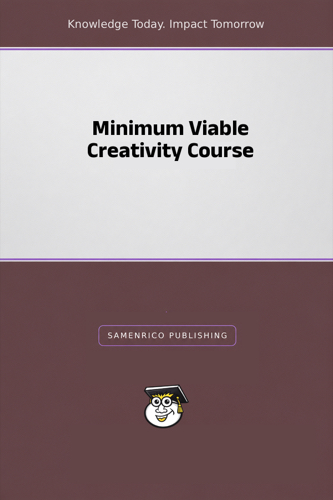
Non-FictionSelf-HelpMinimalismEfficiency
Minimum Viable Creativity Course eBook
Generate just enough creative output to solve prob
Generate just enough creative output to solve problems without overthinking.
Formats
Free sample
Chapter 1: The Permission Slip--–- The blank page stares back. Cursor blinks. Clock ticks. Three hours have passed, and all you have to show for it is a deleted sentence, a renamed file (final_v3_REALfinal), and the growing certainty that you are, somehow, already failing at something you haven't even started.This is not a lack of talent. This is not a lack of intelligence.
This is not even a lack of ideas. You have ideas. You have too many ideas. What you lack is something far more mundane and far more fixable: permission.Permission to be bad. Permission to be mediocre.
Permission to produce something that would embarrass you if your boss, your mother, or your hero saw it. And without that permission, you will never produce anything at all.Welcome to Chapter 1 of the Minimum Viable Creativity Course. Before we talk about techniques, workflows, or tools, we have to talk about the single greatest killer of creative output: the myth that your first attempt should be good.The Masterpiece Myth There is a quiet, poisonous story that most of us absorb without ever noticing. The story goes like this: creative people sit down, channel something mysterious, and produce work that is immediately impressive. The painter touches the canvas and a masterpiece emerges.
The writer types the first sentence and it is quotable. The designer opens Figma and the layout is elegant.This is complete fiction.What actually happens, in every creative field, is that first attempts are embarrassing. The painter's first sketch is wobbly. The writer's first draft is riddled with clichés. The designer's first layout is ugly.
But we never see these first attempts. We only see the finished work, polished and presented, which creates the illusion that the creator skipped the ugly part.This illusion has a name: the Masterpiece Myth. And it is the reason most people never start.Think about the last time you abandoned a creative project. Not because you lost interest, but because you sat down, tried something, hated it, and concluded that you "weren't good enough." What actually happened was not a verdict on your ability. What happened was that you expected your first attempt to meet a standard that even your heroes cannot meet on their first try.Consider this: When Ernest Hemingway revised the ending to A Farewell to Arms, he wrote thirty-nine different versions before settling on the final one.
Thirty-nine. The man who won the Nobel Prize for Literature wrote thirty-nine bad endings. Not "okay" endings. Not "almost there" endings. He wrote endings he himself described as garbage.If Hemingway needed permission to be mediocre, so do you.The Professional vs.
The Amateur In his classic book The War of Art, Steven Pressfield draws a distinction that changes everything about how we understand creative work. He divides the world into two types of people: The Professional and The Amateur.The Amateur waits for inspiration. The Amateur believes that creativity is a mystical force that arrives when conditions are perfect—when the mood strikes, when the office is clean, when there are no distractions, when the stars align. The Amateur produces only when inspired, which means the Amateur produces rarely. The Amateur also judges each piece of work as if it were a final verdict on their worth as a human being.
A bad draft means "I am a bad creative." The Amateur's identity is on the line with every sentence.The Professional, by contrast, shows up every day regardless of inspiration. The Professional treats creativity like a job, not a calling. The Professional produces on a schedule—daily, hourly, by the clock—and understands that most of what they produce will be mediocre. The Professional does not wait for the muse; the Professional knows that the muse shows up when the work is already in progress. Most importantly, the Professional separates the work from the self.
A bad draft is not a judgment on character. A bad draft is just a bad draft. Throw it away. Start another.Here is the uncomfortable truth: The Amateur believes that waiting for perfection is a sign of standards. The Professional knows that waiting is a sign of fear.Which one are you?The exercise that follows will answer that question immediately.
Not in theory, but in action.The 10 Bad Ideas Exercise (Formerly 50 – Here's Why We Changed It)Many creativity books recommend generating 50 or even 100 bad ideas. There is wisdom in that approach: it forces you past the obvious, past the safe, and into the genuinely novel. However, 50 ideas in 10 minutes is intimidating. For someone already stuck in the Creativity Trap, the number itself becomes a barrier.So we have refined the exercise to 10 bad ideas in 10 minutes.Why 10? Research on creative ideation shows a consistent pattern: the first 3 to 5 ideas are generic, predictable, and safe.
These are the ideas your brain retrieves from memory—what everyone else would think. Idea number 6 or 7 starts to get interesting. By idea 8, 9, and 10, you are scraping the bottom of the barrel, and that is precisely where novelty lives. The 10th idea is often the most original because your brain has exhausted its default patterns and has to start making unexpected connections.Ten ideas is enough to push past the obvious. Ten ideas is not so many that you give up before starting.
Ten ideas fits neatly into a 10-minute sprint—one minute per idea, no more.Here is the rule: The ideas must be bad. Not "maybe good." Not "I'll try to be creative." Bad. Stupid. Embarrassing. Impossible.
Illegal (in a fun way). Physically nonsensical. The worse the idea, the more successful you are at this exercise.Why would you deliberately generate bad ideas? Because perfectionism is the fear of being bad. When you intentionally try to be bad, you take the sting out of failure.
You cannot fail at being bad. You can only succeed.The Exercise: 10 Bad Ideas in 10 Minutes Set a timer for 10 minutes. Take out a piece of paper, a text document, or a voice memo app. Choose one problem you are currently facing. It can be small ("how to organize my email inbox") or large ("how to increase team morale").
Then write down 10 bad ideas to solve it.Do not filter. Do not delete. Do not judge. Do not stop to admire or despair. One minute per idea.
If you get stuck, write something absurd. If you run out of ideas, write the same bad idea twice but change one word.Here is an example using the problem: "How to improve boring team meetings."Set the conference room on fire (everyone will pay attention)Replace all words with moans (meeting as performance art)Hide raw fish in the CEO's chair (memorable, but not recommended)Require everyone to stand on one leg (the Meeting Plank)Translate everything into Klingon (finally, a use for that Duolingo streak)Replace the agenda with a bingo card (first to "passive-aggressive sigh" wins)Make the longest talker pay $5 per minute (suddenly, efficiency)Hold the meeting underwater (brevity becomes survival)Randomly fire someone at the 5-minute mark (extreme engagement)Replace the meeting with a silent staring contest (same duration, less jargon)Notice that among these 10 bad ideas, something interesting happens. Idea 6 (bingo card)…
This is the end of the free sample. Get the eBook to keep going. Buy now
About this book
Details
- Author
- Quigley Lecia
- Publisher
- SamEnrico
- Language
- English
- Genre
- Non-Fiction, Self-Help, Minimalism, Efficiency
- Released
- 2026-06-08
- Pages (approx.)
- 123
- Available as
- eBook, Audiobook

Read better in the ZLOADR app
Your eBooks on your phone or tablet. Sign in with your SamEnrico account and start reading.
More by Quigley Lecia
 Housing Cooperatives FinanceQuigley Lecia$11.99
 Colombian Cartel Violent EnforcersQuigley Lecia$11.99
 Refugee Resettlement Social BusinessQuigley Lecia$11.99
 Hospice Nurse Emotional GuideQuigley Lecia$11.99
 The Frozen Frontier: Hans Egede and the Greenlandic Ecosystem RevelationQuigley Lecia$11.99
 The Silk Road’s Shadow: How a 19th-Century Spy Ring Shaped Modern GeopoliticsQuigley Lecia$11.99
 How to Start a Hobby in Learning A Foreign LanguageQuigley Lecia$11.99
 Presenting Data for Crisis Response DashboardsQuigley Lecia$12.99
 Brazil Influencer MarketingQuigley Lecia$12.99
 R/c PlanesQuigley Lecia$11.99
 Understanding Familial Nasal AciliaQuigley Lecia$17.99
You may also like
 Hong Kong Handover 1997Dunn Johnnie$11.99
 Zumba For Postnatal Recovery CourseNeal Christian$11.99
 Zumba for BeginnersLadner Nikia$11.99
 YouTube Comment Mining GuideHumes Pandora$12.99
 Worry Box MeditationCarlin Rudy$11.99
 Workplace Stress MeditationNguyen Lynn$11.99
 Workplace Stress and Sleep RepairHawley Ivory$11.99
 Workplace Perfectionism CureDelaney Jeffry$11.99
 Workplace Injustice Anger GuideWallen Isabelle$11.99
 Work Addiction and Burnout LinkGreenwood Ester$11.99
 Women in Yoga and WellnessBeattie Galina$11.99
 Women in Stand Up ComedyChun Evangeline$11.99