
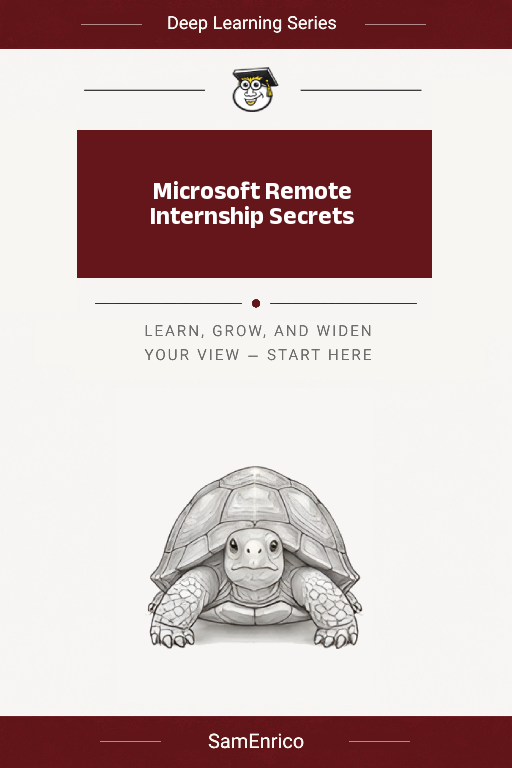
Non-FictionVirtual Work ExperienceCorporate Guide
Microsoft Remote Internship Secrets eBook
Navigate Microsoft's virtual internship program su
Navigate Microsoft's virtual internship program successfully. Learn team collaboration, project management, and networking remotely.
Formats
Free sample
Chapter 1: The Invisible Filter--–- The offer arrives on a Tuesday. You scream. You call your parents. You update your Linked In status within minutes. Then, three days before your start date, reality hits: you have no idea what you just signed up for.You know Microsoft is massive.
You know you’ll be working remotely. But no one told you that the internship itself is a test you didn’t study for—because the real exam isn’t about coding. It’s about surviving invisibility.Let me tell you about Alex. Alex was a junior at a good state school, not Stanford or MIT. He landed a remote software engineering internship at Microsoft in the summer of 2023.
He had the grades, the projects, and the leetcode grind to prove it. On paper, he was ready.On his first day, Alex logged into Teams, waited for his mentor to message him, and stared at a blinking cursor for two hours. His mentor finally sent a link to a repository with a note: “Get familiar with this. We’ll talk tomorrow.” Alex spent the next eight hours trying to build the code. It failed.
He didn’t know who to ask. He didn’t want to seem stupid. By Friday of week one, he had made zero commits, asked zero questions, and felt like he was drowning in silence.Three thousand miles away, another intern named Priya started the same week. Same Microsoft. Same remote setup.
But by Friday, she had already submitted three pull requests, scheduled coffee chats with two senior engineers, and received a shout-out from her manager in the team channel. What did Priya know that Alex didn’t?The answer isn’t talent. It’s a map. Priya had an older sibling who had interned at Microsoft the year before and told her the unwritten rules. Alex had no one.
This book is that sibling.Most books about Microsoft internships focus on how to get in. They obsess over résumés, behavioral interviews, and the infamous “as appropriate” loop. But getting in is only the first battle. The war is fought in the twelve weeks after you accept the offer—especially when no one can see you.This chapter reveals the hidden architecture of Microsoft’s remote internship ecosystem. You will learn why Microsoft treats remote internships as a filter, not a favor.
You will discover the three distinct internship tracks (Explore, Elevate, and General SWE) and why choosing the wrong strategy for your track is like bringing a knife to a gunfight. And you will finally understand the internal OKRs that managers use to grade you—metrics like Autonomy Ratio and Blocked Time Percentage—that no recruiter ever mentions.By the end of this chapter, you will know exactly what game you’re playing. And you’ll never walk into a remote internship blind again.The Great Misunderstanding: Why Remote Internships Are Harder, Not Easier There is a myth that remote internships are easier than in-person ones. The logic sounds reasonable: no commute, no dress code, no awkward elevator small talk. You can roll out of bed, join a meeting in your pajama shirt, and pretend to pay attention while scrolling your phone.That myth has destroyed more internships than imposter syndrome ever will.Remote internships are harder because they remove the safety net of physical presence.
In an office, if you’re stuck, you can walk to a senior engineer’s desk, point at your screen, and say, “This is broken.” The act of showing up signals effort. In a remote environment, no one sees you trying. No one sees you furrowing your brow at an error message. No one sees you staying late. All they see is the output.Microsoft knows this.
That’s precisely why they use remote internships as a filter.Think about it. Microsoft receives hundreds of thousands of applications every year for a few thousand internship slots. They can afford to be picky. But more importantly, they are looking for a specific kind of person—not just someone who can reverse a linked list, but someone who can operate independently in ambiguity. Remote work is the ultimate test of that trait.When you’re remote, every action becomes a data point.
The clarity of your written updates. The speed of your response to messages. The quality of your documentation. The questions you ask—and the questions you don’t ask. Managers are watching all of it, often in ways you don’t realize.One former Microsoft program manager told me, “I can tell within the first week which remote interns will get return offers.
It’s not about how smart they are. It’s about whether they figure out how to unblock themselves without me holding their hand.”That is the invisible filter. Microsoft isn’t just evaluating your technical skills. They are stress-testing your autonomy. And they built the remote internship precisely because it exposes weakness that an office setting would hide.If you succeed remotely—if you learn to communicate asynchronously, document your work religiously, and build relationships through a screen—you become a stronger full-time candidate than someone who needed in-person hand-holding.
Microsoft knows that the future of work is hybrid and remote. They are hiring for that future now.The bad news? Most interns show up completely unprepared for this reality. The good news? You’re reading this book.
So let’s fix that.The Three Tracks: Why Your Internship Is Not Like Your Friend’s One of the most dangerous assumptions you can make is that all Microsoft internships are the same. They are not. Microsoft runs three distinct remote internship programs, each with different expectations, durations, and conversion rates. Confusing them is like confusing boot camp with a book club.Here is the breakdown.Track One: Explore Microsoft Explore is the youngest and most misunderstood track. It is designed for first-year and second-year students, especially those from non-traditional computer science backgrounds.
Microsoft built Explore to cast a wider net—to find talent that might have been overlooked by the traditional recruiting pipeline.The structure is unusual. Explore interns rotate across two different teams during their internship, typically spending six weeks on each. The rotations often mix disciplines: you might spend your first half in product management and your second half in software engineering, or vice versa. The goal is to expose you to different roles before you commit to a full-time path.Remote Explore interns face a unique challenge: you switch managers and projects halfway through. That means you have to onboard twice, build trust twice, and demonstrate impact twice—all without ever meeting anyone in person.
Your documentation needs to be so clear that a new manager can ramp up on your work in a single day. If you leave messy notes or incomplete code, the second manager will assume the first manager made a mistake hiring you.The conversion rate for Explore is lower than the other tracks, not because Explore interns are less capable, but because Microsoft uses Explore as a testing ground. They want to see if you can handle ambiguity and rapid context-switching. If you succeed, you are often…
This is the end of the free sample. Get the eBook to keep going. Buy now
About this book
Details
- Author
- Slater Leandra
- Publisher
- SamEnrico
- Language
- English
- Genre
- Non-Fiction, Virtual Work Experience, Corporate Guide
- Released
- 2026-06-01
- Pages (approx.)
- 147
- Available as
- eBook, Audiobook

Read better in the ZLOADR app
Your eBooks on your phone or tablet. Sign in with your SamEnrico account and start reading.
More by Slater Leandra
 Anger at Ex Spouse CognitiveSlater Leandra$11.99
 Customer Service Anger Triggers WorkbookSlater Leandra$11.99
 Caregiver Burnout In COPD CareSlater Leandra$11.99
 Trying to Conceive at WorkSlater Leandra$11.99
 The Public Speaking Nightmare FixSlater Leandra$11.99
 Wings of Defiance: The Untold Stories of the Tuskegee Airmen’s Secret MissionsSlater Leandra$11.99
 Boston Scientific SWOTSlater Leandra$12.99
 Understanding OdynophobiaSlater Leandra$17.99
 Collections ClerkSlater Leandra$11.99
 10 Ways to Use Curd Cheese (Recipe Book)Slater Leandra$11.99
You may also like
 Hong Kong Handover 1997Dunn Johnnie$11.99
 Zumba For Postnatal Recovery CourseNeal Christian$11.99
 Zumba for BeginnersLadner Nikia$11.99
 YouTube Comment Mining GuideHumes Pandora$12.99
 Worry Box MeditationCarlin Rudy$11.99
 Workplace Stress MeditationNguyen Lynn$11.99
 Workplace Stress and Sleep RepairHawley Ivory$11.99
 Workplace Perfectionism CureDelaney Jeffry$11.99
 Workplace Injustice Anger GuideWallen Isabelle$11.99
 Work Addiction and Burnout LinkGreenwood Ester$11.99
 Women in Yoga and WellnessBeattie Galina$11.99
 Women in Stand Up ComedyChun Evangeline$11.99