
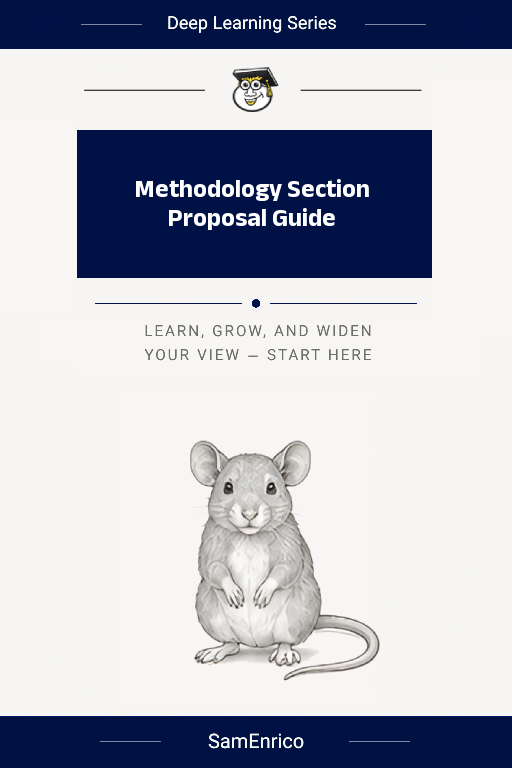
Methodology Section Proposal Guide eBook
Describe your research methods with clarity justif
by Canty Waylon
Describe your research methods with clarity justifying each choice for reproducibility.
Formats
Free sample
Chapter 1: The Red Pen Test--–- On a Tuesday morning in late October, a third-year doctoral student named Sarah printed her dissertation proposal for the seventh time. She had revised every section at least four times. Her literature review was comprehensive. Her research questions were sharp. Her committee had approved her topic unanimously.
She walked into her advisor’s office, placed the 47-page document on the desk, and waited for the nod that would send her to her methodology defense.Her advisor, a soft-spoken methodologist with thirty years of experience, did not nod. He picked up a red pen. Then he began crossing out sentences.Not paragraphs. Not sections. Individual sentences.
One after another. By the time he finished, Sarah’s methodology section—the section she had spent three months perfecting—looked like a crime scene. Red ink everywhere. Whole pages reduced to three or four surviving sentences.Sarah felt her face flush. “What did I do wrong?” she whispered.Her advisor leaned back.
“Nothing. You did exactly what every graduate student does. You described your methods. You told me what you plan to do. You gave me a checklist.
A survey. Ten interviews. A t-test. A thematic analysis. You told me everything.” He paused.
“But you didn’t tell me why.”He held up the red-penned pages. “This is what I removed. Every sentence that describes a method without justifying it. Every sentence that tells me what you will do without telling me why that choice helps answer your research question. And here’s the problem, Sarah.
Your committee is going to do the same thing. They’re going to read your proposal, and for every methodological choice you make, they’re going to ask one question: Why?”Sarah looked at her decimated methodology section. “How do I fix it?”Her advisor smiled. “You learn the Golden Rule.”This book is the answer to Sarah’s question. It exists because every week, in universities across the world, graduate students, postdocs, and early-career researchers submit methodology proposals that are meticulous, thorough, and completely indefensible.
They describe everything. They justify nothing. And then they wonder why their proposals are rejected, sent back for major revisions, or torn apart in oral defenses.The problem is not that these researchers are lazy or uninformed. The problem is that they have been trained to think of methodology as a checklist. Take a methods course.
Learn what a survey is. Learn what a t-test does. Learn what thematic analysis means. Then, when it comes time to write the proposal, simply list the methods you plan to use. The result is a methodology section that reads like a shopping list: “I will use a survey.
I will interview ten people. I will run a power analysis. I will use NVivo for coding.”This is description. And description is the enemy of justification.The single most common fatal flaw in methodology proposals—the flaw that accounts for more rejections and required major revisions than any other—is treating the section as a mere checklist of tasks. Reviewers reject such proposals not because the methods are wrong, but because the logic connecting methods to research questions is missing entirely.
A reviewer reading a checklist proposal thinks: “You have told me what you will do. But you have not told me why this is the right way to answer your research question. And if you cannot tell me why, I cannot approve your proposal.”This chapter diagnoses that flaw. It introduces the historical and disciplinary context that has made justification more important than ever before: the Reproducibility Crisis. It presents the single governing principle that will guide every subsequent chapter in this book: the Golden Rule of Methodology.
And it gives you the first practical tool you will use to audit your own writing: the Red Pen Test.By the end of this chapter, you will understand why most methodology proposals fail, what it means to justify rather than describe, and how to apply a simple diagnostic to your own writing that will immediately reveal its weaknesses. You will also receive a forward reference to Chapter 12, where the Red Pen Test evolves into the more rigorous Stranger Test for full replication auditing.The Reproducibility Crisis: Why Your Methods Section Must Be More Than Transparent Let us begin with a uncomfortable truth. For much of the twentieth century, social and behavioral scientists operated under an implicit contract with their readers. The contract said: “Trust us. We are experts.
We followed rigorous procedures. We have told you the broad strokes of what we did. You do not need every detail to trust our conclusions.”That contract is now broken.Between 2011 and 2016, a series of high-profile replication projects fundamentally reshaped what reviewers expect from a methodology section. The Reproducibility Project in Psychology attempted to replicate 100 studies published in three top psychology journals. The results were devastating.
Only 36 percent of the replications produced statistically significant results in the same direction as the original studies. When the same team replicated 21 social science studies published in Nature and Science, they found that only 62 percent produced effect sizes in the same direction as the originals—and the replicated effect sizes were, on average, only half as large as the originals.These findings were not isolated. In cancer biology, a team attempted to replicate 50 high-impact studies and could confirm the original results in only six. In economics, a replication of 18 studies published in two top journals found that only 11 produced the same significant results. In medicine, the story was the same: a review of 49 highly cited clinical studies found that 45 claimed effective interventions, but later research contradicted 16 of them outright and found weaker effects in another 16.What went wrong?
Fraud played a role in a tiny fraction of cases. So did p-hacking, selective reporting, and other questionable research practices. But the single largest contributor to the Reproducibility Crisis was something far more mundane: vague methods sections.Original authors had not hidden their methods maliciously. They had simply not reported them with sufficient detail. They said “participants were recruited from a university subject pool” without specifying whether recruitment was voluntary or required for course credit.
They said “participants completed a survey” without providing the exact wording of the questions. They said “data were analyzed using regression” without specifying which variables were entered in which order. They said “interviews were analyzed thematically” without naming the specific thematic analysis approach they used.Each of these omissions, by itself, seems small. But when a dozen small omissions accumulate, the methods section becomes impossible to replicate. A researcher in another lab reads the paper and thinks, “I understand the general approach, but I don’t have enough information to run the exact same study.” So they make assumptions.
They fill in the gaps with their own best guesses. And when their results differ from the original, no one knows whether the difference is due to a real phenomenon or merely a difference in methods.This is the Reproducibility Crisis, and it has fundamentally changed what reviewers expect from a methodology proposal. The old contract—“trust us, we are experts”—has been replaced by a new contract: “show us, with excruciating detail, exactly what you did…
This is the end of the free sample. Get the eBook to keep going. Buy now
About this book
Details
- Author
- Canty Waylon
- Publisher
- SamEnrico
- Language
- English
- Genre
- Non-Fiction, Student's Shortcut
- Released
- 2026-05-29
- Pages (approx.)
- 160
- Available as
- eBook, Audiobook

Read better in the ZLOADR app
Your eBooks on your phone or tablet. Sign in with your SamEnrico account and start reading.
More by Canty Waylon
 Napping for Cancer RecoveryCanty Waylon$11.99
 Returning To Work GriefCanty Waylon$11.99
 CrossFit Mobility WorkCanty Waylon$11.99
 Pain Meditation QuizCanty Waylon$11.99
 Conversation Starters for Game NightsCanty Waylon$11.99
 The Surgery Morning WaitCanty Waylon$11.99
 Amazon Coupons and DealsCanty Waylon$11.99
 Tobacco Cessation For COPDCanty Waylon$11.99
 Boundary Setting For First RespondersCanty Waylon$11.99
 The Jet Age Heist: How a Rogue Pilot Stole a 747 and Changed Aviation Security ForeverCanty Waylon$11.99
 The Ghosts of Talavera: Wellington's Bloodied BaptismCanty Waylon$11.99
 Ironclad Duel: The CSS Virginia vs. USS Monitor - The First Clash of TitansCanty Waylon$11.99
You may also like
 LSE Online Program LengthAgee Letisha$11.99
 Harvard Extension School for Working AdultsRoush Yer$11.99
 LSE Online Reading ListAshford Ludivina$11.99
 LSE Online Language RequirementsWhitten Daphine$11.99
 LSE Online Class SizeHughey Garret$11.99
 LSE Online Alumni MentorshipWild Lyla$11.99
 London School of Economics Alumni NetworkDutton Chantal$11.99
 Harvard Extension School Student SupportCantrell Christene$11.99
 Harvard Extension School Library AccessSantana Adah$11.99
 Harvard Extension School Degree CompletionBray Wyatt$11.99
 Harvard Extension School Course AuditingAbbott Craig$11.99
 Harvard Extension School Extension DiplomaNew Joane$11.99