
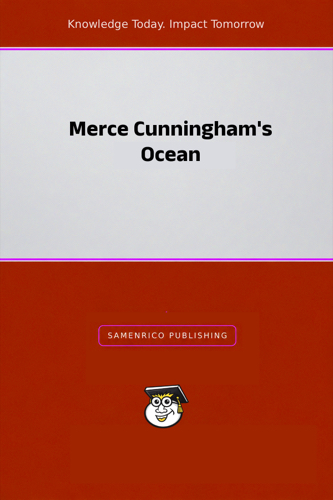
Non-FictionBiographyMultimedia Art
Merce Cunningham's Ocean eBook
Follows the creation of Cunningham's multimedia wo
Follows the creation of Cunningham's multimedia work with live fish tank and indeterminate scoring.
Formats
Free sample
Chapter 1: The Circular Rite...--One year before his death, John Cage sat in his modest loft on Sixth Avenue in New York, staring at a diagram he had drawn on a scrap of paper. It showed three concentric circles. In the innermost ring, dancers. In the middle ring, the audience. In the outermost ring, 112 musicians.
He called it his "Circular Rite" — a quiet homage to Stravinsky's The Rite of Spring, but also something entirely new. The year was 1991. Cage had spent nearly five decades upending every convention of Western music, from silent piano pieces to indeterminate compositions performed by flowers and water. Yet this idea — this impossible, glorious, logistically nightmarish idea — was different. It was not about silence.
It was about saturation. It was about being inside sound rather than receiving it from a single direction. It was, in the purest sense, immersive before anyone had coined the term -1-5.Cage had been thinking about circular performance spaces since the late 1980s. The traditional proscenium arch, he argued, created a hierarchy: performers on a pedestal, audience in darkness below. He wanted to demolish that architecture.
He wanted the audience surrounded — not just by dancers, but by musicians playing unamplified instruments in a complete ring. He wanted the experience to be tidal, enveloping, impossible to escape. "Why should the listener be fixed?" he wrote in a notebook entry from that period. "Why should sound come from one place when it is everywhere?"There was only one problem. In 1991, the idea was technically impossible.The Architecture of an Impossible Dream The logistics were staggering.
Cage's sketch specified 112 musicians — roughly the size of a full symphony orchestra — arranged in a circle around the audience. They would play unamplified, meaning their sound would have to travel across the entire performance space without electronic assistance. In a conventional concert hall, this is difficult enough; in a circular configuration, with musicians facing inward toward the audience rather than outward toward acoustic reflectors, the challenges multiply exponentially. Sound waves would collide, cancel each other, create dead zones where nothing was audible.Then there was the issue of coordination. How do 112 musicians play together without a conductor?
Cage's solution — which he never lived to implement — involved video monitors at each music stand displaying a centralized clock. Each musician would receive an individual score with precise entrance and exit times, playing independently but synchronizing to a shared temporal grid -2-6. It was radical, ingenious, and untested. No one knew if it would work.And finally, there was the cost. A production of this scale — 112 musicians, a full dance company, custom-built circular staging, video monitoring systems — would require funding far beyond what any contemporary dance company could muster.
Cage and his lifelong collaborator Merce Cunningham had spent their careers operating on shoestring budgets, relying on the generosity of foundations and the goodwill of avant-garde patrons. This was different. This was an opera-scale production with no guarantee of return.So the diagram sat on Cage's desk. He showed it to Cunningham during one of their regular dinners at the Japanese restaurant on West 21st Street. Cunningham, then 72 years old, studied the drawing in silence.
"We'll get there," he said. But neither man believed it entirely.The Unfinished Symphony On August 12, 1992, John Cage died. He was 79 years old. The cause was a stroke. He had been working until the end — composing, writing, planning.
The circular diagram was still pinned to his corkboard.Cunningham inherited the vision. But he inherited something more than a logistical puzzle. He inherited an obligation: to bring Cage's final dream into the world, not as a memorial but as a living work. This was a profound burden. Cunningham was not a sentimental man.
He rarely spoke about Cage in emotional terms, and their relationship — 50 years of creative partnership, romantic involvement, and eventual separation — was too complex for easy eulogy. Yet those who knew him well noted a shift after Cage's death. He became more focused, more urgent. He began talking about "Ocean" — the name Cage had provisionally given the piece — in nearly every studio meeting.The search for funding began almost immediately. Cunningham reached out to European presenters, who had always been more receptive to his work than American institutions.
The Théâtre Royal de la Monnaie in Brussels and the Holland Festival in Amsterdam expressed interest. By early 1993, a commission had been secured. The impossible project was moving toward reality.But now Cunningham faced a question that would define the entire enterprise: How do you honor Cage's radical indeterminacy while executing a fixed, highly expensive production? Cage believed that chance operations should govern every aspect of a work — its structure, its content, even its performance conditions. He had composed music by tossing coins and consulting the I Ching.
He had written pieces that could be performed in any order, with any number of musicians, for any duration. Ocean, however, required specificity. It required 112 musicians in a circle, a 90-minute duration, a commissioned orchestra, a film document. These were not chance operations. These were decisions.Cunningham understood the paradox better than anyone.
He had spent his entire career navigating the tension between Cage's philosophy and the practical demands of making dance. His solution was characteristically pragmatic: he would use chance to generate the content of the work — the movement phrases, their durations, their spatial pathways — while accepting the container of the work as a given. The circle was non-negotiable. The duration was fixed. The 112 musicians were a budgetary and logistical reality.
Everything inside that container, however, would be determined by the I Ching -1-9.From 64 to 128The I Ching, or Book of Changes, is an ancient Chinese divination text consisting of 64 hexagrams — six-line figures representing different states of change. Cage had been using it since the 1950s to introduce chance into his compositions. Cunningham adopted the same method for his choreography. For Ocean, however, Cunningham made a significant modification. He doubled the 64 hexagrams to 128, matching the piece's intended length in minutes -5-9.This was not a mathematical coincidence, as some later scholars assumed.
It was a deliberate alignment. Cunningham wanted the duration of the dance — 90 minutes, later refined to 128 minutes — to correspond to the number of choreographic units. Each hexagram would generate one movement phrase, each phrase lasting approximately one minute. The result would be 128 discrete modules, each with its own duration, direction, dynamics, and spatial configuration.The process was painstaking. Cunningham would toss coins to generate a hexagram, then consult a set of pre-determined charts correlating each hexagram to specific movement qualities.
Does this phrase involve a jump or a turn? Is it fast or slow? Does it travel across the space or remain in place? Which body parts initiate the movement? The answers came from the coins, not from Cunningham's preference.
He famously said that chance operations "free the ego" — they prevent the choreographer from falling into habitual patterns, from repeating what has worked before.Over several months in late 1993 and early 1994, Cunningham generated 128 phrases. He notated them in his idiosyncratic system — a mixture of Labanotation, written descriptions, and video recordings. Then he began the work of assembling them into a coherent whole. The 128 phrases were not…
This is the end of the free sample. Get the eBook to keep going. Buy now
About this book
Details
- Author
- Prado Jeffrey
- Publisher
- SamEnrico
- Language
- English
- Genre
- Non-Fiction, Biography, Multimedia Art
- Released
- 2026-06-05
- Pages (approx.)
- 129
- Available as
- eBook, Audiobook

Read better in the ZLOADR app
Your eBooks on your phone or tablet. Sign in with your SamEnrico account and start reading.
More by Prado Jeffrey
 Hollywood Suspects Black DahliaPrado Jeffrey$11.99
 Dreams After Adoption DisclosurePrado Jeffrey$11.99
 Mouth and Lip GesturesPrado Jeffrey$11.99
 The Last Stand of the 47 Ronin: Revenge, Honor, and the Fall of the TokugawaPrado Jeffrey$11.99
 Lorenzenite MiningPrado Jeffrey$11.99
 How to Produce Bedroom FurniturePrado Jeffrey$11.99
 LinkedIn Influencer ComparisonPrado Jeffrey$12.99
 How to Start a Boot Lace Business (Beginners Guide)Prado Jeffrey$11.99
You may also like
 Hong Kong Handover 1997Dunn Johnnie$11.99
 Zumba For Postnatal Recovery CourseNeal Christian$11.99
 Zumba for BeginnersLadner Nikia$11.99
 YouTube Comment Mining GuideHumes Pandora$12.99
 Worry Box MeditationCarlin Rudy$11.99
 Workplace Stress MeditationNguyen Lynn$11.99
 Workplace Stress and Sleep RepairHawley Ivory$11.99
 Workplace Perfectionism CureDelaney Jeffry$11.99
 Workplace Injustice Anger GuideWallen Isabelle$11.99
 Work Addiction and Burnout LinkGreenwood Ester$11.99
 Women in Yoga and WellnessBeattie Galina$11.99
 Women in Stand Up ComedyChun Evangeline$11.99