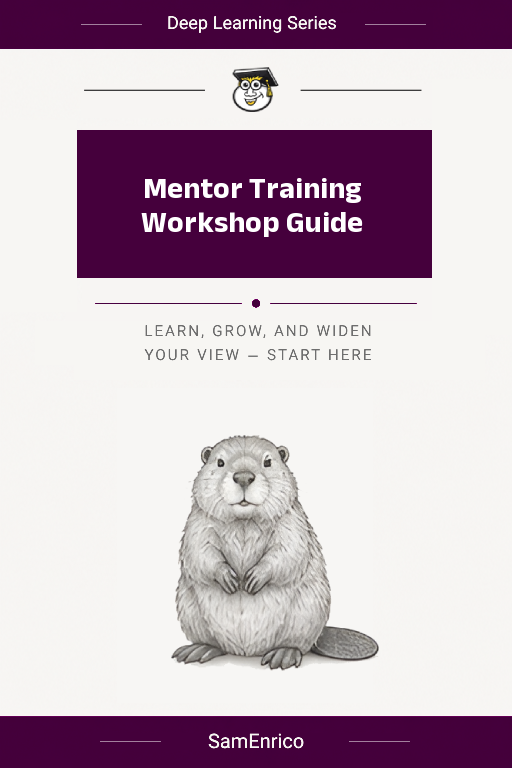
Mentor Training Workshop Guide
Train mentors on cross-cultural communication, fee
Train mentors on cross-cultural communication, feedback, and trust building techniques.
Formats
About this book
Free sample
Chapter 1: The Assumption Audit--Most organizations pour thousands of dollars into mentor training, and most of that money vanishes into the same black hole. They bring in speakers. They hand out binders. They teach mentors how to set SMART goals, how to structure a thirty-minute check-in, how to document progress on shared spreadsheets. And six months later, the mentors are still giving unsolicited advice, the mentees are still nodding silently while feeling unheard, and the program coordinator is wondering why retention rates haven't budged.The problem is not the mentors' intentions.
They genuinely want to help. The problem is not the mentees' willingness. They genuinely want to learn. The problem is that traditional mentor training operates on a false premise: that mentoring is primarily a set of technical skills that can be taught in a classroom and then applied universally.This premise collapses the moment a mentor from Chicago meets a mentee from Chennai. It crumbles further when a senior engineer who rose through the ranks of a low-power-distance organization tries to mentor a junior colleague from a high-power-distance culture.
The engineer asks, "What do you think we should do?" expecting a lively debate. The junior colleague hears, "Prove you are disloyal by contradicting your senior." Neither person is wrong. They are operating from different invisible maps.This chapter exists because mentor training fails at the first and most critical step: it never asks mentors to examine what they already believe. It jumps straight to skills. And when you jump straight to skills, you embed your unexamined assumptions into every technique you teach.
The mentor who believes that "speaking up equals engagement" will praise the loud mentee and worry about the quiet one—missing the possibility that the quiet mentee is showing deep respect through attentive silence. The mentor who believes that "efficiency equals respect" will rush through the agenda and wonder why the mentee from a relationship-first culture never returns for a second session.Before we teach a single technique for cross-cultural communication, feedback, or trust building, we must perform an assumption audit. This is not a theoretical exercise. It is the…
This is the end of the free sample. Get the eBook to keep going. Buy now
Contents
- Chapter 1
- Chapter 2
- Chapter 3
- Chapter 4
- Chapter 5
- Chapter 6
- Chapter 7
- Chapter 8
- Chapter 9
- Chapter 10
- Chapter 11
- Chapter 12
Details
- Author
- Dooley Glynis
- Publisher
- SamEnrico
- Language
- English
- Genre
- Non-Fiction, Professional's Cheat Sheet, Training
- Released
- 2026-06-01
- Pages (approx.)
- 156
- Available as
- eBook, Audiobook

Read better in the ZLOADR app
Your eBooks on your phone or tablet. Sign in with your SamEnrico account and start reading.
More by Dooley Glynis
 Wholesaling Tax Strategy GuideDooley Glynis$11.99
 Email Distraction BatchingDooley Glynis$11.99
 The Perfectionism Recovery WorkbookDooley Glynis$11.99
 Spin Sprint Finish DrillsDooley Glynis$11.99
 Dream Journal for Recurring ThemesDooley Glynis$11.99
 Wholesaling HUD Properties GuideDooley Glynis$11.99
 Carpool Lane Stress GuideDooley Glynis$11.99
 Pain Breath Tolerance PracticeDooley Glynis$11.99
 Howard Schultz ReturnDooley Glynis$11.99
 Quetzalcoatl’s Flute: The Serpent’s Divine MelodyDooley Glynis$11.99
 Oscar Wilde: The Wit, the Scandal, and the MasterpieceDooley Glynis$11.99
 The Green Book of Greenwood: How a Community Built Wealth Beyond the PagesDooley Glynis$11.99