
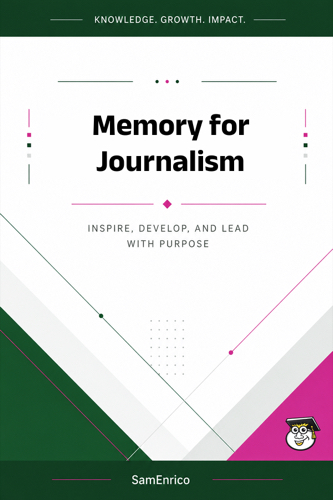
Memory for Journalism eBook
undefined
undefined
Formats
Free sample
Chapter 1: The $10,000 Mistake--The first time Sarah Chen forgot a source’s name, she was standing in the hallway of the Georgia State Capitol, her digital recorder clutched in a sweaty palm, a folded notebook digging into her ribs, and the most important whistleblower she would ever meet staring at her with expectant eyes.She had been a political correspondent for exactly eleven days.The man—a mid-level budget analyst named David Cross—had spent twenty minutes walking her through a discrepancy in the transportation funding formula. The discrepancy suggested that nearly two million dollars had been routed to a shell company with no public oversight. It was, by any measure, the story of a lifetime. And Sarah had listened with every fiber of her being. She had nodded.
She had asked follow-up questions. She had felt the electric thrill of a real investigation beginning to take shape.Then David Cross had extended his hand to say goodbye and said, “You’ll keep my name out of it until I give the green light, right?”And Sarah realized she could not remember his last name.She had written it down somewhere. It was in her notebook. It was on her recorder. But in that moment, standing two feet from a man who was risking his career to talk to her, she had absolutely no access to the information.
Her brain—trained by years of journalism school, polished by internships, certified by every editor who had ever hired her—simply refused to retrieve the name.“Of course,” she said, shaking his hand firmly, smiling as though she had any idea who he was. “I’ll be in touch.”She walked to her car, sat in the driver’s seat, and cried.Not because she was sad. Because she was furious. Because she had just experienced the single most humiliating failure of her professional life, and she knew, with absolute certainty, that it would happen again.She was right.The Cognitive Offload Epidemic Sarah Chen does not exist. But her story—compressed from interviews with more than forty working journalists across print, broadcast, and digital newsrooms—happens every single day.
A version of it happens to you. It happens to the veteran foreign correspondent who forgets a general’s name mid-live shot. It happens to the data journalist who stares at a spreadsheet and cannot remember which column contained the anomaly she spotted thirty seconds ago. It happens to the local news anchor who introduces the same city council member by two different names in the same broadcast.Here is what the journalism industry does not want to admit: we are forgetting more than any generation of reporters before us, and we do not even know we are doing it.The problem has a name. Cognitive psychologists call it the Google Effect—the tendency to remember where information is stored rather than the information itself.
When we know we can look something up, our brains efficiently offload the memory to our devices. This is not laziness. It is a sophisticated cognitive adaptation. Your brain is trying to help you conserve mental energy for tasks that actually require it.The only problem? Your brain is wrong about what those tasks are.Consider the numbers.
The average journalist checks their phone ninety-six times per shift. That is once every five minutes. Each interruption—a notification, an email, a quick search for a fact you could have remembered—pulls your attention away from the primary task of encoding new information. And here is what the research on attention and memory tells us: when you split your attention, you encode neither stream deeply.In a landmark 2016 study published in the Journal of Experimental Psychology, researchers asked participants to watch a video of a complex event while intermittently checking their phones for text messages. The participants who checked their phones remembered forty percent less about the video than those who watched uninterrupted.
But here is the crucial detail: the phone-checkers did not know they had forgotten. When asked how confident they were in their recall, they reported the same level of confidence as the uninterrupted viewers.In other words: you are forgetting constantly, and you have no idea it is happening.This is the hidden crisis of the digital newsroom. Not the decline of print advertising. Not the rise of AI. Not the collapse of trust in media.
Those are real problems. But beneath them all is a more fundamental failure: the reporter who cannot remember yesterday’s quote cannot spot today’s contradiction. The editor who cannot recall last week’s correction cannot prevent tomorrow’s retraction. The journalist who has outsourced every fact to a device has outsourced their judgment along with it.The Myth of the Perfect Digital Memory Here is what every journalist believes: “I don’t need to remember anything because I record everything.”On its face, this seems reasonable. Your phone has a recording app.
Your digital recorder holds hours of audio. Your cloud storage backs up every interview. You can search transcripts. You can scroll back through notes. You have, in your pocket, a device that can retrieve almost any fact you have ever encountered.But this belief rests on three hidden assumptions that are catastrophically wrong.Assumption One: You will know when you need to retrieve a fact.
In reality, most journalistic breakthroughs come from recognizing a connection between two facts that seemed unrelated at the time of encoding. You do not know you need to remember the budget director’s offhand comment about “special appropriations” until six months later when you stumble across a suspicious line item. At the moment of encoding, you have no search query. Your recorder is useless because you do not know what to search for.Assumption Two: Searching is as fast as remembering. Try this experiment.
Ask yourself: what is the capital of Vermont? You almost certainly know the answer (Montpelier) without any conscious effort. The memory simply appears. Now imagine you did not know the answer. You would need to pull out your phone, open a browser, type “capital of Vermont,” wait for results, and read the answer.
The retrieval time jumps from under a second to perhaps fifteen seconds. In a live interview, on a breaking news scene, or during a televised debate, fifteen seconds is an eternity. The journalist who remembers has already asked the next question. The journalist who searches is still looking at their phone.Assumption Three: Your notes and recordings are complete. They are not.
Every journalist knows this. You do not record the moment before an interview when a source says something off the record but crucial. You do not transcribe the hesitation in a politician’s voice when they answer a difficult question. You do not capture the visual detail—the folder left on the table, the quick glance at an aide, the nervous tapping of a foot—that tells you more than any quote ever could. Your devices capture what is said.
They do not capture what is meant.The journalist who relies entirely on external memory is not a journalist. They are a stenographer with a backup drive.What the Great Reporters Know (Without Knowing They…
This is the end of the free sample. Get the eBook to keep going. Buy now
About this book
Details
- Author
- Conroy Lourdes
- Publisher
- SamEnrico
- Language
- English
- Genre
- Non-Fiction, Self-Help
- Released
- 2026-06-10
- Pages (approx.)
- 145
- Available as
- eBook, Audiobook

Read better in the ZLOADR app
Your eBooks on your phone or tablet. Sign in with your SamEnrico account and start reading.
More by Conroy Lourdes
 Floating in Space GuideConroy Lourdes$11.99
 Cocaine Community Support GuideConroy Lourdes$11.99
 The Monk Mode MorningConroy Lourdes$11.99
 Commercial Property Financing OptionsConroy Lourdes$11.99
 Forgiveness for Body ImageConroy Lourdes$11.99
 Handling Coworker InterruptionsConroy Lourdes$11.99
 Household Management BlocksConroy Lourdes$11.99
 Afghanistan Green Beret MedicConroy Lourdes$11.99
 The Last Whisper of the Indus: Secrets of the Mohenjo-DaroConroy Lourdes$11.99
 The Bloomsbury Breakthrough: How Virginia Woolf and the Bloomsbury Group Redefined Modern LiteratureConroy Lourdes$11.99
 The Battle of Carrhae: Rome's Desert Disaster (53 BC)Conroy Lourdes$11.99
 The Complete Guide to the Hamptons DietConroy Lourdes$11.99
You may also like
 Hong Kong Handover 1997Dunn Johnnie$11.99
 Zumba For Postnatal Recovery CourseNeal Christian$11.99
 Zumba for BeginnersLadner Nikia$11.99
 YouTube Comment Mining GuideHumes Pandora$12.99
 Worry Box MeditationCarlin Rudy$11.99
 Workplace Stress MeditationNguyen Lynn$11.99
 Workplace Stress and Sleep RepairHawley Ivory$11.99
 Workplace Perfectionism CureDelaney Jeffry$11.99
 Workplace Injustice Anger GuideWallen Isabelle$11.99
 Work Addiction and Burnout LinkGreenwood Ester$11.99
 Women in Yoga and WellnessBeattie Galina$11.99
 Women in Stand Up ComedyChun Evangeline$11.99