
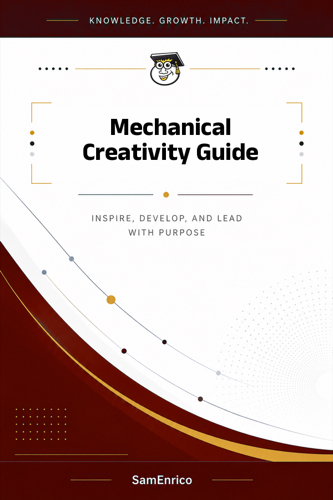
Mechanical Creativity Guide Audiobook
Design novel mechanical systems using biomimicry a
Design novel mechanical systems using biomimicry and functional analogy.
Formats
Free sample
Chapter 1: The 3.8 Billion-Year R&D Department--–- On a cold November morning in 1941, a Swiss engineer named George de Mestral returned from a hunting trip with his dog, annoyed by the hundreds of burrs stuck to his wool trousers and his dog's fur. He plucked one off, examined it under a microscope, and made an observation that would eventually generate over $100 million in annual revenue. The burr wasn't just sticking—it was hooking. Tiny hooks on the burr had latched onto the loops of his trousers' fabric. De Mestral spent the next decade figuring out how to manufacture that simple mechanical principle.
The result was Velcro, a product so elegantly functional that NASA used it to secure equipment in zero gravity, astronauts used it to fasten their suits, and children learned to tie their shoes without ever learning to tie a knot.But here is what most people miss about the Velcro story: de Mestral did not copy the burr. He could not have. A burr is made of plant cellulose, grows organically, and attaches with microscopic irregularities that change with humidity. What de Mestral actually did was something far more sophisticated—he abstracted a mechanical principle from nature and translated it into nylon, polyester, and manufacturing processes that nature had never conceived of. He asked not "What is a burr?" but "How does a burr achieve reversible attachment using only surface geometry?" That question changed industrial design forever.This book is about teaching you to ask that kind of question.
It is about transforming you from a conventional engineer who solves problems with existing components into a hunter of solutions that have already been tested, refined, and perfected over 3.8 billion years of evolution. It is about moving beyond copying nature's forms to abstracting nature's functions—and then embodying those functions in steel, polymers, silicon, and software.The Vastness of Evolutionary Time To understand why biomimicry is not merely a creativity technique but arguably the most underutilized R&D resource on the planet, you must first internalize the sheer scale of evolutionary time. Humans have been practicing systematic engineering for roughly five thousand years—since the invention of the wheel, the lever, and the inclined plane. Five thousand years. That sounds impressive until you compare it to 3.8 billion years.Consider this: if the entire history of life on Earth were compressed into a single 24-hour day, multi-cellular organisms would not appear until after…
This is the end of the free sample. Get the Audiobook to keep going. Buy now
About this book
Details
- Author
- Paulson Queen
- Publisher
- SamEnrico
- Language
- English
- Genre
- Non-Fiction, Self-Help, Mechanical Design
- Released
- 2026-06-10
- Pages (approx.)
- 156
- Available as
- eBook, Audiobook

Listen in the VoxFlicks app
Audiobooks and audio dramas wherever you go. Sign in with your SamEnrico account and press play.
More by Paulson Queen
 Fecal Transplant BrainPaulson Queen$11.99
 The Charles Eastman BiographyPaulson Queen$11.99
 Morning Tech Stack GuidePaulson Queen$11.99
 Self Talk For GratitudePaulson Queen$11.99
 Personalization Anger FixPaulson Queen$11.99
 Loma Linda Adventists GuidePaulson Queen$11.99
 Nicoya PeninsulaPaulson Queen$11.99
 The Wrong Man: The Great Melbourne Jewel Heist and the Innocent ConvictedPaulson Queen$11.99
 The Iron Crown and the Black Eagle: The Rise of the Holy Roman EmpirePaulson Queen$11.99
 How to Produce Extruded PolystyrenePaulson Queen$11.99
 A Collector's Handbook to the Alfa Romeo 1750 BerlinaPaulson Queen$11.99
 B2B Sales for Events IndustryPaulson Queen$12.99