
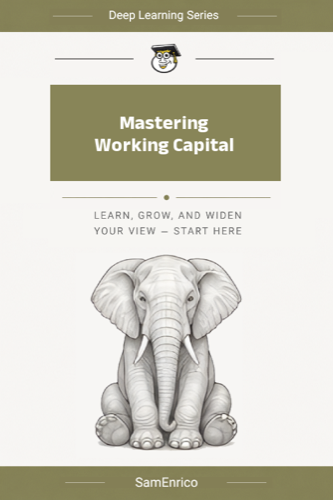
Non-FictionInformativeEducational
Mastering Working Capital
This publication, published by SamEnrico, covers M
This publication, published by SamEnrico, covers Mastering Working Capital
Formats
About this book
Free sample
Chapter 1: The Feast That Starves--–- It was the best quarter in the company’s history. Sales had grown 47 percent year over year. Gross margins were healthy at 38 percent. The pipeline was fuller than it had ever been. The CEO was already drafting his shareholder letter, rehearsing phrases like “record performance” and “positioned for accelerated growth.” The board had scheduled a special call to congratulate the management team.Thirty-two days later, the same company missed payroll.This is not a hypothetical.
It happened to a real $50 million manufacturing business that Sam Enrico advised during the post-COVID supply chain crisis. The company’s name is protected by confidentiality, but its pathology is now taught in this chapter as a warning. The executives had done everything conventional wisdom said to do. They had cut costs. They had optimized production.
They had grown revenue aggressively. They had a positive net income on their income statement. By every traditional measure, they were succeeding.And yet, they were bankrupt in everything but paperwork.The villain was not falling demand. It was not margin compression. It was not debt, fraud, or incompetence.
The villain was a silent killer that destroys more middle-market companies than any other cause: overtrading. The company sold so much, so fast, that its working capital could not keep up. Every new sale consumed cash before it generated cash. The faster they grew, the faster they died.This chapter dismantles everything you think you know about cash management. It introduces a new mental model—one that separates companies that merely survive from those that scale with velocity.
By the end of this chapter, you will understand why profitable companies go broke, why the Current Ratio is a dangerous lie, and why the concept of “cash hoarding” may be the most expensive financial mistake you are making right now.The Paradox of Profitability Let us begin with a simple question that most finance professionals answer incorrectly: Can a profitable company run out of cash?The instinctive answer is no. Profitability implies that revenues exceed expenses. If revenues exceed expenses, the company should have more cash at…
This is the end of the free sample. Get the eBook to keep going. Buy now
Contents
- Chapter 1
- Chapter 2
- Chapter 3
- Chapter 4
- Chapter 5
- Chapter 6
- Chapter 7
- Chapter 8
- Chapter 9
- Chapter 10
- Chapter 11
- Chapter 12
Details
- Author
- Tompkins Tomoko
- Publisher
- SamEnrico
- Language
- English
- Genre
- Non-Fiction, Informative, Educational
- Released
- 2026-05-08
- Pages (approx.)
- 139
- Available as
- eBook, Audiobook

Read better in the ZLOADR app
Your eBooks on your phone or tablet. Sign in with your SamEnrico account and start reading.
More by Tompkins Tomoko
 B Vitamin Complex Complete GuideTompkins Tomoko$11.99
 Dissociation Trigger RecoveryTompkins Tomoko$11.99
 The IBS Pantry MakeoverTompkins Tomoko$11.99
 Maritime DecarbonizationTompkins Tomoko$11.99
 Bradley TomTompkins Tomoko$11.99
 The First Year Without PetTompkins Tomoko$11.99
 Sam Sheppard Bedroom ReconstructionTompkins Tomoko$11.99
 Harm OCD GuideTompkins Tomoko$11.99
 Anger Journal For CouplesTompkins Tomoko$11.99
 The Ghost of Checkpoint Charlie: The Untold Story of the Berlin Tunnel 29Tompkins Tomoko$11.99
 The Deep Blue Chronicles: Black Scholars Who Mapped the Ocean's SecretsTompkins Tomoko$11.99
 Growing Verbascum (Mullein)Tompkins Tomoko$11.99
You may also like
 Hong Kong Handover 1997Dunn Johnnie$11.99
 Zumba For Postnatal Recovery CourseNeal Christian$11.99
 Zumba for BeginnersLadner Nikia$11.99
 YouTube Comment Mining GuideHumes Pandora$12.99
 Worry Box MeditationCarlin Rudy$11.99
 Workplace Stress MeditationNguyen Lynn$11.99
 Workplace Stress and Sleep RepairHawley Ivory$11.99
 Workplace Perfectionism CureDelaney Jeffry$11.99
 Workplace Injustice Anger GuideWallen Isabelle$11.99
 Work Addiction and Burnout LinkGreenwood Ester$11.99
 Women in Yoga and WellnessBeattie Galina$11.99
 Women in Stand Up ComedyChun Evangeline$11.99