
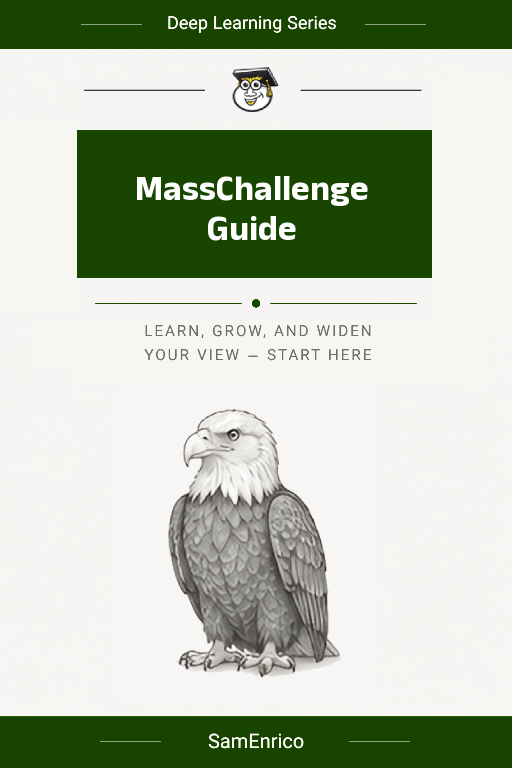
Non-FictionStartup GuideNon-Dilutive Grants
MassChallenge Guide eBook
Apply to MassChallenge accelerator and competition
by Maloney Lura
Apply to MassChallenge accelerator and competition. Non-dilutive funding and global network access.
Formats
Free sample
Chapter 1: The Equity-Free Paradox...–- Most founders believe that raising money means giving away a piece of their soul. They are half right. The other half—the part that keeps you awake at 3 AM wondering if you just sold your company for less than the cost of a modest house—that part is optional. Mass Challenge exists because someone finally asked a radical question: What if we gave startups cash and kept absolutely nothing in return? No equity.
No convertible notes. No warrants. No hidden “strategic partnerships” that slowly bleed you dry. Just money, mentorship, and a global platform. And then we ask for nothing except that you try to build something great.This is not how the startup world normally works.
The traditional path is predictable, almost ritualistic. You bootstrap until you cannot. You pitch angel investors who ask for 10 percent and a board seat. You graduate to venture capitalists who want 20 percent and veto rights. By the time you raise a Series A, you might own less than half of the company you founded in your garage.
That is the deal. That is the sacrifice. And for decades, entrepreneurs accepted it as the only game in town.But Mass Challenge changed the rules. Founded in 2009 in Boston, the organization set out to create something that had never existed before: a zero-equity, high-touch accelerator combined with a multimillion-dollar global competition. The model was simple but revolutionary.
Startups apply for free. Judges select the most promising ventures. Selected teams receive intensive mentorship, workspace, and access to corporate partners. And at the end of the program, a panel of judges awards cash prizes—often exceeding $100,000—to the top startups. No equity changes hands.
No repayment terms. No future obligations.The reaction from the venture capital establishment was predictable. “It will never scale,” they said. “Without equity, you cannot align incentives.” “Startups will take the money and disappear.” Fifteen years and thousands of alumni later, Mass Challenge has awarded over 100millioninnon−dilutivefundingtomorethan2,500startups.Thosecompanieshavegoneontoraiseover100 million in non-dilutive funding to more than 2,500 startups. Those companies have gone on to raise over 100millioninnon−dilutivefundingtomorethan2,500startups.Thosecompanieshavegoneontoraiseover4 billion in follow-on capital and create tens of thousands of jobs.
The model did not just work. It thrived.So why have you never heard of non-dilutive funding as a serious option? Because venture capital is a story that venture capitalists tell. It is a narrative of risk and reward, of billion-dollar exits and founder sacrifices. The media loves that story.
The conferences sell tickets to that story. But there is another story—quieter, more strategic, and often more profitable for founders—that involves taking grant money, government awards, and competition prizes before ever selling a single share. Mass Challenge sits at the center of that alternative universe.This chapter will show you exactly where Mass Challenge fits in the startup funding landscape, why the equity-free model creates opportunities that traditional accelerators cannot match, and how to determine whether this path is right for your startup right now.The Funding Ladder: Where Mass Challenge Lives Every startup climbs a funding ladder. The rungs are predictable: friends and family, angel investors, seed funds, venture capital, growth equity, and eventually public markets or acquisition. But most founders miss a crucial set of rungs that sit between bootstrapping and angel investment.
These are non-dilutive funding sources: government grants (SBIR, STTR), corporate innovation prizes, philanthropic awards, and accelerators like Mass Challenge that offer cash without equity.Traditional venture capital operates on a power law model. A VC fund expects nine out of ten investments to fail, one to return the fund, and a rare unicorn to return the fund many times over. To make that model work, VCs need large ownership stakes—typically 15 to 30 percent—and liquidation preferences that guarantee they get paid before you do. This is not malevolence. It is mathematics.
If a fund cannot own enough of your company to turn a 10millioninvestmentinto10 million investment into 10millioninvestmentinto100 million, the model breaks.Mass Challenge operates on a completely different logic. The organization is a nonprofit. Its mandate is economic development, not financial returns. The prize money comes from corporate sponsors, philanthropic foundations, and regional economic development funds. These stakeholders want jobs created, innovations commercialized, and ecosystems strengthened.
They do not need to own your company to succeed. A single Mass Challenge graduate that creates 200 jobs in Boston, Austin, or Zurich delivers exactly the outcome the sponsors paid for.This distinction matters enormously for founders. When you take money from a VC, you are signing up for a marriage. That investor will have board rights, approval rights over future financing, and often a contractual say in whether you can sell the company. When you take money from Mass Challenge, you are receiving a gift.
There are no board seats. There are no approval rights. There is no repayment schedule. The only requirement is that you complete the program and make a good-faith effort to build your business.Mass Challenge vs. The Competition: A Founder’s Table To understand why Mass Challenge matters, you need to see how it compares to the other major pathways for early-stage funding.
Here is a direct comparison across the most common options available to pre-revenue and early-revenue startups.Friends and Family: You raise $50,000 from your parents and your college roommate. The terms are informal, often undocumented. The cost is not financial but relational. When the company struggles—and it will—holiday dinners become awkward. The ceiling is low because your network is finite.Angel Investors: You raise 100,000to100,000 to 100,000to500,000 from wealthy individuals.
In exchange, you give up 5 to 20 percent of your company. Angels may or may not add value beyond the check. Many will want a board seat or observer rights. The process takes three to six months of intensive networking and pitching.Venture Capital Seed Funds: You raise 500,000to500,000 to 500,000to2 million from institutional seed funds. You give up 15 to 25 percent of your company.
You receive a term sheet with multiple pages of legal provisions: liquidation preferences, anti-dilution protections, pro-rata rights, and sometimes participating preferred stock. The process takes six to twelve months and requires a lead investor.Mass Challenge: You win 50,000to50,000 to 50,000to100,000 in cash. You give up nothing. The application process takes two to four weeks. You receive four months of structured programming, mentorship from corporate partners, and lifetime access to a global alumni network.
There is no term sheet. There are no lawyers negotiating your cap table. The money arrives as a grant, not an investment.Government Grants (SBIR/STTR): You win 50,000to50,000 to 50,000to250,000 in non-dilutive funding. The application process takes forty to eighty hours. You must meet specific technology focus areas and small business ownership requirements.
The reporting requirements are extensive. The money arrives nine to twelve months after application.The comparison reveals something important. Mass Challenge is not the largest source of non-dilutive funding. Government grants often write bigger checks. Mass Challenge is not the most intensive accelerator.
Techstars and Y Combinator provide more hands-on mentorship. Mass Challenge is not the fastest path to capital. A friends and family round can close in a weekend.What Mass Challenge offers is unique combination of zero equity, medium-sized checks, structured…
This is the end of the free sample. Get the eBook to keep going. Buy now
About this book
Details
- Author
- Maloney Lura
- Publisher
- SamEnrico
- Language
- English
- Genre
- Non-Fiction, Startup Guide, Non-Dilutive Grants
- Released
- 2026-05-30
- Pages (approx.)
- 149
- Available as
- eBook, Audiobook

Read better in the ZLOADR app
Your eBooks on your phone or tablet. Sign in with your SamEnrico account and start reading.
More by Maloney Lura
 Assertiveness in Text and EmailMaloney Lura$11.99
 The Brain Training WorkbookMaloney Lura$11.99
 Sleep Meditation for School Age KidsMaloney Lura$11.99
 Loneliness In Rural AreasMaloney Lura$11.99
 The Task Batching Alternative GuideMaloney Lura$11.99
 The Silk Road Derby: How a Medieval Rivalry Shaped Football's FutureMaloney Lura$11.99
 Supporting Documents for ITAMaloney Lura$12.99
 Audit Associate DirectorMaloney Lura$11.99
 Learn to Play the BirbynėMaloney Lura$11.99
 How to Start a Carbon Brush Business (Beginners Guide)Maloney Lura$11.99
You may also like
 Hong Kong Handover 1997Dunn Johnnie$11.99
 Zumba For Postnatal Recovery CourseNeal Christian$11.99
 Zumba for BeginnersLadner Nikia$11.99
 YouTube Comment Mining GuideHumes Pandora$12.99
 Worry Box MeditationCarlin Rudy$11.99
 Workplace Stress MeditationNguyen Lynn$11.99
 Workplace Stress and Sleep RepairHawley Ivory$11.99
 Workplace Perfectionism CureDelaney Jeffry$11.99
 Workplace Injustice Anger GuideWallen Isabelle$11.99
 Work Addiction and Burnout LinkGreenwood Ester$11.99
 Women in Yoga and WellnessBeattie Galina$11.99
 Women in Stand Up ComedyChun Evangeline$11.99