
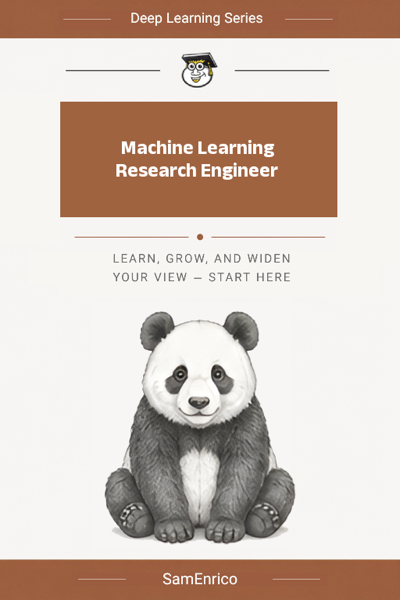
Machine Learning Research Engineer eBook
A Coursebook on Machine Learning Research Engineer
by Rea Eugenio
A Coursebook on Machine Learning Research Engineer
Formats
Free sample
Chapter 1: The Chasm Crossed--–- The email arrived at 11:47 PM on a Tuesday. "Congratulations! You've been conditionally offered the position of Machine Learning Research Engineer at Deep Research Labs." Two weeks earlier, you had survived the infamous "reproducibility interview"—three hours in which they gave you a PDF of a paper you'd never seen ("Attention is All You Need"—of course) and asked you to implement the core equation from scratch, run it on a tiny dataset, and explain why the loss started at 0.69. You did. Barely. Now you're staring at an offer letter with a number that makes your previous software engineering salary look like an internship stipend. There's only one problem: you're not sure you actually know what a Machine Learning Research Engineer does, or how to survive the first ninety days without embarrassing yourself.This book is the guide you wished existed on that Tuesday night.The chasm between "someone who can train a model from a tutorial" and "someone who reproduces state-of-the-art research and deploys it to production" is wider than most aspiring practitioners realize. On one side, you have Kaggle competitions and Jupyter notebooks—beautiful, ephemeral, single-run experiments that produce impressive metrics but crumble under real-world constraints. On the other side, you have research papers with missing hyperparameters, distributed systems that fail silently, and loss curves that plateau for three weeks. The Machine Learning Research Engineer stands in the middle, one foot in the mathematics of generalization, the other in the cgroups of a Kubernetes cluster.This chapter does three things. First, it defines precisely what a Research Engineer is—and why the role commands salaries that rival surgeons. Second, it diagnoses the seven deadly sins that separate aspirational practitioners from professionals. Third, it gives you a ninety-day roadmap to transform from someone who "knows Py Torch" into someone who can take an ar Xiv paper to production, alone if necessary, and explain every trade-off along the way.If you complete this book and implement every Core Lab, you will never again feel the impostor syndrome of staring at a Na N loss without knowing where to look. You will, however, feel the productive discomfort of knowing exactly how much you don't know—which, it turns out, is the true mark of a research engineer.The Three Archetypes of AI Practitioners Before we define the Research Engineer, we must distinguish them from their close cousins. Most organizations have three distinct roles, and confusing them leads to failed projects, burned-out teams, and the infamous "it works in my notebook" conversation with product managers.Archetype 1: The Machine Learning Scientist This person holds a Ph D (or equivalent experience) in statistics, computer science, or applied mathematics. Their primary output is knowledge in the form of papers, models, or theorems. They care about generalization bounds, convergence proofs, and whether a new architecture improves upon the state-of-the-art by a statistically significant margin. They can derive the gradient of the loss function with respect to the parameters of a variational autoencoder on a whiteboard, but they may not know how to write a Dockerfile or why torch.no_grad() matters in production.When a scientist says "the model is ready," they mean: "under ideal conditions, with carefully curated data, and assuming no distribution shift, the metrics meet the acceptance criteria." They are not wrong. They are also not finished.Archetype 2: The Machine Learning Engineer This person often comes from a software engineering background. Their primary output is systems: data pipelines, serving infrastructure, monitoring dashboards, and CI/CD workflows. They care about latency, throughput, cost per inference, and the five nines of availability. They can deploy a model to a Kubernetes cluster, set up auto-scaling based on request rate, and debug a memory leak in a production service—but they may not understand why gradient clipping prevents exploding gradients or how to debug a transformer's attention patterns when the loss diverges.When an engineer says "the model is ready," they mean: "it is containerized, versioned, monitored, and can handle peak load with acceptable tail latency." They are not wrong. They are also not finished.Archetype 3: The Machine Learning Research Engineer (You)This person sits at the intersection. Their primary output is reproducible, optimized, production-ready research. They can read a paper, extract the core mathematical contribution, implement it from scratch, debug training instabilities using gradient norms and loss landscapes, profile the implementation to identify memory or compute bottlenecks, write a custom CUDA kernel if necessary, and deploy the result as a scalable service—all without waiting for a separate engineer to "productionize" their work.When a research engineer says "the model is ready," they mean: "the research is reproduced, the training is stable and documented, the inference latency is within business requirements, and the system can be deployed with one command." This is a much higher bar. It is also the bar for the most valuable AI professionals in the industry.Consider the salary data from 2024–2025. At top AI companies (Open AI, Anthropic, Deep Mind, FAIR), a Machine Learning Scientist with a Ph D starts at 200k–200k–200k–300k total compensation. A Machine Learning Engineer with equivalent experience starts at 180k–180k–180k–280k. A Research Engineer—someone who can do both—starts at 280k–280k–280k–500k. The premium exists for a simple reason: these individuals unblock themselves. They do not wait for someone else to reproduce a paper, or deploy a model, or debug a training failure. They do it all.The Seven Deadly Sins of Aspirational Practitioners Over the past decade of teaching ML to engineers at companies ranging from startups to FAANG, I have observed seven recurring failure modes. These are the sins that keep good practitioners from becoming great research engineers. Read them carefully. Each one is a trap you will encounter in this book—and each one has a corresponding antidote built into the chapters that follow.Sin 1: The Math Evasion Symptom: You copy-paste an optimizer from Stack Overflow without understanding why Adam W has weight decay and Adam doesn't. You use nn.Linear without understanding that it performs x W^T + b and wonder why your shapes mismatch. You treat a Na N loss as a mysterious artifact rather than a clue (it's almost always a division by zero, log of zero, or exploding gradient).Why it's fatal: Without mathematical intuition, you cannot debug training failures beyond random hyperparameter searches. You become a "hyperparameter monkey"—someone who tweaks learning rates until something works, then moves on without understanding why. This does not scale to novel architectures or research reproduction.The antidote: This chapter gives you the 80/20 math toolkit—the specific concepts that appear in 80% of research papers. Chapter 4 forces you to implement backpropagation manually so you can never again be mystified by an autograd error.Sin 2: The Notebook Prison Symptom: You do all your work in Jupyter notebooks, with cells in non-linear order, global variables mutated invisibly, and no version control. Your "training pipeline" is a collection of cells that must be run in exactly the right order, and you've trained yourself to ignore the warning "kernel restart recommended."Why it's fatal: Notebooks are for exploration, not production. Research engineering requires reproducibility—the ability to run the same experiment twice and get the same result. Notebooks encourage statefulness, hidden dependencies, and the "it worked when I ran it yesterday" problem.The antidote: Every Core Lab in this book is designed…
This is the end of the free sample. Get the eBook to keep going. Buy now
About this book
Details
- Author
- Rea Eugenio
- Publisher
- SamEnrico
- Language
- English
- Genre
- research, Informative, Educational
- Released
- 2026-05-18
- Pages (approx.)
- 154
- Available as
- eBook, Audiobook

Read better in the ZLOADR app
Your eBooks on your phone or tablet. Sign in with your SamEnrico account and start reading.
More by Rea Eugenio
 Eliminate Quadrant Three ClutterRea Eugenio$11.99
 Fear Of Failure In DivorceRea Eugenio$11.99Fear Of Failure In DivorceRea Eugenio$11.99
 Philips SmartSleep AlarmRea Eugenio$11.99
 Endometriosis Differential DiagnosisRea Eugenio$11.99
 The Black Dahlia Murder Scene AnalysisRea Eugenio$11.99
 The Timbuktu Scholars: Unlocking the Secrets of the StarsRea Eugenio$11.99
 How to Become a Ornamental-iron-worker ApprenticeRea Eugenio$11.99
 Understanding Reynolds–neri–hermann SyndromeRea Eugenio$17.99
 Grading System Turkey GuideRea Eugenio$12.99