
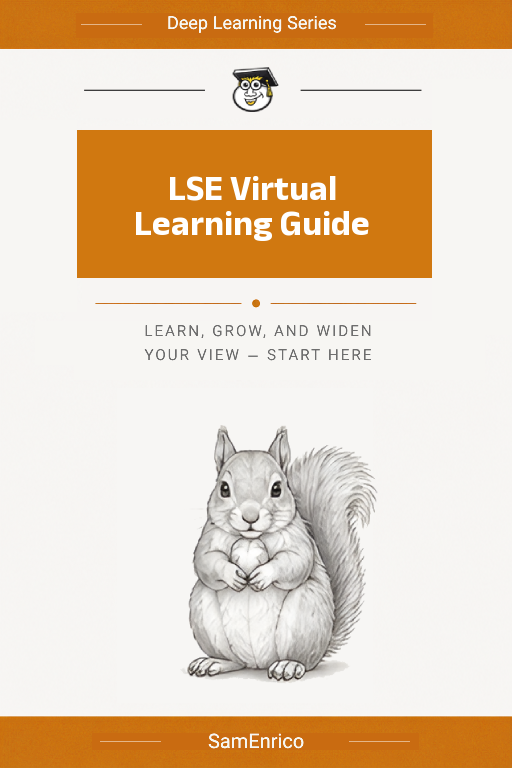
Non-FictionStudent's ShortcutVirtual Campus
LSE Virtual Learning Guide eBook
Experience LSE online learning including live semi
by Poore Jerrie
Experience LSE online learning including live seminars, global classrooms, and virtual library access.
Formats
Free sample
Chapter 1: The Active Mindset...--–- The email arrives in your inbox at 9:47 AM London time. You have been accepted to the London School of Economics and Political Science. For a moment, there is only joy—the culmination of years of work, the validation of your intellectual ambition. Then, in the next breath, a different feeling arrives. You scroll down.
You see the words: Online Programme. And something shifts.The question forms silently, the one that thousands of LSE online students ask themselves but rarely say aloud: Will I really belong?You imagine the classic LSE student striding through the Saw Swee Hock Building, debating monetary policy over coffee in the Fourth Floor Café, pulling all-nighters in the British Library of Political and Economic Science. That is the LSE of legend. That is the LSE of your imagination. And you will be attending from a spare bedroom in Manchester, a kitchen table in Mumbai, a cramped flat in Singapore, or a coffee shop in New York City at 2:00 AM because the time zones demand it.Here is the truth that no orientation video will tell you: You are not at a disadvantage.
You are playing a different game entirely.The online student who succeeds at LSE is not the one who wishes they were on campus. The online student who thrives is the one who recognizes that virtual learning, done correctly, offers advantages that the residential student cannot access. You have recorded seminars you can rewatch. You have global classmates who bring perspectives no London-only cohort could replicate. You have the entire LSE Digital Library at your fingertips, open at hours when the physical building is locked.
And you have this book: the first comprehensive guide to mastering the specific, unique, sometimes infuriating, ultimately transformative experience of being an LSE student online.But before we talk about Moodle plugins and Echo360 analytics and the perfect email template for a missed Zoom link, we must talk about something more fundamental. We must talk about the active mindset. Because without it, the best technology in the world is just expensive furniture.The Great Confusion: Why Most Online Students Fail Before They Begin Let us name the enemy. It is not Zoom fatigue, though that is real. It is not time zones, though they are brutal.
It is not even loneliness, though it will visit you.The enemy is passive consumption disguised as learning.Here is how it happens. You log into Moodle. You see ten new files: three PDFs, four recorded lectures, two discussion prompts, and a supplementary reading list. You download everything. You feel productive.
You open the first lecture video, press play, and scroll through Twitter while a professor explains the efficient markets hypothesis. You open the first PDF, skim the abstract, and save it to a folder called "Week 3." You tell yourself you will return to it later. You never do.At the end of the week, you have "done the work." But ask yourself: what do you actually remember? What argument can you defend? What question would you dare to ask in a live seminar?This is the trap.
The Virtual Learning Environment (VLE) is designed to make downloading effortless. A single click delivers a semester's worth of reading. But downloading is not learning. Collecting is not understanding. And Moodle is not a digital filing cabinet—or at least, it should not be.LSE's official documentation is clear on this point.
The VLE is designed as a "virtual classroom where learning, teaching, collaboration, discussion, and reflection occur." Those are active verbs. Learning. Teaching. Collaborating. Discussing.
Reflecting. None of them happen while your lecture video plays in a minimized tab.The difference between a struggling online student and a thriving one is not intelligence. It is not even time management, though that matters. It is the ability to distinguish between passive consumption (downloading files, watching videos absentmindedly, skimming readings) and active asynchronous learning (watching with intention, taking timestamped notes, completing interactive quizzes, contributing to discussion forums, synthesizing arguments before live sessions).This chapter is about building that distinction into your daily practice. It is about transforming Moodle from a passive repository into your intellectual home.
And it begins with a single, uncomfortable question that you must ask yourself before every study session: Am I consuming, or am I learning?The Architecture of Active Learning: How LSE's Moodle Is Actually Designed Before you can use a tool well, you must understand what it was built to do. LSE's Moodle installation is not generic. The School's Eden Centre for Education Enhancement has spent years customizing the platform for the specific demands of social science education. Understanding these customizations is the difference between fighting your tools and wielding them.The Collaborative Spine: Open Forum and Hot Question Most students ignore discussion forums. This is a catastrophic error.The standard Moodle forum is a clunky, linear thread that discourages genuine conversation.
LSE has replaced it in many courses with Open Forum, a responsive alternative designed to mimic the back-and-forth of a live seminar. Replies nest visually. Participants can "like" contributions without creating noise. And perhaps most importantly, the interface encourages you to respond to specific claims rather than just adding a new top-level post.Here is what Open Forum enables that a standard forum does not: genuine intellectual disagreement at scale. In Week 2 of a typical economics module, you might see a student post a critique of the Solow growth model.
In a standard forum, replies would be buried. In Open Forum, that critique becomes a branching conversation thread, with five, ten, fifteen replies building on, challenging, and refining the original argument. By Friday, the thread has become a collaborative paper that no single student could have written alone.Hot Question is even more powerful. This plugin allows students to submit questions during or after lectures, and then vote on which questions most urgently need answers. The result is democratic prioritization.
If thirty students are confused about instrumental variables and only three are confused about heteroskedasticity, Hot Question surfaces the collective confusion. Your professor knows exactly where to focus their limited live time.The student who treats these tools as optional is leaving marks on the table. Participation in Open Forum is often ungraded. But professors notice. And more importantly, the act of writing a response forces you to crystallize your thinking in a way that silent reading never can.The Visual Dashboard: Collapsed Topics and Grid Format You have forty-seven Moodle courses.
Not really, but it feels that way. The default Moodle view is a scrolling nightmare of nested folders, each containing more nested folders. LSE offers two alternative display formats that will save your sanity.Collapsed Topics Format does exactly what it promises. Each week or topic appears as a clickable header. Everything else stays hidden until you need it.
This reduces cognitive load dramatically. Instead of seeing every assignment for the entire semester, you see only this week's work. When you finish, you collapse it and move on. The relief is immediate.Grid Format is for the visually oriented. Each course unit appears as a tile.
You see at a glance what is coming: Lecture 1, Seminar 1, Reading 1, Quiz 1. The grid reveals gaps.…
This is the end of the free sample. Get the eBook to keep going. Buy now
About this book
Details
- Author
- Poore Jerrie
- Publisher
- SamEnrico
- Language
- English
- Genre
- Non-Fiction, Student's Shortcut, Virtual Campus
- Released
- 2026-05-29
- Pages (approx.)
- 155
- Available as
- eBook, Audiobook

Read better in the ZLOADR app
Your eBooks on your phone or tablet. Sign in with your SamEnrico account and start reading.
More by Poore Jerrie
 Financial Control Freak RecoveryPoore Jerrie$11.99
 NVC Parenting DisciplinePoore Jerrie$11.99
 Teresa of Ávila Foundations Journey GuidePoore Jerrie$11.99
 Remote IT Support PlaybookPoore Jerrie$11.99
 Boundary Setting with Adult ChildrenPoore Jerrie$11.99
 The Drowning Choir of St. Elmo's ReefPoore Jerrie$11.99
 The Cosmic Lens: Vanuatu’s Telescope and the Birth of a StargazerPoore Jerrie$11.99
 Understanding Epidermolysis Bullosa Simplex With Anodontia, HairPoore Jerrie$17.99
 Digital Nomad House Sitting KitPoore Jerrie$12.99
 Inbound ReceivingPoore Jerrie$11.99
 How to Become a Casting-room OperatorPoore Jerrie$11.99
You may also like
 Hong Kong Handover 1997Dunn Johnnie$11.99
 Zumba For Postnatal Recovery CourseNeal Christian$11.99
 Zumba for BeginnersLadner Nikia$11.99
 YouTube Comment Mining GuideHumes Pandora$12.99
 Worry Box MeditationCarlin Rudy$11.99
 Workplace Stress MeditationNguyen Lynn$11.99
 Workplace Stress and Sleep RepairHawley Ivory$11.99
 Workplace Perfectionism CureDelaney Jeffry$11.99
 Workplace Injustice Anger GuideWallen Isabelle$11.99
 Work Addiction and Burnout LinkGreenwood Ester$11.99
 Women in Yoga and WellnessBeattie Galina$11.99
 Women in Stand Up ComedyChun Evangeline$11.99