
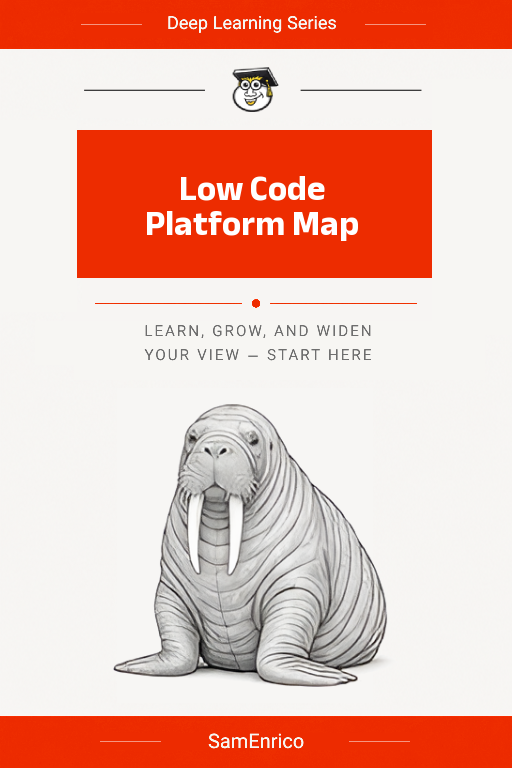
Non-FictionStrategic AtlasLow Code
Low Code Platform Map eBook
Plot Microsoft Power Apps, Salesforce, ServiceNow,
Plot Microsoft Power Apps, Salesforce, ServiceNow, and Appian on citizen developer versus pro-code extensibility.
Formats
Free sample
Chapter 1: The Fragile Handoff--The most expensive software in the world is not the one that requires a thousand developers. It is the one that requires a thousand meetings between the person who has the problem and the person who knows how to code.For thirty years, enterprises have accepted this friction as inevitable. A business analyst writes a requirements document. A project manager prioritizes it. A developer estimates it.
A backlog grows. Months pass. By the time the software arrives, the problem has either changed, been solved by a spreadsheet, or been abandoned entirely. This gap between the need and the implementation is the single greatest source of wasted technology spending in the Fortune 500. And for three decades, the proposed solution has been binary: either train business people to code (failed experiment, 1990s) or hire more coders (failed economics, 2010s).The low-code platform emerged as a third path, promising to collapse the distance between idea and application.
A marketing manager could build an event registration app on Monday morning and launch it by Tuesday. A procurement specialist could automate a vendor approval workflow before lunch. This promise sparked a gold rush. Microsoft Power Apps, Salesforce, Service Now, and Appian each built ecosystems that put application development into the hands of "citizen developers"—business users with no formal coding background.Then something strange happened.The same platforms that promised to eliminate the backlog created a new kind of debt. Companies that enthusiastically deployed low-code tools found themselves, eighteen months later, with hundreds of applications they could not govern, data models they could not reconcile, and a new breed of shadow IT that looked professional but behaved like a house of cards.
The citizen developer, celebrated as a hero of agility, became a villain of entropy. The low-code platform, hailed as the democratization of technology, was rebranded as the creator of technical debt in drag-and-drop clothing.The problem was never the platforms. The problem was the map.The Unspoken Assumption Every low-code platform makes a seductive promise: you do not need to know how to code. But this promise conceals a more difficult truth. You do need to know how to structure data.
You do need to understand event-driven architecture. You do need to think about security, concurrency, idempotency, and state management. The platform abstracts the syntax but not the complexity. A citizen developer who cannot write a SQL query can still create a database with Power Apps Dataverse—but they may create a database with circular relationships, duplicate keys, and no indexing strategy. The platform will happily build this application.
It will run. It will even delight its users. For three months.At the three-month mark, something shifts. The application that was built for a team of twenty is now used by a department of two hundred. The approval workflow that handled fifty requests per week now handles five hundred.
The simple dropdown field that fed a single report is now referenced by seven other applications built by three different teams. The citizen developer who built the original app has been promoted, transferred, or has simply forgotten how the nested conditions work. The platform does not warn you. It does not send an email that says, "Congratulations, you have just created an unmaintainable object." It just keeps running, faster and faster toward the cliff.This is the fragile handoff. It is the moment when a citizen-built application outgrows its creator's capacity to maintain it but has not yet been discovered by the IT team responsible for rescuing it.
In that gap—between agility and governance, between speed and stability—companies lose millions. Not because the platform failed, but because no one asked the essential question: Who will own this application in twelve months?The Four Platforms, Four Inheritances To understand the fragile handoff, we must understand what each platform inherited from its origin. Software platforms are not neutral. They carry the assumptions, trade-offs, and architectural biases of their founding problems.Microsoft Power Apps inherited the DNA of Excel and Share Point. Its earliest ancestors were spreadsheets and shared document libraries.
This heritage explains both its greatest strength and its greatest vulnerability. The Excel inheritance means Power Apps feels familiar to business users. Formulas use Power Fx, a language explicitly designed to resemble Excel functions. The Share Point inheritance means sharing and collaboration are first-class concepts. But the same heritage creates the Dataverse dilemma, which we will explore in depth later: the platform allows citizen developers to bypass structured databases entirely, storing data in Share Point lists or Excel files embedded in Teams.
The platform will not stop you. It will not say, "You are making a mistake that will cost you six months of refactoring." It will simply build what you ask for, because its deepest assumption is that you, the user, know what you are doing. This is the Microsoft way: powerful, permissive, and perilous without discipline.Salesforce inherited the DNA of customer relationship management. Its earliest purpose was tracking leads, opportunities, and accounts. This heritage means Salesforce is metadata-obsessed in a way that other platforms are not.
Every object, every field, every button, every validation rule exists as metadata—structured definitions that can be versioned, deployed, and audited. This is extraordinarily powerful for governance. But it creates a high ceiling for citizen developers. Salesforce Flow, the primary low-code automation tool, is drag-and-drop only up to a point. Beyond that point, you must understand the difference between a before-save flow and an after-save flow, between a scheduled flow and a triggered flow, between a platform event and a change data capture event.
These are not marketing terms. They are architectural distinctions with profound implications for performance and reliability. The citizen developer who builds a flow that triggers other flows that trigger other flows has created a recursion nightmare. Salesforce will execute it. It will consume governor limits.
It will fail silently at 2 AM. And the platform will not warn you that the problem began with a well-intentioned business user who just wanted to automate an email.Service Now inherited the DNA of IT service management. Its earliest purpose was tracking incidents, changes, and problems. This heritage means Service Now thinks in terms of tickets, workflows, and service level agreements. The platform's core abstraction is the task—something that is assigned, worked, resolved, and closed.
This is powerful for structured, auditable processes. But it creates friction when citizen developers try to build applications that are not fundamentally task-shaped. A facilities request application maps cleanly to the task abstraction: someone submits a request, it is assigned to a technician, the technician completes it. But a product catalog application, or a customer feedback aggregator, or a real-time dashboard? These do not fit the task mold.
The citizen developer must contort them into the shape of scoped applications, custom tables, and flow designer actions. The platform will allow this contortion. It will not say, "You are using the wrong tool for this problem." It will simply build what you ask for, because its deepest assumption is that every problem can be expressed as a workflow with assignees and due dates. Some cannot. And those applications become the brittle, hard-to-maintain corners of the Service Now…
This is the end of the free sample. Get the eBook to keep going. Buy now
About this book
Details
- Author
- Andre Marquitta
- Publisher
- SamEnrico
- Language
- English
- Genre
- Non-Fiction, Strategic Atlas, Low Code
- Released
- 2026-06-01
- Pages (approx.)
- 141
- Available as
- eBook, Audiobook

Read better in the ZLOADR app
Your eBooks on your phone or tablet. Sign in with your SamEnrico account and start reading.
More by Andre Marquitta
 Loving Kindness For MenAndre Marquitta$11.99
 The Frugal MuseAndre Marquitta$11.99
 Interswitch IPO Wait GuideAndre Marquitta$11.99
 The English Reformation TimelineAndre Marquitta$11.99
 Remote Work Rage GuideAndre Marquitta$11.99
 The Silk Road's Phantom Merchant: The Untold Story of Mei XingAndre Marquitta$11.99
 Understanding PhotoaugliaphobiaAndre Marquitta$17.99
 Agrellite MiningAndre Marquitta$11.99
 Time Zone Management for VAsAndre Marquitta$12.99
 How to Start a Cab Hire Business (Beginners Guide)Andre Marquitta$11.99
You may also like
 Hong Kong Handover 1997Dunn Johnnie$11.99
 Zumba For Postnatal Recovery CourseNeal Christian$11.99
 Zumba for BeginnersLadner Nikia$11.99
 YouTube Comment Mining GuideHumes Pandora$12.99
 Worry Box MeditationCarlin Rudy$11.99
 Workplace Stress MeditationNguyen Lynn$11.99
 Workplace Stress and Sleep RepairHawley Ivory$11.99
 Workplace Perfectionism CureDelaney Jeffry$11.99
 Workplace Injustice Anger GuideWallen Isabelle$11.99
 Work Addiction and Burnout LinkGreenwood Ester$11.99
 Women in Yoga and WellnessBeattie Galina$11.99
 Women in Stand Up ComedyChun Evangeline$11.99