
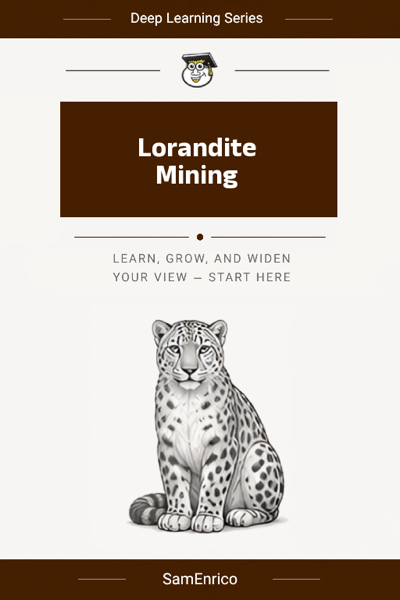
Non-FictionInformativeEducational
Lorandite Mining eBook
A Coursebook on Lorandite Mining
A Coursebook on Lorandite Mining
Formats
Free sample
Chapter 1: The Crimson Clue...-- It began not with a pickaxe or a drill, but with a faint, carmine-red stain on a miner’s fingers—a stain that would not wash out, would not be scrubbed away with lye or pumice, and seemed, to the superstitious villagers of the mountain hamlet, to be a mark of death itself. The year was 1894, and the place was the remote, windswept slopes of the Alšar Mountains in the Ottoman Empire’s province of Kosovo, a land of deep gorges and older grudges. A local prospector, known only as Jovan, had been digging for arsenic and antimony, common elements used in the dyes and pharmaceuticals of the Austro-Hungarian Empire to the north. He had found a vein of soft, red ore that was heavier than lead and left a streak the color of dried blood on everything it touched. Jovan had no interest in the strange, dense material; it was not gold or silver, and it seemed to curse the earth around it.
Nothing grew on the gray-white tailings he piled outside his adit. Birds that drank from the puddles near the mine entrance were found stiff and lifeless the next morning. Jovan himself developed a persistent tingling in his feet, then a numbness that crept up his legs, and finally, a month after he began extracting the red ore, his hair fell out in clumps. He abandoned the claim and fled the mountain, and the red vein was forgotten by commerce. But it was not forgotten by science.In Budapest, a letter arrived at the Geological Institute.
It was a brief, almost dismissive note from a local Ottoman official accompanying a small, cloth-wrapped parcel. The parcel contained three jagged fragments of the red ore, each no larger than a walnut. The official’s note read simply: “Unusual mineral from the Alšar. Miner sick. Please identify.” The institute’s mineralogists were initially unimpressed.
The sample was a sulfosalt—a large, messy family of minerals that combined metals with sulfur and arsenic—and it was visually similar to realgar, the common red arsenic sulfide used in fireworks and leather treatment. But initial assays showed something deeply strange: the mineral contained a large, unreconciled percentage of mass. Realgar has a density around 3.6 grams per cubic centimeter. This red ore was far heavier—over 5.5 times denser than water. Something massive was hiding within its structure.
The sample was passed up the chain, eventually reaching the desk of one of Europe’s most formidable—and unusual—scientific minds: Loránd Eötvös.Eötvös was not a mineralogist. He was a physicist, and specifically, a physicist obsessed with a single, elegant question: what is the nature of gravity? He had spent the previous decade perfecting a torsion balance, a breathtakingly sensitive instrument that could measure minuscule variations in gravitational pull across a landscape. While others sought economic metals by panning streams or following outcroppings, Eötvös believed he could find them by mapping the very shape of the Earth’s gravitational field. Dense ore bodies, he reasoned, would tug ever so slightly on a suspended mass, revealing their hidden locations.
The Alšar red ore was an accidental test of his life’s work. And when he personally performed a gravimetric analysis on the sample, he noticed something deeper than its density. The mineral’s crystal structure—determined by painstaking optical goniometry—was monoclinic, a simple, asymmetrical lattice. But its chemical signature was anything but simple. It contained arsenic.
It contained sulfur. And it contained a massive, unexpected component that resisted all conventional identification. The mystery element, when finally isolated, had a bright, silvery-white luster that instantly tarnished to a dull, leaden gray in air. It was soft enough to cut with a knife. And it was lethally, spectacularly toxic.
Eötvös had discovered thallium, and the mineral that carried it would bear the scientist’s own name, Latinized: lorandite.This book is not Jovan’s story, though his ghost haunts every page. This book is the story of the mineral that killed his chickens and fled his tools. It is the story of lorandite, Tl As S₂, the world’s primary ore of thallium, and one of the most scientifically significant, industrially challenging, and environmentally dangerous minerals on Earth. In the following chapters, we will follow its trail from the toxic dumps of North Macedonia to the high-security clean rooms of German solar neutrino laboratories; from the flexible, smearing crystals that defeat conventional crushers to the genetically adapted bacteria that may someday clean its wounds. We will explore why this mineral—obscure, rare, and deadly—has become a cornerstone of both cutting-edge astrophysics and sustainable mining research.
But first, we must answer a deceptively simple question: what, exactly, is lorandite, and why, more than a century after a miner’s fingers were stained red, does it still matter?1.1 A Formal Definition: The Sulfosalt Identity At its most reductionist, lorandite is a chemical compound: thallium arsenic disulfide, written as Tl As S₂. This formula tells a story of three elements from three distinct realms of the periodic table. Thallium (Tl) is a heavy post-transition metal, sitting directly below gallium and indium, and it is the story’s protagonist and poison. Arsenic (As) is a metalloid, lurking two spaces away from thallium, famous in history as both a medicine and a murder weapon. Sulfur (S) is a nonmetal, the common binder, the glue that, in the high-pressure, low-temperature world of hydrothermal veins, bridges the metallic and the deadly.
But classification is never merely chemical. The International Mineralogical Association (IMA), the world’s official body for naming and categorizing minerals, places lorandite within the sulfosalt subclass. A sulfosalt is not simply a metal plus sulfur; it is a complex crystal in which a semi-metal (like arsenic or antimony) substitutes for sulfur in the lattice, creating anionic groups that then bond with true metals. In lorandite, the arsenic and sulfur form the discrete, pyramidal anion [As S₃]³⁻, and this group then coordinates with the thallium cations (Tl⁺) to form a stable, charge-balanced structure. This is not pyrite (Fe S₂), where simple iron-sulfur bonds predominate.
It is a more intricate, more fragile architecture, and that fragility will become a central theme of our processing chapters.The IMA’s approval of lorandite as a valid mineral species came in 1895, one year after Eötvös’s identification, and the type specimen—the gold standard reference sample against which all other finds are compared—remains housed in the Hungarian Natural History Museum in Budapest. That original specimen, still a dull red, still dense, still containing the exact crystallographic angles that Eötvös measured by hand, represents the touchstone for all subsequent exploration. Every lorandite crystal found in Macedonia, China, Switzerland, or Nevada is measured against that fist-sized lump of red ore. Its chemical formula is inviolable, but its physical expression—its color, its cleavage, its fatal habits—varies subtly with the impurities and thermal history of each deposit. And it is those physical properties that most deeply affect the miner, the metallurgist, and the physicist.1.2 The Physical Signature: Color, Streak, and Heft If you were able to hold a pure, unweathered lorandite crystal in your palm—an unlikely…
This is the end of the free sample. Get the eBook to keep going. Buy now
About this book
Details
- Author
- Felton Zulema
- Publisher
- SamEnrico
- Language
- English
- Genre
- Non-Fiction, Informative, Educational
- Released
- 2026-05-08
- Pages (approx.)
- 138
- Available as
- eBook, Audiobook

Read better in the ZLOADR app
Your eBooks on your phone or tablet. Sign in with your SamEnrico account and start reading.
More by Felton Zulema
 Self Talk for Parenting GuideFelton Zulema$11.99
 The Uni Assist Application GuideFelton Zulema$11.99
 Bulgarian Business GuideFelton Zulema$11.99
 Teams Microsoft Outage ResponseFelton Zulema$11.99
 Scott Peterson Trial HighlightsFelton Zulema$11.99
 Whispers of the Djinn: Odin’s Lost RunesFelton Zulema$11.99
 Parental Leave Return PromotionFelton Zulema$12.99
 FlutterFlow UI Design GuideFelton Zulema$12.99
 Ultimate Handbook Guide to Binzhou : (China) Travel GuideFelton Zulema$11.99
 Understanding Vasovagal SyncopeFelton Zulema$17.99
You may also like
 Hong Kong Handover 1997Dunn Johnnie$11.99
 Zumba For Postnatal Recovery CourseNeal Christian$11.99
 Zumba for BeginnersLadner Nikia$11.99
 YouTube Comment Mining GuideHumes Pandora$12.99
 Worry Box MeditationCarlin Rudy$11.99
 Workplace Stress MeditationNguyen Lynn$11.99
 Workplace Stress and Sleep RepairHawley Ivory$11.99
 Workplace Perfectionism CureDelaney Jeffry$11.99
 Workplace Injustice Anger GuideWallen Isabelle$11.99
 Work Addiction and Burnout LinkGreenwood Ester$11.99
 Women in Yoga and WellnessBeattie Galina$11.99
 Women in Stand Up ComedyChun Evangeline$11.99