
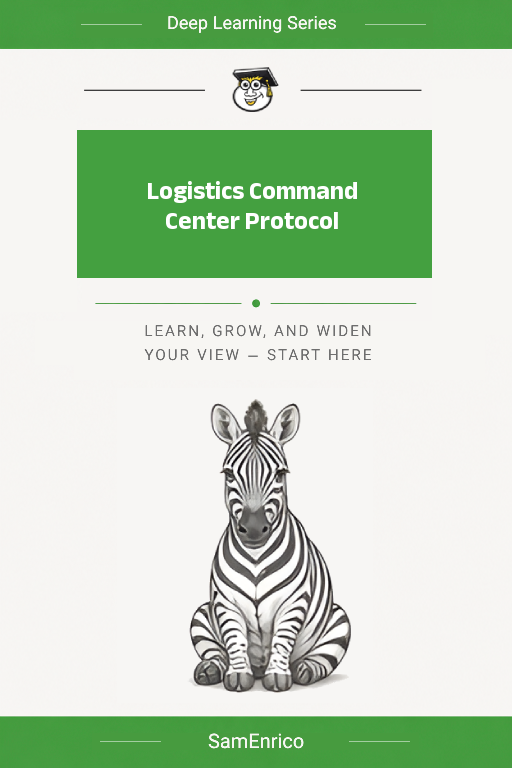
Logistics Command Center Protocol eBook
Establish a 24/7 supply chain war room with escala
by Colley Dawne
Establish a 24/7 supply chain war room with escalation triggers and communication channels. Covers shift rotations, decision authorities, and real-time dashboard requirements.
Formats
Free sample
Chapter 1: The Visibility Trap--–- The conference room smelled of stale coffee and desperation. On the wall-mounted screen, a 4.7millioncontroltowerdashboardglowedinshadesofgreen,yellow,andred—fourteendistinctalertsblinkingintheupperrightcorner.The Chief Supply Chain Officerofa4.7 million control tower dashboard glowed in shades of green, yellow, and red—fourteen distinct alerts blinking in the upper right corner. The Chief Supply Chain Officer of a 4.7millioncontroltowerdashboardglowedinshadesofgreen,yellow,andred—fourteendistinctalertsblinkingintheupperrightcorner.The Chief Supply Chain Officerofa9 billion consumer goods company stared at the screen, then at her team, then back at the screen. “Which one do I look at first?” she asked. No one answered.
The room had been live for seventy-two hours. A port strike in Halifax had metastasized into a continental logistics paralysis. Trucks were idling at gates. Warehouses were filling past capacity. Retailers were threatening to cancel holiday orders.
And the dashboard—the expensive, customized, endlessly debated dashboard—was showing her everything and nothing at the same time.This scene is not hypothetical. It happens every week, somewhere in the global supply chain. Over seventy percent of supply chain command centers fail within their first eighteen months of operation. Not because the technology was bad. Not because the team was incompetent.
But because of a fundamental misunderstanding about what a command center is supposed to do. Most organizations buy software expecting resilience. They install dashboards expecting clarity. They staff twenty-four-seven operations expecting speed. What they actually get is an expensive room full of expensive screens displaying expensive chaos in high resolution.This book exists because that failure is preventable.
The Logistics Command Center Protocol is not another technology framework. It is not a software buying guide. It is a decision-making protocol for human beings under extreme pressure. It is designed for the manager standing in the War Room at 2 AM, watching red alerts pile up, with a phone in one hand and a coffee in the other, needing to know one thing: who decides?The Billion-Dollar Misunderstanding Let us begin with a distinction that will save you millions of dollars if you remember nothing else from this chapter. There are two operating modes in supply chain management.
The first is Steady-State. This is normal operations. This is optimization, cost-efficiency, predictable demand, stable lead times, and pre-approved processes. In Steady-State, the goal is to make the supply chain run smoothly at the lowest possible cost. The second is Disruption.
This is survival. This is trade-offs, speed over precision, broken processes, incomplete data, and decisions made under time pressure. In Disruption, the goal is to keep product flowing by any means necessary.Here is the problem. Most supply chain organizations build their command centers for Steady-State. They design dashboards that show monthly trends.
They staff for normal shift patterns. They create escalation processes that assume everyone has time to write emails. Then a disruption hits, and those same teams instinctively revert to their Steady-State habits. They analyze data instead of acting on it. They wait for perfect information instead of moving with seventy percent certainty.
They escalate through email chains instead of picking up the phone. This is called paralysis by visibility, and it has destroyed more supply chain careers than any port strike or factory fire ever will.Consider the case of a global electronics manufacturer that invested fourteen million dollars in a supply chain control tower. The dashboard was beautiful. It showed real-time inventory positions across forty-seven warehouses. It tracked supplier on-time performance in three different currencies.
It predicted potential disruptions using machine learning algorithms. Six months after go-live, a fire at a semiconductor plant in Taiwan disrupted seventy percent of the company’s microcontroller supply. The dashboard lit up like a Christmas tree. Two hundred and thirty-seven alerts fired in the first hour. The team spent the next six hours in meetings, arguing about which alerts were real, which data sources to trust, and who had authority to authorize emergency sourcing.
By the time they made a decision, three of their five competitors had already secured the available spot inventory. The company lost two hundred and ten million dollars in revenue. The control tower was decommissioned eleven months after launch.The autopsy of this failure revealed a simple truth. The team had plenty of visibility. What they lacked was a protocol.
They could see the problem coming from seventeen different angles. But no one had pre-agreed which angle mattered most. No one had pre-assigned who would decide what when certain thresholds were crossed. No one had practiced the difference between Steady-State analysis and Disruption action. They had built a monitoring station, not a decision engine.The Two-Mode Operating Model The solution begins with a physical object.
Every War Room needs a Mode Switch. This can be a red and green light on the wall. It can be a digital toggle on the main dashboard. It can be a physical key that someone turns. The form does not matter.
The function is everything. When the switch is set to Green, the War Room operates in Steady-State mode. When the switch is set to Red, the War Room operates in Disruption mode. There is no Yellow. There is no “sort of.” The switch is binary because crises require clarity.In Green mode, the analyst decides.
More precisely, the analyst executes pre-approved decision playbooks. These playbooks are developed during calm periods and cover the ninety-five percent of decisions that are routine. A shipment is delayed by one day. A supplier misses a weekly target. A carrier raises rates within a negotiated band.
In Green mode, these are not emergencies. They are operational adjustments. The analyst follows the playbook. No escalation is required. No War Room is activated.
This is efficiency.In Red mode, the Incident Commander decides. The Incident Commander is a single human being with single-threaded ownership of the response. Their job is not to analyze data. Their job is not to build consensus. Their job is to say yes or no to a short list of pre-defined decision types.
The Mode Switch is turned to Red when a disruption exceeds the thresholds defined in the Severity Matrix (which we will cover in Chapter 6). When that happens, the rules change instantly. Speed becomes more important than precision. Action becomes more important than analysis. The Commander becomes the final authority.Here is why the Mode Switch is non-negotiable.
In the absence of an explicit signal, teams will default to their training. If they have spent ninety-five percent of their time in Steady-State, they will behave as if they are still in Steady-State even when the crisis hits. The Mode Switch is a cognitive forcing function. It tells every person in the room, in a way that cannot be ignored, that the operating rules have changed. It is the difference between a team that escalates questions and a team that executes decisions.The Fewer Arguments Rule The Mode Switch solves the governance problem.
But it does not solve the decision speed problem. For that, we need the Fewer Arguments Rule. Here it is: for every alert, the team is limited to three clarifying questions before a decision must be made. Not four. Not five.
Three.This rule is deliberately provocative because the problem it solves is deadly serious. In every War Room failure I have…
This is the end of the free sample. Get the eBook to keep going. Buy now
About this book
Details
- Author
- Colley Dawne
- Publisher
- SamEnrico
- Language
- English
- Genre
- Non-Fiction, Crisis Management, Logistics Resilience, Command Guide
- Released
- 2026-05-30
- Pages (approx.)
- 142
- Available as
- eBook, Audiobook

Read better in the ZLOADR app
Your eBooks on your phone or tablet. Sign in with your SamEnrico account and start reading.
More by Colley Dawne
 Sleep Routine Evening GuideColley Dawne$11.99
 Disagreeing RespectfullyColley Dawne$11.99
 Prison Partner Self EsteemColley Dawne$11.99
 Arachnophobia Recovery GuideColley Dawne$11.99
 The Recovery Capital Assessment GuideColley Dawne$11.99
 The Tsar's Composer: Tchaikovsky and the Soul of RussiaColley Dawne$11.99
 North America Consumer Spending ForecastColley Dawne$12.99
 How to Start a British Board of Film Classifications Business (Beginners Guide)Colley Dawne$11.99
 Zoisite MiningColley Dawne$11.99
 Understanding Inactive ColonColley Dawne$17.99