
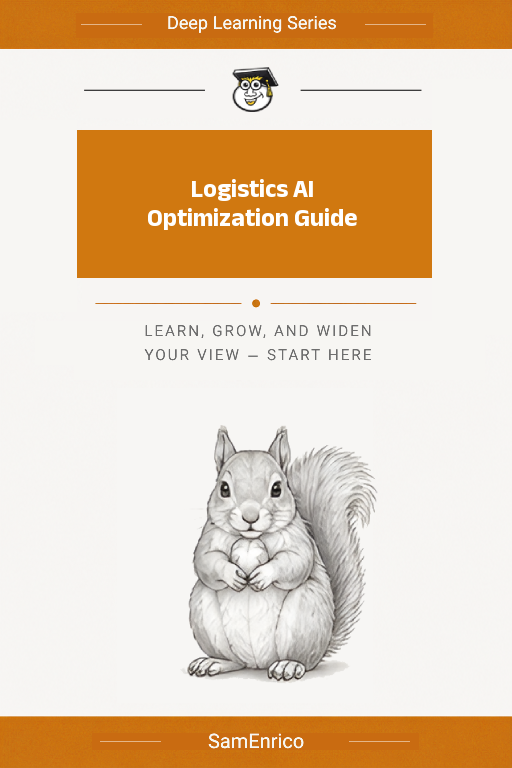
Logistics AI Optimization Guide eBook
Analyze route optimization, demand forecasting, an
by Howe Chung
Analyze route optimization, demand forecasting, and carrier selection using machine learning.
Formats
Free sample
Chapter 1: The Self-Optimizing Lie--Most logistics executives believe they are already running a "smart" supply chain. They have dashboards. They have GPS trackers. They have monthly reports that show on-time delivery percentages hovering somewhere in the 90s. And yet, when a port shuts down unexpectedly, when fuel prices spike overnight, or when a snowstorm closes a major highway, their entire operation grinds to a halt while they scramble to reroute trucks with phone calls and spreadsheets.This is not intelligence.
This is well-documented chaos.The uncomfortable truth that the multi-billion dollar logistics software industry does not want you to hear is this: the vast majority of supply chain "optimization" is neither optimized nor intelligent. It is reactive, rule-based, and brittle. The algorithms that power most Transportation Management Systems (TMS) are not learning. They are not adapting. They are executing the same deterministic logic today that they executed five years ago, regardless of whether the world has changed around them.This book exists because that era is ending.
Not gently, and not gradually, but with the force of a structural break in the history of logistics.Over the next twelve chapters, you will learn how to build what we call a Self-Optimizing Logistics Network – a system where demand sensing, dynamic routing, carrier selection, and inventory positioning operate as a single, closed-loop learning engine. But before we get to the algorithms, the architectures, and the code, we must first confront a more fundamental question: why have traditional Supply Chain Operating Networks (SCONs) failed so spectacularly, and what does it actually mean for a logistics system to be "cognitive"?This chapter answers that question. It introduces the maturity model that will serve as your roadmap for the rest of the book. It defines the unified Digital Twin framework that will appear in every subsequent chapter. And it gives you a simple, brutal self-assessment tool to determine exactly where your organization stands – not where your vendors claim you stand, but where you actually are.Let us begin by diagnosing the disease before we prescribe the cure.The Illusion of Optimization Walk into the control room of any mid-sized logistics operation, and you will see screens.
Lots of screens. Maps with little moving dots. Color-coded tables showing ETAs. A red alert here and there when a driver is running late. It looks impressive.
It feels like command and control.But sit with the dispatchers for a day, and the illusion shatters.What you will actually observe is a constant stream of manual interventions. A driver calls because a customer's receiving dock is full – the dispatcher pulls up a spreadsheet of nearby warehouses and starts calling around. A late truck means three other trucks need to shift their routes – the dispatcher redraws polygons on a map by hand. A carrier demands a rate increase for a spot load – the dispatcher checks a printed rate sheet from six months ago and guesses.The software is not optimizing. It is visualizing.
And visualization is not optimization.This distinction is not merely semantic. A system that shows you where your trucks are is fundamentally different from a system that decides where your trucks should go. A system that alerts you to a delay is fundamentally different from a system that automatically reroutes around that delay while respecting driver hours, customer time windows, and fuel costs. Most logistics technology today is firmly in the first category: descriptive and reactive. What you need – what this book will teach you to build – is prescriptive and cognitive.The term Supply Chain Operating Network (SCON) was coined to describe the interconnected web of systems, processes, and partners that move goods from raw materials to final delivery.
In theory, a SCON integrates demand planning, inventory management, transportation execution, and last-mile delivery into a seamless whole. In practice, most SCONs are a patchwork of disconnected systems held together by email, phone calls, and heroic human effort.The failure modes are consistent and predictable. Let me name three that you have almost certainly experienced.Failure Mode One: The Bullwhip of Bad Information When a retailer's demand forecast is off by 10%, that error propagates upstream. The distributor sees a 15% variance and adjusts inventory upward. The manufacturer sees a 25% variance and increases production.
The raw material supplier sees a 40% variance and builds safety stock. By the time the signal reaches the top of the supply chain, a 10% forecast error has become a 100% inventory imbalance. This is the bullwhip effect, first documented in the 1960s and still rampant today.Traditional SCONs make the bullwhip effect worse, not better, because each node in the network optimizes locally rather than globally. The distributor does not know the retailer's inventory position. The manufacturer does not know the distributor's transportation constraints.
Each makes decisions that seem rational in isolation but are collectively disastrous.Failure Mode Two: The Frozen Plan Fallacy Every logistics plan is a prediction about the future. And every prediction about the future is wrong. Not sometimes wrong. Not mostly wrong. Always wrong.
The question is not whether your plan will fail, but how quickly and how badly.Traditional optimization systems produce a single, deterministic plan: Truck A leaves Warehouse B at 8:00 AM, makes stops C, D, and E, and returns by 5:00 PM. This plan is immediately invalid the moment traffic changes, a customer cancels, or a driver needs a bathroom break. Yet most systems treat the plan as a fixed target rather than a dynamic hypothesis. They optimize for the plan rather than for the outcome.This is the frozen plan fallacy, and it is the single largest source of inefficiency in last-mile logistics. You cannot optimize your way to a perfect plan because the perfect plan never exists.
You can only optimize your ability to adapt when the plan inevitably breaks.Failure Mode Three: The Algorithmic Gap Here is a question that separates the pretenders from the practitioners: what is the difference between an algorithm and a heuristic?An algorithm guarantees an optimal solution if given enough time and computing power. The Traveling Salesman Problem (TSP) has an exact algorithm – it is just computationally impossible for more than about 20 stops. A heuristic finds a good enough solution quickly, with no guarantee of optimality. Most logistics "optimization" is actually heuristic-based. It finds a route that is better than random, but rarely the best possible.The gap between what executives think their optimization software does (find optimal solutions) and what it actually does (find plausible solutions using rules of thumb) is vast.
And it is rarely disclosed. This book will teach you to close that gap by replacing hand-coded heuristics with machine learning models that improve with experience. But first, you must acknowledge that the gap exists.The Four Maturity Levels of Logistics AINot all logistics operations are ready for cognitive AI. In fact, most are not. Attempting to jump straight from spreadsheets to reinforcement learning is a recipe for failure – expensive, demoralizing, and publicly visible failure.
I have seen it happen at three different Fortune 500 companies.To help you assess your readiness and chart a realistic path forward, this book introduces the Logistics AI Maturity Model. It has four levels, each building on the last. Your goal is not to skip levels.…
This is the end of the free sample. Get the eBook to keep going. Buy now
About this book
Details
- Author
- Howe Chung
- Publisher
- SamEnrico
- Language
- English
- Genre
- Non-Fiction, Forecast & Outlook, Logistics AI
- Released
- 2026-05-29
- Pages (approx.)
- 145
- Available as
- eBook, Audiobook

Read better in the ZLOADR app
Your eBooks on your phone or tablet. Sign in with your SamEnrico account and start reading.
More by Howe Chung
 Emergency Room Registration Clerk Stress CourseHowe Chung$11.99
 Disappointment in Surrogacy JourneyHowe Chung$11.99
 For Family of GamblersHowe Chung$11.99
 Work Addiction Among Lawyers GuideHowe Chung$11.99
 Self Worth Affirmation Practice GuideHowe Chung$11.99
 The Last Parole: America's Longest-Serving Prisoner SpeaksHowe Chung$11.99
 Understanding Leber Optic AtrophyHowe Chung$17.99
 Circular Dichroism Spectrometer TechnicianHowe Chung$11.99
 Organic Growth Algorithm HandbookHowe Chung$12.99
 How to Start a Chain (non-precision) Business (Beginners Guide)Howe Chung$11.99