
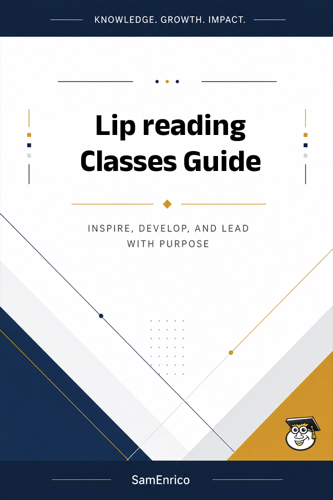
Non-FictionHealth & WellnessCommunication
Lip reading Classes Guide eBook
Teaches visual communication skills for severe hea
Teaches visual communication skills for severe hearing loss.
Formats
Free sample
Chapter 1: The Mc Gurk Moment...--–- Close your eyes for a moment. Imagine you are standing in a crowded restaurant. The person across from you is speaking, but their voice is swallowed by the clatter of plates, the hum of conversation, the hiss of the espresso machine. You lean in. You squint.
You catch a word here, a phrase there. Then suddenly, you realize you understood an entire sentence—not because you heard it clearly, but because you saw it. Their lips moved in a certain way, their eyebrows lifted at the right moment, and your brain filled in the gaps. You didn't know you were doing it. But you were.
You have been doing it your whole life.This is what we call the Mc Gurk Moment. It is the moment you realize that your ears are not the only organs of hearing. Your eyes are listening, too.Let us make that strange idea concrete. In 1976, a psychologist named Harry Mc Gurk accidentally discovered something remarkable. He was showing a video to a group of participants, asking them to pay attention to how a speaker’s lip movements matched a dubbed audio track.
But at one point, the technology slipped. The audio said one syllable—"ba"—while the video showed lips pronouncing another—"ga." Mc Gurk expected his participants to notice the mismatch. Instead, they reported hearing something entirely different: "da." A third sound, created entirely by the collision of seeing and hearing. Their brains had fused two conflicting signals into a single, invented perception. Even when Mc Gurk told them what was happening, they could not un-hear the illusion.
The brain, it turned out, trusts what it sees more than what it hears.If you have ever watched a foreign film with subtitles and felt like you could almost understand the original language, you have experienced a version of this. If you have ever struggled to understand someone on a poor phone connection but understood them perfectly when you switched to a video call, you have lived it. Your brain is a master integrator of sensory information. It does not wait for perfect auditory input. It predicts, guesses, and constructs meaning from every available clue—the flash of teeth, the purse of lips, the tilt of a head, the context of a sentence, the leftover fragments of sound your damaged ears still manage to capture.This chapter is called "The Mc Gurk Moment" because it marks the beginning of a transformation.
Before this moment, you may have believed that hearing loss is purely an ear problem—that your ears are broken and your only hope is to turn up the volume or beg people to repeat themselves. After this moment, you will understand something far more powerful: hearing is not listening, and listening is not only auditory. You are not a passive receiver of sound waves. You are an active, creative, relentless meaning-maker. And the tools you need to communicate are not missing.
They have been hiding in plain sight.The Myth of the Perfect Ear Let us begin by dismantling a myth. The myth is this: normal hearing means hearing everything perfectly. In reality, even people with clinically normal hearing do not hear every word. They fill in gaps constantly. They use context.
They read lips without realizing it. They anticipate what comes next. The difference between a normal-hearing person and a person with severe hearing loss is not a binary switch—hearing versus deafness. It is a matter of degree. The normal-hearing person’s brain has to work a little to fill in the blanks.
Your brain has to work a lot.That extra work has a name: cognitive load. Every conversation becomes a mental marathon. You are not just listening; you are guessing, cross-referencing, discarding impossible options, and piecing together fragments like a detective at a crime scene. By the end of a family dinner or a work meeting, you are exhausted—not because the conversation was long, but because your brain has been running at full throttle while everyone else coasted.Here is what the best research on speechreading tells us—and this comes from O’Neill and Oyer’s foundational text, Visual Communication for the Hard of Hearing, as well as decades of audiology studies: even the most skilled speechreaders in the world visually identify only 30 to 50 percent of spoken words correctly. Let that sink in.
The best of the best—people who have practiced for years, who have taken classes, who rely on this skill every single day—still miss half or more of what is said when they rely on vision alone. That is not failure. That is physics. Many speech sounds look identical on the lips. The letter P, B, and M all look the same.
So do F and V. So do SH and CH. So do a dozen other sound groups.This is not a limitation of your eyes. It is a limitation of the human face. Mouths are not transparent.
Tongues and teeth hide in shadows. And yet, despite this hard physical ceiling, speechreaders routinely understand conversations. They catch jokes. They follow instructions. They fall in love and argue and make plans.
How? Because they are not relying on vision alone. They are using everything: context, residual hearing, facial expression, body language, knowledge of the speaker, knowledge of the topic, and a set of clever repair strategies that turn misunderstandings into recoverable moments.The goal of this book is not to turn you into a 100 percent speechreader. That goal is impossible, and anyone who promises it is selling a fantasy. The goal is to make you a better 30 to 50 percent speechreader—more accurate, less exhausted, more confident—and to teach you how to leverage that visual information alongside every other tool at your disposal.The Darkened Room: What Hearing Loss Takes Away Betty Woerner Carter, in her classic book I Can’t Hear You in the Dark, describes a phenomenon that every person with severe hearing loss knows intimately.
Imagine you are in a room with someone you love. The lights are on. You can see their face clearly. You are having a decent conversation—not perfect, but workable. Then someone turns off the lights.
The room goes dark. That same person keeps talking. And suddenly, you understand almost nothing. The words become a blur. The meaning evaporates.
You are reduced to nodding and guessing.This is not a metaphor. It is a literal description of what happens when a speechreader loses visual access. Carter’s title captures the terror of that moment: the lights go out, and you are left alone with sound that no longer makes sense. For a person with severe hearing loss, a darkened room is not just inconvenient. It is a communication blackout.But here is the hopeful corollary.
If darkness destroys communication, then light restores it. If turning away destroys communication, then facing each other restores it. If a mustache or a hand over the mouth destroys communication, then a clear, unobstructed view restores it. The problem is not that your ears have failed. The problem is that the visual information your brain desperately needs has been blocked.
And unlike your hearing loss—which may be permanent—those visual blocks are almost always removable.This is the central insight of modern…
This is the end of the free sample. Get the eBook to keep going. Buy now
About this book
Details
- Author
- Borrego Shantel
- Publisher
- SamEnrico
- Language
- English
- Genre
- Non-Fiction, Health & Wellness, Communication
- Released
- 2026-06-06
- Pages (approx.)
- 147
- Available as
- eBook, Audiobook

Read better in the ZLOADR app
Your eBooks on your phone or tablet. Sign in with your SamEnrico account and start reading.
More by Borrego Shantel
 The Nutrition and Emotion LinkBorrego Shantel$11.99
 TM for Emotional Eating GuideBorrego Shantel$11.99
 Self Hypnosis for Fear of DogsBorrego Shantel$11.99
 Hep B Immunization ProtocolBorrego Shantel$11.99
 John Ramsey TodayBorrego Shantel$11.99
 Martha Washington First LadyBorrego Shantel$11.99
 Divorce Acceptance GuideBorrego Shantel$11.99
 The Royal Astronomers of Meroë: Mapping the Cosmos from the Nile’s HeartBorrego Shantel$11.99
 Starlight Pilgrims: The Last Ark of AtlantisBorrego Shantel$11.99
 How to Produce SemiconductorsBorrego Shantel$11.99
 How to Produce Flying DiscsBorrego Shantel$11.99
 A Collector's Handbook to the Bentley Speed SixBorrego Shantel$11.99
You may also like
 Hong Kong Handover 1997Dunn Johnnie$11.99
 Zumba For Postnatal Recovery CourseNeal Christian$11.99
 Zumba for BeginnersLadner Nikia$11.99
 YouTube Comment Mining GuideHumes Pandora$12.99
 Worry Box MeditationCarlin Rudy$11.99
 Workplace Stress MeditationNguyen Lynn$11.99
 Workplace Stress and Sleep RepairHawley Ivory$11.99
 Workplace Perfectionism CureDelaney Jeffry$11.99
 Workplace Injustice Anger GuideWallen Isabelle$11.99
 Work Addiction and Burnout LinkGreenwood Ester$11.99
 Women in Yoga and WellnessBeattie Galina$11.99
 Women in Stand Up ComedyChun Evangeline$11.99