
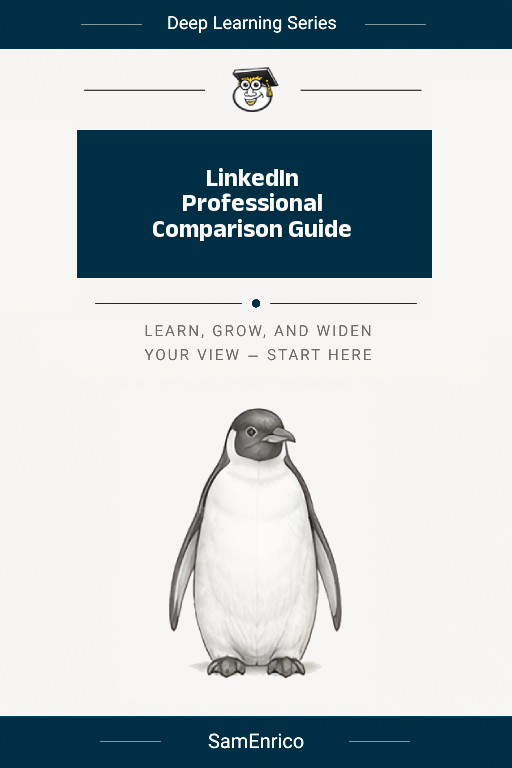
Non-FictionMental WealthCareer Psychology
LinkedIn Professional Comparison Guide
Stop comparing career trajectories on LinkedIn wit
Stop comparing career trajectories on LinkedIn with strategies for authentic professional growth.
Formats
About this book
Free sample
Chapter 1: The Dopamine Trap--–- The first time Maria cried over Linked In, she was sitting in her parked car outside a grocery store. It was a Tuesday. She had just watched a former classmate—someone she distinctly remembered copying homework from in college—announce his new "Head of Product" title at a company she had been rejected from six months prior. The post had 247 likes. Eighty-three comments.
A humble brag wrapped in gratitude: "Thrilled to share… couldn't have done it without the team… so grateful for this next chapter."Maria had no new chapter. She had the same chapter she had for eighteen months: Senior Analyst, third floor, windowless office. Her most recent Linked In notification was a birthday wish from a recruiter she had never met. She locked her phone, stared at the steering wheel, and asked herself a question that no promotion post ever answers: "What is wrong with me?"The answer, as this book will show you, is nothing. The problem is not Maria.
The problem is not you. The problem is the platform's invisible architecture—a machine designed to monetize your insecurity by hijacking the oldest survival instinct in the human brain: the drive to know where you stand.Welcome to the dopamine trap.The Neurology of Not Enough Every time you open Linked In, you are not simply checking a feed. You are walking into a neurological casino designed to make you feel both desperate and hopeful in equal measure. To understand why, we need to look at three components: Social Comparison Theory, the dopamine loop, and the algorithmic amplification of boastful content.Social Comparison Theory, first proposed by psychologist Leon Festinger in 1954, argues that humans have an innate drive to evaluate themselves against others—especially peers who are similar in age, education, industry, or geography. We cannot help it.
It is not a character flaw. It is a survival mechanism. Our ancestors needed to know if they were falling behind the tribe because falling behind meant fewer resources, lower status, and—in extreme cases—exclusion.The problem is that Linked In is not a tribe. It…
This is the end of the free sample. Get the eBook to keep going. Buy now
Contents
- Chapter 1
- Chapter 2
- Chapter 3
- Chapter 4
- Chapter 5
- Chapter 6
- Chapter 7
- Chapter 8
- Chapter 9
- Chapter 10
- Chapter 11
- Chapter 12
Details
- Author
- Zuniga Talisha
- Publisher
- SamEnrico
- Language
- English
- Genre
- Non-Fiction, Mental Wealth, Career Psychology
- Released
- 2026-05-30
- Pages (approx.)
- 150
- Available as
- eBook, Audiobook

Read better in the ZLOADR app
Your eBooks on your phone or tablet. Sign in with your SamEnrico account and start reading.
More by Zuniga Talisha
 The Self Hypnosis for Public SpeakingZuniga Talisha$11.99
 Processing End of Life NightmaresZuniga Talisha$11.99
 Departure Knowledge Transfer Emergency KitZuniga Talisha$11.99
 Teenage Girl Confidence GuideZuniga Talisha$11.99
 Immigrant Coffee Roaster SuccessZuniga Talisha$11.99
 Young Widow GuideZuniga Talisha$11.99
 Stevie Wonder VisionZuniga Talisha$11.99
 TRT Therapy GuideZuniga Talisha$11.99
 The Jade Emperor's Celestial Trial: How a Mortal Outwitted the GodsZuniga Talisha$11.99
 Excalibur’s Shadow: The Forgotten Knights of the Round Table’s Darkest SecretZuniga Talisha$11.99
 How to Produce Automotive Plastic ProductsZuniga Talisha$11.99
 How to Produce Occupational and Physical Therapy EquipmentZuniga Talisha$11.99
You may also like
 Hong Kong Handover 1997Dunn Johnnie$11.99
 Zumba For Postnatal Recovery CourseNeal Christian$11.99
 Zumba for BeginnersLadner Nikia$11.99
 YouTube Comment Mining GuideHumes Pandora$12.99
 Worry Box MeditationCarlin Rudy$11.99
 Workplace Stress MeditationNguyen Lynn$11.99
 Workplace Stress and Sleep RepairHawley Ivory$11.99
 Workplace Perfectionism CureDelaney Jeffry$11.99
 Workplace Injustice Anger GuideWallen Isabelle$11.99
 Work Addiction and Burnout LinkGreenwood Ester$11.99
 Women in Yoga and WellnessBeattie Galina$11.99
 Women in Stand Up ComedyChun Evangeline$11.99