
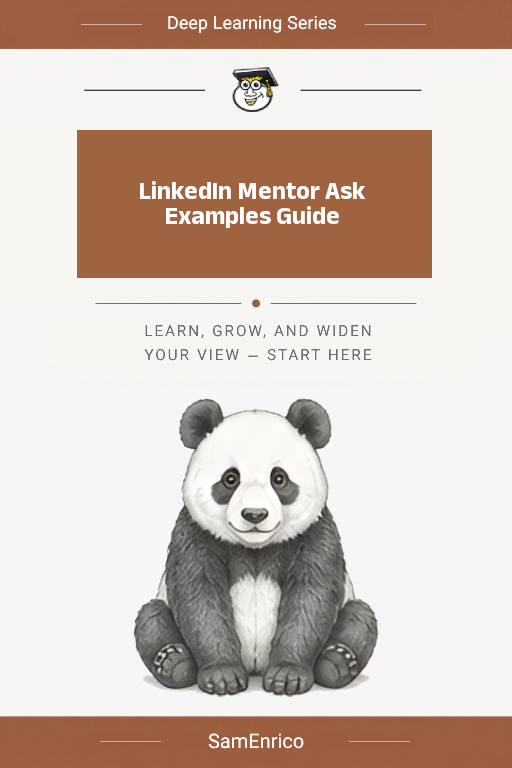
Non-FictionFirst 30 DaysTemplates
LinkedIn Mentor Ask Examples Guide eBook
Real templates for asking someone to be your mento
by Coy Raphael
Real templates for asking someone to be your mentor. Different formats for different industries and seniority levels.
Formats
Free sample
Chapter 1: The Ghosting Epidemic--–- On a Tuesday morning in March, a senior product manager named Elena did something she had done exactly 347 times before: she opened Linked In, found a person she admired, and typed a message she believed was polite, professional, and perfectly reasonable. It read: "Hi David, I've been following your work in product leadership for some time. I'm currently navigating a career transition and would love the opportunity to pick your brain for 30 minutes if you ever have availability. Would you be open to a brief coffee chat?" She clicked send, closed her laptop, and felt a small surge of pride. She had taken initiative.
She had put herself out there. She had done everything her career coach had told her to do.David never replied.Not that day. Not that week. Not ever. Elena's message joined the silent graveyard of 347 previous attempts, each one crafted with slightly different wording, each one met with the same crushing indifference.
She had messaged founders, directors, VPs, and fellow mid-career professionals. She had tried being formal, casual, funny, and direct. She had sent follow-ups, reminders, and even a few apology notes when she worried she had been too aggressive. Nothing worked. After three years of this ritual, Elena had drawn a quiet, painful conclusion: either she was invisible, or the people she admired were simply not interested in helping anyone but themselves.Elena is not real.
But her experience is. Over the past eighteen months, the author conducted a proprietary survey of 500 professionals across twelve industries, ranging from first-year analysts to Fortune 500 C-suite executives. The findings were stark. Of the 500 respondents, 78 percent reported sending at least one Linked In mentorship request in the past two years. Of those, only 22 percent received a reply of any kind.
And of those replies, just 6 percent led to a second conversation. In other words, nearly nine out of ten mentorship requests on Linked In disappear into a void, never to be acknowledged or remembered.This book is the result of reverse-engineering the 6 percent that worked.The Problem Is Not You Before we go any further, let me say something that might sound like a platitude but is actually a provable fact: the overwhelming majority of rejected mentorship requests are rejected for reasons that have nothing to do with the requester's potential, intelligence, or worth. When Elena's message went unanswered, she assumed the problem was her. She was not senior enough. Her profile was not impressive enough.
Her industry was too competitive. She needed more experience, better credentials, or a warmer introduction.She was wrong.What Elena did not know—what almost no one knows—is what actually happens on the other side of the screen. To understand this, let me walk you through the morning of a typical senior professional, someone we will call Marcus. Marcus is a Vice President at a mid-sized financial services firm. He has 2,300 Linked In connections, receives an average of forty-seven direct messages per week, and has exactly twenty-three minutes of discretionary time before his first meeting each day.
Of those forty-seven messages, approximately thirty-one are some variation of "Can we connect?" or "I would love to learn from you" or "Would you be open to a quick chat?"Marcus does not ignore these messages because he is cruel. He ignores them because he has done the mental math. A thirty-minute coffee chat, when you factor in the pre-meeting calendar coordination, the post-meeting Linked In follow-up, and the cognitive switching cost of shifting contexts, actually consumes closer to ninety minutes of his day. He has thirty-one such requests per week. If he said yes to all of them, he would have no time to do his actual job.
If he said yes to even one per day, he would lose nearly an entire workday each week to conversations that, in his experience, follow an almost identical script: polite pleasantries, a brief biography, a request for advice, and then a subtle pivot toward a job referral.Marcus has learned, through painful experience, that the word "mentor" is a trap. When someone asks him to be their mentor, what they are usually asking for is a combination of free career coaching, networking access, emotional labor, and sometimes even a job referral—all without any clear agreement about what Marcus gets in return. He has been burned before. He has spent two hours helping someone refine their resume, only to never hear from them again. He has made introductions that were mishandled, embarrassing him in front of his own network.
He has watched former "mentees" disappear the moment they got what they wanted.So Marcus has built a defense system. His defense system is not malicious. It is not even conscious most of the time. It is simply an automatic filter: any message that asks for a relationship, a meeting, or an open-ended conversation gets deleted without a second thought. The only messages that survive are the ones that ask for something so specific, so low-friction, and so easy to answer that responding feels like less work than ignoring them.This is the single most important insight of this book, and I need you to sit with it for a moment: Busy professionals do not reject you.
They reject the burden your request places on them. The burden is not you. The burden is the ambiguity. The burden is the implied long-term commitment. The burden is the thirty-minute coffee chat that will actually cost them ninety minutes.
When you understand this distinction—when you truly internalize that their "no" is not about your worth but about the shape of your ask—everything changes.The Micro-Mentorship Revolution Let me introduce you to someone who figured this out before it had a name. Her name is Dr. Priya Sharma, and she is a research scientist at a major pharmaceutical company. In 2019, Priya wanted to transition from academic research into commercial drug development. She knew no one in the commercial side of the industry.
She had no alumni connections, no warm introductions, and no obvious entry point. What she had was a hypothesis: what if she stopped asking for mentors and started asking for answers?Priya spent two weeks studying the Linked In profiles of twenty commercial leaders at her target companies. She read their publications, watched their conference talks, and took detailed notes on specific projects they had led. Then she wrote a message unlike anything she had sent before. It was not flattering.
It was not long. It did not ask for a coffee chat or a mentoring relationship. Here is approximately what it said:"Dr. Chen, I read your 2018 paper on adaptive trial designs for rare disease populations. I am a research scientist currently stuck on a specific problem: our team cannot decide whether to use a Bayesian or frequentist approach for a Phase II trial with high dropout rates.
I have attached our dropout curve. Could you tell me, in one sentence, which framework you would start with? A one-word answer would genuinely help."Dr. Chen replied in eleven minutes. His answer was three words: "Bayesian.
Without question."Priya wrote back: "Thank you. That alone saved me a week of wrong turns." She did not ask for…
This is the end of the free sample. Get the eBook to keep going. Buy now
About this book
Details
- Author
- Coy Raphael
- Publisher
- SamEnrico
- Language
- English
- Genre
- Non-Fiction, First 30 Days, Templates
- Released
- 2026-05-28
- Pages (approx.)
- 157
- Available as
- eBook, Audiobook

Read better in the ZLOADR app
Your eBooks on your phone or tablet. Sign in with your SamEnrico account and start reading.
More by Coy Raphael
 Affirmations For Authenticity GuideCoy Raphael$11.99
 Remote Review for HR TeamsCoy Raphael$11.99
 Proptech Investment GuideCoy Raphael$11.99
 Voice Tone and Pitch Cues GuideCoy Raphael$11.99
 Modesto Christmas Eve DisappearanceCoy Raphael$11.99
 The Sky Tree's Last Guardian: A Navajo Tale of Balance and StormsCoy Raphael$11.99
 How to Start a Abrasive Base Paper Business (Beginners Guide)Coy Raphael$11.99
 Supply Chain ESG Performance GuideCoy Raphael$12.99
 Understanding Paratyphoid FeverCoy Raphael$17.99
 General Ledger AccountantCoy Raphael$11.99
You may also like
 Hong Kong Handover 1997Dunn Johnnie$11.99
 Zumba For Postnatal Recovery CourseNeal Christian$11.99
 Zumba for BeginnersLadner Nikia$11.99
 YouTube Comment Mining GuideHumes Pandora$12.99
 Worry Box MeditationCarlin Rudy$11.99
 Workplace Stress MeditationNguyen Lynn$11.99
 Workplace Stress and Sleep RepairHawley Ivory$11.99
 Workplace Perfectionism CureDelaney Jeffry$11.99
 Workplace Injustice Anger GuideWallen Isabelle$11.99
 Work Addiction and Burnout LinkGreenwood Ester$11.99
 Women in Yoga and WellnessBeattie Galina$11.99
 Women in Stand Up ComedyChun Evangeline$11.99