
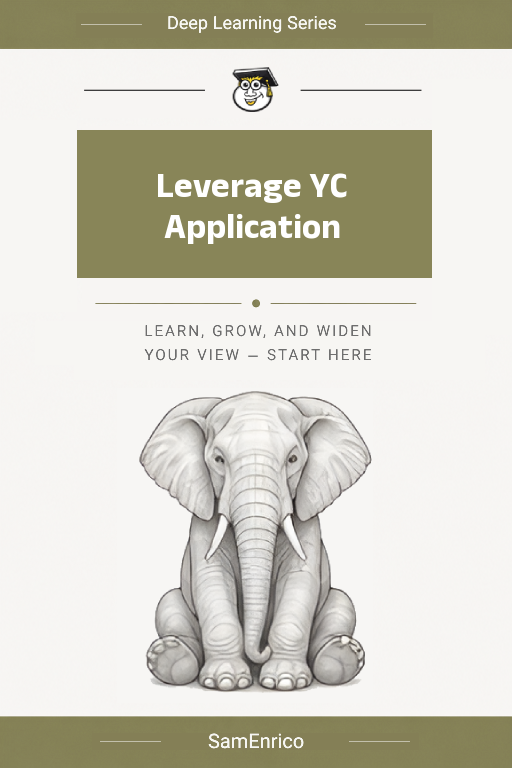
Non-FictionStartup GuideAccelerator PrepProductivity
Leverage YC Application eBook
Learn Leverage Y Combinator productivity platform
Learn Leverage Y Combinator productivity platform application and apply their remote work story to African tech.
Formats
Free sample
Chapter 1: The Rejection Algorithm...--–- It was 11:47pm on a Tuesday when Shola Akinlade closed his laptop for the fourth time in eighteen months and told his co-founder, “I don’t think we’re supposed to get in.”He wasn’t being dramatic. He was being analytical. Paystack had revenue. It had users. It had a working product processing real payments in a market where moving money across Nigerian bank accounts was still considered a minor miracle.
By every objective measure, they were further along than half the startups that had already graduated from Y Combinator. And yet, rejection after rejection arrived with the same polite, maddeningly opaque email: “We appreciate your interest, but we’ve decided not to move forward with your application at this time.”No explanation. No feedback. Just silence.Shola did something that most founders in his position would not do. He did not rage-tweet about VC bias.
He did not write a bitter blog post about how the system was rigged against African founders. He did not blame the application form, or the time zone difference, or the fact that his demo video had buffered twice during submission.Instead, he opened a Google Doc and started a log.He titled it “Rejection Log – Paystack.” He wrote down the date of each application, the version of the product at the time, the composition of his team, and—most importantly—what he thought the weakness had been. The first rejection: team structure (two non-technical founders, one outsourced developer). The second rejection: market sizing (he had written “Nigerian payments” instead of “African digital commerce”). The third rejection: traction metrics (he had reported total users instead of week-over-week growth).By the time he finished the fourth entry, he noticed something.
The rejections were not random. They were not bias. They were a feedback loop—cold, impersonal, and brutally honest. Each one pointed to a weakness he had already suspected but had been too proud to name.He rewrote the application for the fifth time. Not the product.
The story. He stopped pitching Paystack as a “payment processor” and started pitching it as “the company that will digitize the market women of Lagos—the women who sell yams and textiles and phone cards, who have never had a bank account, who lose forty percent of their profit to cash shrinkage. We are giving them a digital ledger in their pocket.”YC called within forty-eight hours. Stripe acquired Paystack for two hundred million dollars two years later.This book is not about Paystack. It is about the algorithm that Shola discovered—the hidden logic behind Y Combinator applications that almost no one talks about because almost no one bothers to log their rejections.
The algorithm is simple, uncomfortable, and completely learnable:YC does not fund ideas. It funds learning velocity. Your application is not a pitch. It is a data point in a feedback loop.Let me say that again because it is the single most important sentence in this chapter: Your application is not a pitch. It is a data point in a feedback loop.Most founders treat the YC application like a college admissions essay.
They polish. They optimize. They obsess over word choice and paragraph order and whether to use an exclamation point after their revenue number. Then they submit, hold their breath, and blame the universe when the rejection arrives.That is the wrong mental model entirely.The right mental model is a scientific instrument. You are not trying to impress YC partners.
You are trying to generate a signal—a clean, interpretable data point that tells you exactly where your startup is weak. Rejection is not failure. Rejection is measurement. And if you are not learning something specific from every rejection, you are not applying correctly.This chapter will teach you the Rejection Algorithm: a four-step feedback loop that turns every YC application—accepted or rejected—into a tool for building a better company. You will learn why Waydev applied thirteen times before getting in, and why most founders should stop after four.
You will learn the Fake Door Test, a Whats App-powered method for generating traction before writing a single line of code. And you will learn Africa’s unfair advantage: the specific kinds of problems that make YC partners sit up straight, not because they are exotic, but because they are hard.Let us begin with the most misunderstood word in the startup lexicon: rejection.The 13th Try (And Why You Should Stop at 4)Waydev is a software engineering intelligence platform. The founding team applied to Y Combinator thirteen times over six years. Thirteen times. They were rejected twelve times.
On the thirteenth attempt, they were accepted.If you hear that story and think, “I will just keep applying until I get in,” you have missed the point entirely—and you will waste years of your life.Here is what actually happened at Waydev. Each rejection revealed a specific, addressable weakness. After rejection one: the team had no technical founder. They fixed that. After rejection three: the market sizing was too small.
They expanded their total addressable market from “Israeli developers” to “global engineering teams.” After rejection seven: their traction metrics were vanity metrics (downloads, not active users). They rebuilt their dashboard to report weekly engagement instead of cumulative installs. After rejection ten: their application narrative was generic. They rewrote it to focus on a single, visceral problem: “Engineering managers cannot tell if their teams are actually shipping value or just appearing busy.”Every rejection taught them something specific. Every rejection forced a fundamental change—not just to the application, but to the company itself.
By the thirteenth application, Waydev was a completely different business than the one that had applied the first time.Now here is the warning that almost no one gives you: YC internally flags applicants who apply more than three or four times without material progress. The partners have seen it all before. They know that most founders who apply repeatedly without changing anything are not persistent—they are delusional. They are treating YC like a lottery when it is actually a diagnostic.The rule of thumb is simple: you may re-apply only if you can point to a fundamental change in at least one of four categories:Team structure: You added a technical co-founder, replaced a non-performer, or brought in domain expertise you previously lacked.Traction: Your week-over-week growth rate doubled, your retention crossed seventy percent, or your revenue inflected upward by an order of magnitude.Market: The competitive landscape shifted (a competitor died, a regulation changed, a new distribution channel opened).Narrative: You completely reframed your problem and solution—not just better wording, but a different mental model entirely.If none of these things have changed, do not apply again. Go build.
Come back when you have new data.This is why Shola Akinlade’s rejection log was so powerful. He did not just feel rejected. He analyzed rejection. He turned an emotional experience into a structured dataset. After four applications, he could see the pattern: weak team narrative, vague market sizing, vanity traction metrics.
He fixed all three on the fifth try and got in.Actionable: Open a Google Sheet right now. Title it “Rejection…
This is the end of the free sample. Get the eBook to keep going. Buy now
About this book
Details
- Author
- Calkins Debby
- Publisher
- SamEnrico
- Language
- English
- Genre
- Non-Fiction, Startup Guide, Accelerator Prep, Productivity
- Released
- 2026-05-30
- Pages (approx.)
- 133
- Available as
- eBook, Audiobook

Read better in the ZLOADR app
Your eBooks on your phone or tablet. Sign in with your SamEnrico account and start reading.
More by Calkins Debby
 Pinterest VA Monthly Reporting TemplatesCalkins Debby$11.99
 Email Archive vs Delete StrategyCalkins Debby$11.99
 Meditation for Fibromyalgia ReliefCalkins Debby$11.99
 Small Talk for Apartment BuildingsCalkins Debby$11.99
 Breast MRI Screening ProtocolCalkins Debby$11.99
 Into the Abyss: The Forgotten Pioneers of the Mariana TrenchCalkins Debby$11.99
 The Last Stand at the Chaco War: A Desert Clash of NationsCalkins Debby$11.99
 Email Blocking FrameworkCalkins Debby$12.99
 Ultimate Handbook Guide to Shiraz : (Iran) Travel GuideCalkins Debby$11.99
 Understanding Coenzyme Q Cytochrome C Reductase Deficiency OfCalkins Debby$17.99
 Briggs Turnip Rape HarvestingCalkins Debby$11.99
You may also like
 Hong Kong Handover 1997Dunn Johnnie$11.99
 Zumba For Postnatal Recovery CourseNeal Christian$11.99
 Zumba for BeginnersLadner Nikia$11.99
 YouTube Comment Mining GuideHumes Pandora$12.99
 Worry Box MeditationCarlin Rudy$11.99
 Workplace Stress MeditationNguyen Lynn$11.99
 Workplace Stress and Sleep RepairHawley Ivory$11.99
 Workplace Perfectionism CureDelaney Jeffry$11.99
 Workplace Injustice Anger GuideWallen Isabelle$11.99
 Work Addiction and Burnout LinkGreenwood Ester$11.99
 Women in Yoga and WellnessBeattie Galina$11.99
 Women in Stand Up ComedyChun Evangeline$11.99