
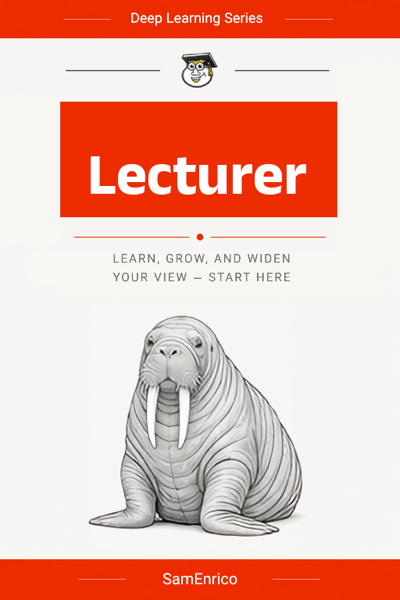
Non-FictionInformativeEducational
Lecturer eBook
A Coursebook on Lecturer
A Coursebook on Lecturer
Formats
Free sample
Chapter 1: The First Classroom...--–- The fluorescent lights hummed a monotonous verdict: you are not ready for this. You have twenty-three faces looking at you, and eighteen of them are already looking at their phones. Two are asleep. One is eating something that smells like regret. The remaining two are staring at you with an expression that could be either intense interest or profound confusion, and you cannot tell the difference yet.
Your carefully prepared seventy-two slides are open on the screen behind you. You have a detailed script in your notes. You have read every assigned paper. You have a Ph D. And yet, standing here, you feel less like an expert and more like a fraud wearing adult clothes.This is the first classroom.
It is not the one you imagined during graduate school, where students leaned forward eagerly, hung on your every theoretically profound word, and left each session transformed. This is the real one. And it is terrifying.The transition from student to scholar is not a smooth, linear promotion. It is a rupture. For the previous twenty years of your life, you have been an expert at being a student.
You know how to sit in a chair. You know how to take notes. You know how to perform attentive interest even when you are bored. You know the hidden rhythms of academic life from the consumer side. But now, someone has handed you the keys to the front of the room, and everything you learned about being a student is suddenly useless.
Worse, it is actively working against you.This chapter is for the person standing in that fluorescent-lit room, wondering if anyone has noticed that you have no idea what you are doing. They have not noticed. Or rather, they have noticed something, but it is not what you think. The good news is that the first year of lecturing is not about excellence. It is about navigation.
It is about survival. And survival is a skill you can learn.The Shock of the New: Why the First Year Feels Like Drowning Every new lecturer experiences some version of what educational psychologist Robert Boice called "the shock of the new." Boice studied hundreds of new faculty members across American universities and found that the first year is characterized by three predictable crises: time scarcity, social isolation, and role confusion. These are not signs of personal inadequacy. They are structural features of the job that no one warned you about.Time scarcity is the most immediately obvious. In graduate school, you had one job: your dissertation.
Everything else was secondary. Now, suddenly, you are expected to teach three courses, attend departmental meetings, serve on a committee you did not volunteer for, advise students you have never met, answer four hundred emails a week, and somehow continue your research. The math does not work. You will work sixty hours a week and still feel behind. This is not because you are inefficient.
It is because the job is designed to demand more hours than exist, and the only way to survive is to learn what not to do.Social isolation is more insidious. As a graduate student, you had a cohort. You had shared misery. You had a supervisor who, however imperfectly, had some responsibility for your development. As a new lecturer, you are suddenly a colleague, which sounds wonderful until you realize that colleagues are not required to mentor you.
They have their own work. They are friendly in the hallway but not available for the two-hour panic conversations you used to have with your fellow graduate students. You are alone in a building full of people, and loneliness in academia has a particular quality: it feels like failure. You assume everyone else has figured it out, and you are the only one still guessing.Role confusion is the deepest crisis. Who are you now?
You are no longer a student. But you do not feel like a full scholar yet. You are expected to have authority, but you remember, vividly, how you used to mock your own professors' authority. You are expected to be an expert, but you know exactly how much you do not know. You are expected to be a mentor, but you are still figuring out your own life.
This identity vacuum is exhausting. It produces what psychologists call "ego depletion": the constant effort of pretending to be something you are not yet drains your cognitive resources, leaving you less able to make good decisions by 3 PM.The solution is not to pretend harder. The solution is to understand that these three crises are normal, predictable, and survivable. They are not evidence that you made a mistake. They are evidence that you have joined a profession that does a terrible job of onboarding its new members.
This chapter will give you the tools to build your own onboarding.The Hidden Curriculum: What No One Told You About How Academia Really Works Every institution has a hidden curriculum. This is the set of unwritten rules, tacit expectations, and unspoken norms that determine who succeeds and who struggles. In graduate school, you learned the hidden curriculum of being a student: how to write a seminar paper, how to navigate advisor relationships, how to perform interest at conferences. But the hidden curriculum of being a lecturer is different, and no one gives you a manual.Here are five hidden rules that no one will tell you explicitly, but that will determine your first year:Hidden Rule One: Your colleagues are not thinking about you. This sounds harsh, but it is liberating.
New lecturers often experience what social psychologists call "the spotlight effect": the belief that everyone is watching and judging them. In reality, your colleagues are too busy with their own stress to evaluate your teaching. The few who do notice you are generally rooting for you. The ones who are not rooting for you are not worth your attention. The spotlight is in your head.Hidden Rule Two: Students will test your boundaries in the first three weeks.
They are not malicious. They are doing what all humans do: learning where the limits are. They will submit late work. They will ask for extensions. They will challenge your grading.
They will arrive late. They will leave early. This is not a personal attack. It is a negotiation. Your job is to hold the line calmly, consistently, and without anger.
If you hold the line for three weeks, they will stop testing. If you do not, they will continue testing all semester.Hidden Rule Three: Your teaching evaluations will be weird, contradictory, and sometimes unfair. You will receive comments that say "best class I've ever taken" and "worst class I've ever taken" about the same session. You will be criticized for things you did not do and praised for things you did not intend. This is not because you are a bad teacher.
It is because student evaluations are noisy, unreliable instruments that measure student satisfaction more than learning. Learn what useful signal you can extract from them (usually patterns across many students) and ignore the noise.Hidden Rule Four: Service work expands…
This is the end of the free sample. Get the eBook to keep going. Buy now
About this book
Details
- Author
- Mejia Jenelle
- Publisher
- SamEnrico
- Language
- English
- Genre
- Non-Fiction, Informative, Educational
- Released
- 2026-06-02
- Pages (approx.)
- 139
- Available as
- eBook, Audiobook

Read better in the ZLOADR app
Your eBooks on your phone or tablet. Sign in with your SamEnrico account and start reading.
More by Mejia Jenelle
 Small Talk for Flight AttendantsMejia Jenelle$11.99
 Breath Awareness Meditation GuideMejia Jenelle$11.99
 Suicide Loss Dream GuideMejia Jenelle$11.99
 Choreographing For BroadwayMejia Jenelle$11.99
 The Harmonic Visionary: Henri Christophe's Symphony of LiberationMejia Jenelle$11.99
 Bank Account for Israeli FoundersMejia Jenelle$12.99
 How to Produce Bearing GreaseMejia Jenelle$11.99
 How to Start a Physiotherapy Clinic Business (Beginners Guide)Mejia Jenelle$11.99
You may also like
 Hong Kong Handover 1997Dunn Johnnie$11.99
 Zumba For Postnatal Recovery CourseNeal Christian$11.99
 Zumba for BeginnersLadner Nikia$11.99
 YouTube Comment Mining GuideHumes Pandora$12.99
 Worry Box MeditationCarlin Rudy$11.99
 Workplace Stress MeditationNguyen Lynn$11.99
 Workplace Stress and Sleep RepairHawley Ivory$11.99
 Workplace Perfectionism CureDelaney Jeffry$11.99
 Workplace Injustice Anger GuideWallen Isabelle$11.99
 Work Addiction and Burnout LinkGreenwood Ester$11.99
 Women in Yoga and WellnessBeattie Galina$11.99
 Women in Stand Up ComedyChun Evangeline$11.99