
Non-FictionSelf-HelpLearning Differences
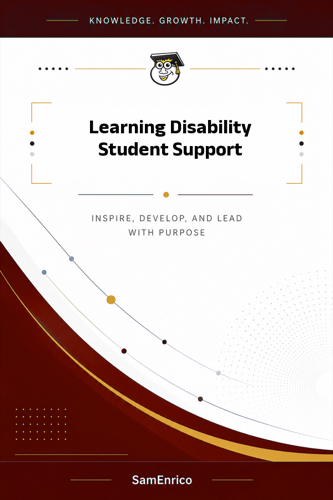
Learning Disability Student Support
Advocate for accommodations and use strengths-base
Advocate for accommodations and use strengths-based stress reduction techniques.
Formats
About this book
Free sample
Chapter 1: The Broken Label--–- The first time someone called Maya “lazy,” she was seven years old. She had spent forty-five minutes trying to read a single page of a chapter book—moving her finger under each word, sounding out the same sentence three times—and when her teacher asked why she wasn’t finished, Maya said she didn’t know. The teacher sighed. “You’re not trying hard enough.” Maya believed her. For the next eight years, Maya tried harder.
She stayed up late, rewrote her notes until her hand cramped, and memorized spelling words by writing each one fifty times. Her grades improved slightly. Her anxiety skyrocketed. By the time she was a sophomore in high school, Maya had concluded something devastating: I am broken, and trying harder will never fix me.Maya’s story is not unusual. It is, in fact, the default narrative for millions of students with learning disabilities (LD) across the United States and beyond.
From the moment they struggle with a task that seems easy for their peers, they are handed a label—lazy, unfocused, difficult, behind, low-potential—that has nothing to do with their actual neurology and everything to do with a system that measures fish by their ability to climb trees. This chapter exists to smash that label into pieces and build something new from the rubble.The Deficit Trap: How Schools Taught You to Hate Your Own Brain For most of the last century, the field of special education operated on what researchers now call the deficit model. In plain English, this means that professionals looked at a student with a learning disability and asked one question: What is wrong with this child? The answer came back as a checklist of weaknesses: poor phonemic awareness, slow processing speed, weak working memory, disorganized output. The solution was always remediation: drill the weak skill until it becomes less weak.
Spend more time on phonics. Do more worksheets. Take the same test with more time.On the surface, this sounds reasonable. If you have a weak muscle, you exercise it. But brains are not…
This is the end of the free sample. Get the eBook to keep going. Buy now
Contents
- Chapter 1
- Chapter 2
- Chapter 3
- Chapter 4
- Chapter 5
- Chapter 6
- Chapter 7
- Chapter 8
- Chapter 9
- Chapter 10
- Chapter 11
- Chapter 12
Details
- Author
- Valerio Young
- Publisher
- SamEnrico
- Language
- English
- Genre
- Non-Fiction, Self-Help, Learning Differences
- Released
- 2026-06-06
- Pages (approx.)
- 137
- Available as
- eBook, Audiobook

Read better in the ZLOADR app
Your eBooks on your phone or tablet. Sign in with your SamEnrico account and start reading.
More by Valerio Young
 Adrenal Fatigue Meal Timing GuideValerio Young$11.99
 Rapid Sleep Self HypnosisValerio Young$11.99
 Food Addiction and Depression HandbookValerio Young$11.99
 Personal Ing For Success JournalValerio Young$11.99
 The Great Thaw: When the Arctic Melted the MarketsValerio Young$11.99
 The Silk Road's Phantom Caravans: Lost Treasures of the Ancient TradeValerio Young$11.99
 Freelance Bookkeeper LaunchValerio Young$12.99
 IoT Data Breach GuideValerio Young$12.99
 Electric Unicycle TechnicianValerio Young$11.99
 Understanding Ectrodactyly Recessive FormValerio Young$17.99
 How to Start a Fast Food Outlet With Restaurant (unlicensed) Business (Beginners Guide)Valerio Young$11.99
You may also like
 Hong Kong Handover 1997Dunn Johnnie$11.99
 Zumba For Postnatal Recovery CourseNeal Christian$11.99
 Zumba for BeginnersLadner Nikia$11.99
 YouTube Comment Mining GuideHumes Pandora$12.99
 Worry Box MeditationCarlin Rudy$11.99
 Workplace Stress MeditationNguyen Lynn$11.99
 Workplace Stress and Sleep RepairHawley Ivory$11.99
 Workplace Perfectionism CureDelaney Jeffry$11.99
 Workplace Injustice Anger GuideWallen Isabelle$11.99
 Work Addiction and Burnout LinkGreenwood Ester$11.99
 Women in Yoga and WellnessBeattie Galina$11.99
 Women in Stand Up ComedyChun Evangeline$11.99