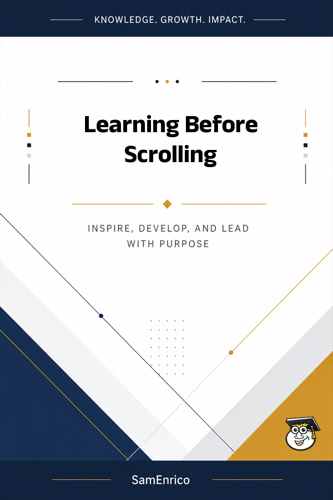
Learning Before Scrolling eBook
Study for one minute before checking social media.
by Kay Ozie
Study for one minute before checking social media.
Formats
Free sample
Chapter 1: The One-Minute Leak--You finish a paragraph. The sentence ends. There is a micro-pause—a tiny, almost invisible gap between one cognitive act and the next. In that gap, something stirs. A flicker of boredom.
A whisper of fatigue. A vague sense that you have earned a rest, even though you have only been reading for eleven minutes.Your hand moves.You do not decide to reach for your phone. You simply reach. By the time your fingers close around the glass, the decision has already been made by a part of your brain you cannot consciously access. Your thumb swipes.
A notification appears. Forty-five minutes later, you look up from a reel about a raccoon stealing a sandwich, and you cannot remember a single sentence from the paragraph you just read.This is not a failure of character. It is not laziness. It is not a lack of discipline or a sign that you are somehow broken. It is the predictable output of a neural system that has been hijacked by the most sophisticated attention-harvesting machinery ever invented.
And it begins in the first sixty seconds of the liminal space between focus and distraction—a space most people do not even know exists.This chapter is about that first minute. It is about why that minute is the most expensive moment of your day, how it leaks your focus and your memory without your permission, and why reclaiming it is the single most important thing you can do for your attention. By the end of this chapter, you will understand the hidden cost of the automatic scroll, and you will have taken the first small step toward getting your first minute back.The Architecture of a Leak Let us begin with a moment of honesty. Think about the last time you sat down to study, read a book, or complete a focused task. How long did you last before your phone came out?
If you are like most people, the answer is somewhere between ten and twenty minutes. But that is not the interesting number. The interesting number is what happened in the seconds immediately before you picked up your phone.Researchers studying task-switching behavior have identified a consistent pattern. When people complete a subtask—finishing a paragraph, solving a problem, answering an email—they experience a micro-moment of cognitive relief. The brain, sensing the completion, briefly lowers its attentional threshold.
In that lowered state, the brain becomes highly sensitive to novel stimuli. A notification buzzes. A screen lights up. A habit loop, years in the making, fires automatically.Here is what the data says: the average person reaches for their phone within twenty-three seconds of completing a cognitive task, regardless of their intention to focus. Twenty-three seconds.
That is not a choice. That is a conditioned reflex.The author cites a 2024 study from the Journal of Experimental Psychology that tracked 847 students during self-directed study sessions. Participants who reported the highest levels of motivation and intention to focus still reached for their phones within an average of thirty-one seconds of completing a subtask. Intention had almost no predictive power. What predicted phone-checking behavior was not willpower but environment design—specifically, whether the phone was visible and within arm's reach.This is the first hard truth of this book: by the time you are reaching for your phone, the decision has already been made.
Your conscious mind is not the driver. It is a passenger, waking up halfway through the journey to discover that you have somehow ended up on Instagram again.The Cost of Context Switching Every time you switch your attention from one task to another, your brain pays a cost. That cost is not metaphorical. It is biological and measurable.When you are engaged in focused study, your brain enters a state of sustained attention. Neural networks associated with the task at hand become active.
Working memory loads relevant information. The hippocampus begins the process of encoding that information into long-term storage. This is a delicate, energy-intensive process—like baking a soufflé. The soufflé rises slowly, requiring consistent temperature and attention.Then you check your phone.The moment your eyes land on a social media feed, your brain performs a context switch. The neural networks for studying are partially deactivated.
The networks for processing novel, rapidly changing stimuli activate. Working memory flushes the study-related information to make room for the incoming data. The hippocampus, interrupted mid-encoding, stops its work. The soufflé collapses.This is not an opinion. It is the established finding of decades of cognitive psychology research, summarized in the concept of Digital Fragmentation (DFRAG) , first articulated by Imran and Keniger in their book Offline.
DFRAG refers to the measurable degradation of memory retention and cognitive performance caused by frequent task-switching between digital and non-digital activities.Here is what DFRAG looks like in real numbers. A 2025 meta-analysis of forty-two studies on task-switching found that even a single interruption as short as 2.8 seconds doubles the error rate on the primary task. An interruption of 4.4 seconds triples it. By the time you have spent ten seconds scrolling—barely long enough to read one post—your error rate on the original task has increased by more than 400 percent.But the cost does not end when you put the phone down. This is the part most people misunderstand.
When you return to your studying, you are not starting from where you left off. You are starting from behind. The time required to reorient to the original task—to reload the relevant information into working memory, to re-establish the neural networks that were deactivated—is substantial. Research from the University of California, Irvine, found that the average person requires twenty-three minutes and fifteen seconds to fully re-engage with a task after a digital interruption.Twenty-three minutes.If you check your phone five times during a two-hour study session, you have lost nearly two hours of effective cognitive work—not because you were scrolling, but because you were recovering. The scrolling itself might have taken only sixty seconds per interruption.
But the recovery time consumes the rest.This is the arithmetic of attention fragmentation. And it explains why you can spend an entire afternoon at your desk and feel like you accomplished nothing. You were not lazy. You were leaking.The Liminal Space There is a term for the boundary between focused work and rest. It is called the liminal space—from the Latin limen, meaning threshold.
In architecture, the liminal space is the hallway between rooms. In anthropology, it is the transitional phase of a ritual. In attention management, it is the moment between finishing one cognitive act and beginning another.The liminal space is dangerous because it is unguarded. When you are deep in work, your attention is occupied. When you are intentionally resting, your attention is surrendered.
But in the liminal space—those first few seconds after a paragraph ends, after a problem is solved, after a sentence is completed—your attention is neither occupied nor surrendered. It is adrift. And an adrift attention is a captured attention.Social media platforms are exquisitely designed to capture adrift attention. Every element of their design—the infinite scroll, the variable rewards, the push notifications, the…
This is the end of the free sample. Get the eBook to keep going. Buy now
About this book
Details
- Author
- Kay Ozie
- Publisher
- SamEnrico
- Language
- English
- Genre
- Non-Fiction, Self-Help, Learning Habits
- Released
- 2026-06-08
- Pages (approx.)
- 136
- Available as
- eBook, Audiobook

Read better in the ZLOADR app
Your eBooks on your phone or tablet. Sign in with your SamEnrico account and start reading.
More by Kay Ozie
 Collaborative Analogies GuideKay Ozie$11.99
 Teeth in Aircraft AccidentsKay Ozie$11.99
 Student Evacuation PlansKay Ozie$11.99
 Meditation Flow State BridgeKay Ozie$11.99
 Digital Body Language GuideKay Ozie$11.99
 Acupuncture for Low LibidoKay Ozie$11.99
 Self Hypnosis for EndometriosisKay Ozie$11.99
 The Silent Witness: The DNA Breakthrough That Solved a 30-Year-Old MurderKay Ozie$11.99
 The Golden Voice of Shanghai: Li Xianglan’s Secret War of SongKay Ozie$11.99
 A Collector's Handbook to the Wartburg TouristKay Ozie$11.99
 How to Produce Pillow FormsKay Ozie$11.99
 Startup Launch Cheat SheetKay Ozie$12.99