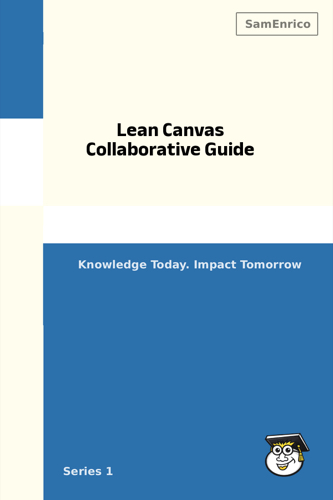
Lean Canvas Collaborative Guide Audiobook
Build startup hypotheses as a team using this prac
by Blythe Quyen
Build startup hypotheses as a team using this practical creativity workbook.
Formats
Free sample
Chapter 1: The Silent Killers...--–- The year is 2018. A first-time founder named Maya has spent eighteen months and four hundred thousand dollars building a meal-planning app for “health-conscious millennials.” She has a patent-pending algorithm, a sleek interface, and a launch team of twelve engineers. On opening day, she gets seventeen thousand downloads. She celebrates. Three months later, she has forty-three daily active users.
Six months later, she shuts down. In her post-mortem blog post, she writes: “We built exactly what we said we would build. Nobody wanted it.”Maya’s story is not unusual. It is not even remarkable. According to CB Insights, which analyzed over one hundred startup post-mortems, “no market need” is the #1 cause of failure—accounting for forty-two percent of all failed startups.
That is more than twice the rate of running out of cash. More than three times the rate of getting outcompeted. More than ten times the rate of having a bad team.Here is the question Maya never asked herself until it was too late: How did we spend eighteen months building something without ever stress-testing the most basic assumption—that someone would actually want it?The answer, as you might have guessed, lives inside a single document. Not a business plan. Not a pitch deck.
Not a requirements document. A Lean Canvas.But here is the twist that most books, courses, and blog posts will not tell you: A Lean Canvas filled out by a single person is not a strategy. It is a hallucination.The Hallucination Problem The Lean Canvas, created by Ash Maurya, is a one-page business model template with nine boxes: Customer Segments, Problems, Alternatives, Solutions, Unique Value Proposition, Channels, Revenue Streams, Cost Structure, Key Metrics, and Unfair Advantage. It is elegant, simple, and dangerous—because it is easy to fill out alone in a coffee shop and mistake that solitary act for strategy.When you fill out a Lean Canvas by yourself, your brain does something predictable and tragic. It fills in the gaps with assumptions dressed as facts.
You write “small business owners” in Customer Segments and you see a specific person—your cousin who owns a bakery. But the canvas does not say “bakery owners.” It says “small business owners.” That vagueness is a trap. Your reader (your team, your investor, your future self) sees something different. But you never notice the gap because you are alone.This…
This is the end of the free sample. Get the Audiobook to keep going. Buy now
About this book
Details
- Author
- Blythe Quyen
- Publisher
- SamEnrico
- Language
- English
- Genre
- Non-Fiction, Self-Help, Lean Startup
- Released
- 2026-06-07
- Pages (approx.)
- 155
- Available as
- eBook, Audiobook

Listen in the VoxFlicks app
Audiobooks and audio dramas wherever you go. Sign in with your SamEnrico account and press play.
More by Blythe Quyen
 Hidden Food Addicts GuideBlythe Quyen$11.99
 Serena Williams Unstoppable ForceBlythe Quyen$11.99
 McClintock Eugenics Controversy HandbookBlythe Quyen$11.99
 Green Beret Psyops SpecialistBlythe Quyen$11.99
 The Silent Strike: How a Single Tweet Changed the NBABlythe Quyen$11.99
 Maui and Hina: The Fisherman’s Daughter and the God of SunlightBlythe Quyen$11.99
 Understanding Gamstorp Episodic AdynamyBlythe Quyen$17.99
 How to Become a Dipper And BakerBlythe Quyen$11.99
 Chinese ESL Student RetentionBlythe Quyen$12.99
 Trades Entrepreneurship PrimerBlythe Quyen$12.99
 Collections DriverBlythe Quyen$11.99