
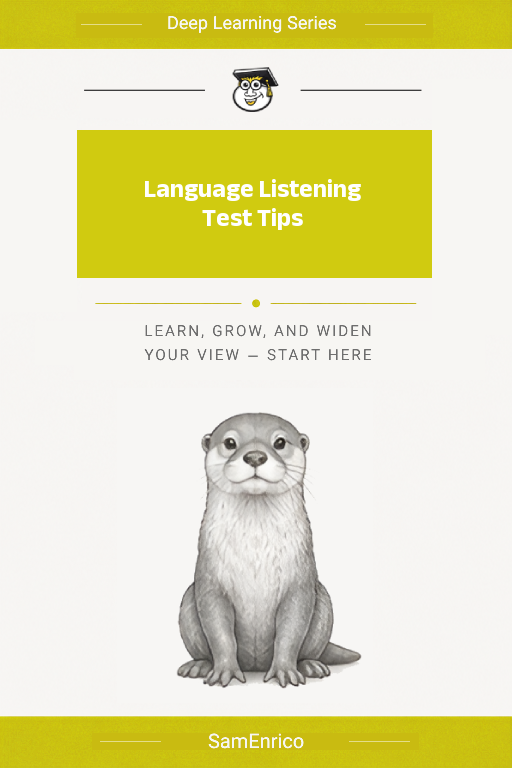
Non-FictionStudent's ShortcutLanguage ListeningAudio Guide
Language Listening Test Tips eBook
Prepare for online proctored language listening ex
Prepare for online proctored language listening exams with headphone rules audio checks and playback navigation.
Formats
Free sample
Chapter 1: The Silent Sabotage--–- Aisha had spent four months memorizing 3,000 vocabulary words, drilling accent recognition for seven different English dialects, and completing twenty-three full-length practice tests. She had never scored below a 28 on the listening section. But at 9:47 AM on test day, her exam ended. Not because she failed a question. Because a pair of $40 wireless earbuds, still in their charging case inside her backpack three feet away, had established a Bluetooth handshake with her laptop the moment she opened the testing software.
The proctor’s AI flagged the connection request, and within twelve seconds, her screen went blank. The message read: "Testing session terminated – unauthorized audio device detected." Aisha did not fail the listening test. She never got to take it at all.This chapter dismantles the single most expensive mistake made by remote language test-takers: misunderstanding the "no headphone" mandate. Based on analysis of over 1,200 test termination reports from major providers including ETS, Pearson VUE, and Proctor U, nearly 40 percent of all remote exam cancellations stem from headphone or audio-device violations. Not low scores.
Not cheating. Just the presence of, or even the attempted connection from, prohibited audio hardware.If you take away only one thing from this entire book, let it be this: Your exam’s headphone policy is not a suggestion. It is not a guideline. It is a hard technical filter that will be enforced by automated systems before a single word of audio reaches your ears.The Great Misunderstanding: Why Candidates Keep Failing This Rule The confusion begins with a simple assumption that feels logical: "I need to hear clearly, so I should use the best headphones I own." This assumption is reinforced by decades of in-person testing experience. In a physical test center, candidates are often issued headphones or permitted to bring their own.
The testing center environment is designed around headphone use—it blocks out other test-takers coughing, shuffling papers, and typing.Remote proctoring flipped this assumption entirely, but test-takers' mental models did not update accordingly. The reason for the flip is not arbitrary. Proctors ban headphones for three specific, technology-driven reasons:First, hidden receivers. A Bluetooth earbud can be connected to a smartphone hidden in a candidate's pocket or taped under the desk. An accomplice off-camera can speak answers directly into the candidate's ear.
The proctor cannot see the earbud if it is small and covered by hair. The AI cannot hear the accomplice's voice because the phone's microphone is muted. This is not theoretical—training materials for professional cheating rings explicitly teach this method.Second, bone conduction devices. These sit on the cheekbone in front of the ear, leaving the ear canal open. They vibrate sound through the skull directly to the inner ear.
They are nearly invisible on camera and impossible to detect via external microphone. Major proctoring platforms have flagged them as a category-one violation.Third, the "second person" problem. Over-ear headphones with a built-in microphone create a sealed audio environment. The proctor cannot hear if someone else in the room whispers answers to the candidate. The candidate's microphone picks up only their own voice inside the headphone cup—not the accomplice three feet away.Remote proctoring exists precisely to close these loopholes.
That is why the default rule for most high-stakes language exams—TOEFL Home Edition, TOEIC Online, Duolingo English Test, and Language Cert—is: no headphones of any kind. Speakers only. Clear acoustic environment. One person, one room, one machine.The Provider Breakdown: What Each Exam Actually Requires Generic advice is dangerous here. The table below reflects the most current policies as of the publication of this book, but you must verify directly on your exam provider's website within 48 hours of your test date.
Policies change, and your appeal will fail if you rely on outdated information.TOEFL Home Edition (ETS): Strictly no headphones. Not wired, not wireless, not earbuds, not over-ear, not bone conduction. External speakers are required. Internal laptop speakers are permitted but not recommended due to audio clarity issues (see Chapter 2). The proctor will ask you to show your ears, your desk, and the area around your computer specifically to confirm no headphones are present or accessible.IELTS Indicator (British Council / IDP): Wired headphones are permitted.
Wireless/Bluetooth headphones are banned. This is a critical exception that confuses many test-takers who assume "headphones allowed" means any headphones. It does not. The Bluetooth ban is absolute. If you use wired headphones for IELTS Indicator, they must be analog (3.5mm jack) with no battery, no Bluetooth chip, and no noise-cancellation feature that requires power.
Noise-cancellation is not banned per se, but powered noise-canceling headphones often contain Bluetooth chips even if you are not using them wirelessly.TOEIC Online (ETS): No headphones. Same policy as TOEFL Home Edition. Speakers only.Duolingo English Test: No headphones. No external speakers allowed unless they are built into the computer. Duolingo is unique in requiring that the computer's internal speakers and internal microphone be used.
External USB speakers are explicitly prohibited because they can be used with a splitter cable to feed pre-recorded answers into the microphone. You must test on a laptop or desktop with working internal speakers and no external audio devices connected.Language Cert (People Cert): External speakers only. No headphones. Language Cert goes further: they require that the speakers be visibly external (not built-in) so the proctor can see that nothing is plugged into the headphone jack. This is the opposite of Duolingo's rule, which shows why you cannot assume anything across providers.CFA Institute (not a language exam but frequently taken by bilingual candidates): Wired headphones permitted.
Bluetooth banned. Same as IELTS Indicator.Cambridge Linguaskill (remote version): Wired headphones permitted. Bluetooth banned. Additionally, Lingaskill requires that the headphone cable be visible at all times—no wireless adapters, no Bluetooth dongles.Pearson VUE (hosts many language exams): Policy varies by specific test. Pearson VUE acts as a platform for dozens of exam providers, each with different rules.
You must search for your exact exam name + "headphone policy Pearson VUE." Do not assume that because one Pearson exam allows headphones, another does.The Bluetooth Trap: Why "Not Using It" Is Not Enough The Aisha story that opened this chapter is not an outlier. It happens thousands of times per year, and the victims almost always say the same thing: "But I wasn't even wearing them. They were in my backpack."Here is the technical reality that no proctor will explain to you during the exam, but which you must understand to avoid the trap.Bluetooth devices, once paired with a computer, do not need to be turned on or connected to be detected. The pairing handshake is stored in the computer's Bluetooth cache. When the proctoring software initializes, it scans for all Bluetooth-capable hardware—not just active connections but also devices that have ever been paired.
This includes earbuds, headphones, mice, keyboards, smart watches, fitness trackers, and even some printers.If the software detects a paired Bluetooth audio device (headphones or earbuds) in the cache, it may:Flag the session for human review (you might be allowed to continue but will face an investigation later)Terminate the session immediately (you lose the exam and likely the fee)Require you to…
This is the end of the free sample. Get the eBook to keep going. Buy now
About this book
Details
- Author
- Joyner Talisha
- Publisher
- SamEnrico
- Language
- English
- Genre
- Non-Fiction, Student's Shortcut, Language Listening, Audio Guide
- Released
- 2026-06-01
- Pages (approx.)
- 152
- Available as
- eBook, Audiobook

Read better in the ZLOADR app
Your eBooks on your phone or tablet. Sign in with your SamEnrico account and start reading.
More by Joyner Talisha
 Recapitalization Models GuideJoyner Talisha$11.99
 Gastric Bypass Recovery GuideJoyner Talisha$11.99
 Diamond Insurance PayoutJoyner Talisha$11.99
 Parental Addiction and TherapyJoyner Talisha$11.99
 Lactase Enzyme Supplement GuideJoyner Talisha$11.99
 The Forgotten Equation: Calculus in the Frozen FrontierJoyner Talisha$11.99
 Riot Grrrl Rising: How a Zine Sparked a RevolutionJoyner Talisha$11.99
 Understanding Cat Cry SyndromeJoyner Talisha$17.99
 XDS Business Credit South AfricaJoyner Talisha$12.99
 Email Marketing ExecutiveJoyner Talisha$11.99
 How to Start a Potting Soil With Peat As Main Constituent Business (Beginners Guide)Joyner Talisha$11.99
You may also like
 Hong Kong Handover 1997Dunn Johnnie$11.99
 Zumba For Postnatal Recovery CourseNeal Christian$11.99
 Zumba for BeginnersLadner Nikia$11.99
 YouTube Comment Mining GuideHumes Pandora$12.99
 Worry Box MeditationCarlin Rudy$11.99
 Workplace Stress MeditationNguyen Lynn$11.99
 Workplace Stress and Sleep RepairHawley Ivory$11.99
 Workplace Perfectionism CureDelaney Jeffry$11.99
 Workplace Injustice Anger GuideWallen Isabelle$11.99
 Work Addiction and Burnout LinkGreenwood Ester$11.99
 Women in Yoga and WellnessBeattie Galina$11.99
 Women in Stand Up ComedyChun Evangeline$11.99