
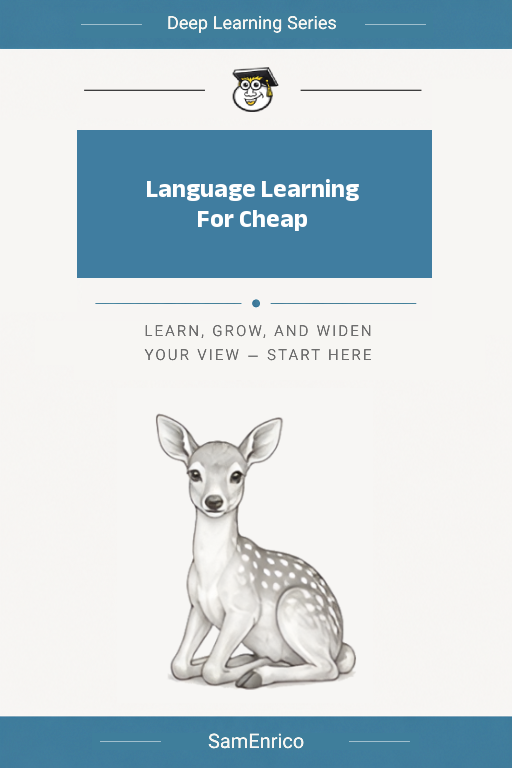
Non-FictionStudent's ShortcutLanguage LearningLocal Degrees
Language Learning For Cheap eBook
Learn the local language for free using university
by Corley Bart
Learn the local language for free using university courses and apps to qualify for cheaper local taught master programs.
Formats
Free sample
Chapter 1: The 1000-Hour Bet--Most people spend their entire lives believing that opportunity speaks English. They scroll through Linked In, browse master’s programs in London or Boston, and quietly accept that a graduate degree will cost them somewhere between a new car and a small house. They take out loans. They work extra jobs. They tell themselves that debt is just the price of admission to a better life.They are wrong.There is a parallel universe of graduate education that most Western students never see.
In this universe, tuition is measured in hundreds of euros, not tens of thousands of dollars. Lectures are delivered in German, French, Italian, and Spanish. Classrooms are filled with international students who made a different bet. They bet that learning a language to the B2 level of the Common European Framework of Reference for Languages (CEFR) would pay better dividends than any stock market investment.And they were right.This chapter is about that bet. It is about the cold, hard math of tuition arbitrage.
It is about why investing roughly 1,000 to 1,500 hours into learning German or French or Italian can save you between 40,000and40,000 and 40,000and80,000 in tuition fees. But more than that, this chapter is about a fundamental reframing. You are not learning a language to order coffee or impress strangers at parties. You are learning a language to unlock a financial lever that most people do not even know exists.Welcome to the 1,000-hour bet.The Arithmetic of Desperation and Desire Let us start with the numbers because the numbers are the only thing that matters at the beginning. Everything else is motivation.
Everything else is strategy. The numbers are the truth.A typical master’s degree in the United States costs between 30,000and30,000 and 30,000and80,000 in tuition alone. That figure does not include living expenses, health insurance, textbooks, or the interest that accrues on student loans while you are still in school. According to the National Center for Education Statistics, the average graduate student in the United States borrows over $70,000 to complete a master’s degree. In the United Kingdom, the situation is similar, with international master’s students paying £15,000 to £40,000 per year at most universities.Now consider the alternative.Public universities in Germany charge tuition fees that range from €0 to approximately €1,500 per semester.
The University of Hamburg charges €328 per semester. The Technical University of Munich, once an outlier that charged fees for non-EU students, still costs a fraction of American or British institutions. The University of Fribourg in Switzerland charges roughly €1,000 per year. Politecnico di Milano charges non-EU students approximately €3,500 per year if they have demonstrated Italian B2 proficiency. The University of Paris-Saclay charges €250 to €3,800 per year depending on the program.These are not discount institutions.
These are world-class universities. The Technical University of Munich ranks among the top 50 universities globally for engineering. The University of Paris-Saclay produces Nobel laureates with routine regularity. Politecnico di Milano is one of Europe’s premier design and architecture schools.The difference is not quality. The difference is the funding model.
European public universities are subsidized by taxpayers who believe that education is a public good, not a private commodity. That belief creates an arbitrage opportunity for anyone willing to meet one condition: prove that you can follow a lecture, read a textbook, and write an exam in the local language.That condition is measured by the Common European Framework of Reference for Languages. It has six levels: A1, A2, B1, B2, C1, and C2. For the purpose of qualifying for a cheap taught master’s program, B2 is the magic number. B1 means you can ask for directions and order dinner.
B2 means you can understand the main ideas of a complex text, interact with a degree of fluency, and produce clear, detailed writing on a wide range of subjects. B2 is the minimum standard for following a lecture in a university setting.The difference between B1 and B2 is roughly 600 to 800 hours of focused study. The difference between A0 (no knowledge) and B2 is roughly 1,000 to 1,500 hours. That is the investment. That is the bet.Calculating Your Language Return on Investment Every serious financial decision requires a calculation of return on investment.
Language learning for the purpose of tuition arbitrage is no different. The formula is simple:(Tuition Saved – Exam Fees – Opportunity Cost) ÷ Estimated Study Hours = Your Hourly Wage for Learning Let us walk through a realistic example.Assume you are an American student considering a master’s degree in public policy. The average cost of a master’s in public policy at a decent American university is 50,000intuitionalone.Youdiscoverthatthe Universityof Konstanzin Germanyoffersa Masterof Public Policytaughtin Germanwithtuitionof€500persemester,orroughly€1,000peryearforatwo−yearprogram.Thatisapproximately50,000 in tuition alone. You discover that the University of Konstanz in Germany offers a Master of Public Policy taught in German with tuition of €500 per semester, or roughly €1,000 per year for a two-year program. That is approximately 50,000intuitionalone.Youdiscoverthatthe Universityof Konstanzin Germanyoffersa Masterof Public Policytaughtin Germanwithtuitionof€500persemester,orroughly€1,000peryearforatwo−yearprogram.Thatisapproximately1,100 per year, or $2,200 total.Your tuition savings are 50,000–50,000 – 50,000–2,200 = $47,800.You will need to take the Goethe-Zertifikat B2 exam, which costs between €200 and €300 depending on the testing center.
You might also need to pay for a retake if you fail the first attempt. Let us budget €500 or roughly $550 for exam fees.Now estimate your study hours. Research from the Foreign Service Institute suggests that a native English speaker needs roughly 750 hours of classroom instruction to reach B2 in a Category II language like German. Self-directed study is less efficient, so let us estimate 1,200 hours of focused, deliberate practice.Your calculation: (47,800–47,800 – 47,800–550) ÷ 1,200 hours = $39.37 per hour.That is higher than the median hourly wage in the United States. And it is tax-free because you are not earning income.
You are saving money that you would have paid to a bank or a loan servicer. Every hour you spend studying German is effectively earning you 39.37.Athree−hourstudysessionona Sundayafternoonearnsyou39.37. A three-hour study session on a Sunday afternoon earns you 39.37.Athree−hourstudysessionona Sundayafternoonearnsyou118. A 20-minute daily practice (which we will cover in Chapter 3) earns you 13perday,ornearly13 per day, or nearly 13perday,ornearly400 per month.Now compare that to the alternative. If you take out a 50,000studentloanat6percentinterestandpayitbackovertenyears,youwillpayroughly50,000 student loan at 6 percent interest and pay it back over ten years, you will pay roughly 50,000studentloanat6percentinterestandpayitbackovertenyears,youwillpayroughly66,000 in principal and interest.
Your effective hourly wage for studying German is actually higher than $39 because you are also avoiding compound interest.This is the arithmetic that changes lives. This is why the 1,000-hour bet is the smartest investment most people will never make.The Hidden Costs of the Traditional Path To fully appreciate the bet, you must understand what you are betting against. The traditional path to a master’s degree in an English-speaking country is not just expensive. It is financially dangerous in ways that most students do not fully grasp until years after graduation.First, there is the principal. Borrowing 50,000to50,000 to 50,000to80,000 for a master’s degree means that you start your professional life in a hole.
Your first job out of graduate school, which might pay 60,000to60,000 to 60,000to80,000 per year, is immediately reduced by 600to600 to 600to1,000 per month in loan payments.…
This is the end of the free sample. Get the eBook to keep going. Buy now
About this book
Details
- Author
- Corley Bart
- Publisher
- SamEnrico
- Language
- English
- Genre
- Non-Fiction, Student's Shortcut, Language Learning, Local Degrees
- Released
- 2026-06-01
- Pages (approx.)
- 126
- Available as
- eBook, Audiobook

Read better in the ZLOADR app
Your eBooks on your phone or tablet. Sign in with your SamEnrico account and start reading.
More by Corley Bart
 Rest and Creativity LinkCorley Bart$11.99
 Inside The Heist CrewCorley Bart$11.99
 Cochlear Implant Decision GuideCorley Bart$11.99
 Manager Employee Anger GuideCorley Bart$11.99
 Nicotine Withdrawal Symptom GuideCorley Bart$11.99
 Dust Storm Pioneers: Chasing the Great Arabian TempestsCorley Bart$11.99
 Cosmic Grooves: How Motown’s Sound Conquered the Space RaceCorley Bart$11.99
 Understanding Cardiac Conduction Defect, FamilialCorley Bart$17.99
 Ramadan B2B Sales GuideCorley Bart$12.99
 Real Estate AdministratorCorley Bart$11.99
You may also like
 Hong Kong Handover 1997Dunn Johnnie$11.99
 Zumba For Postnatal Recovery CourseNeal Christian$11.99
 Zumba for BeginnersLadner Nikia$11.99
 YouTube Comment Mining GuideHumes Pandora$12.99
 Worry Box MeditationCarlin Rudy$11.99
 Workplace Stress MeditationNguyen Lynn$11.99
 Workplace Stress and Sleep RepairHawley Ivory$11.99
 Workplace Perfectionism CureDelaney Jeffry$11.99
 Workplace Injustice Anger GuideWallen Isabelle$11.99
 Work Addiction and Burnout LinkGreenwood Ester$11.99
 Women in Yoga and WellnessBeattie Galina$11.99
 Women in Stand Up ComedyChun Evangeline$11.99