
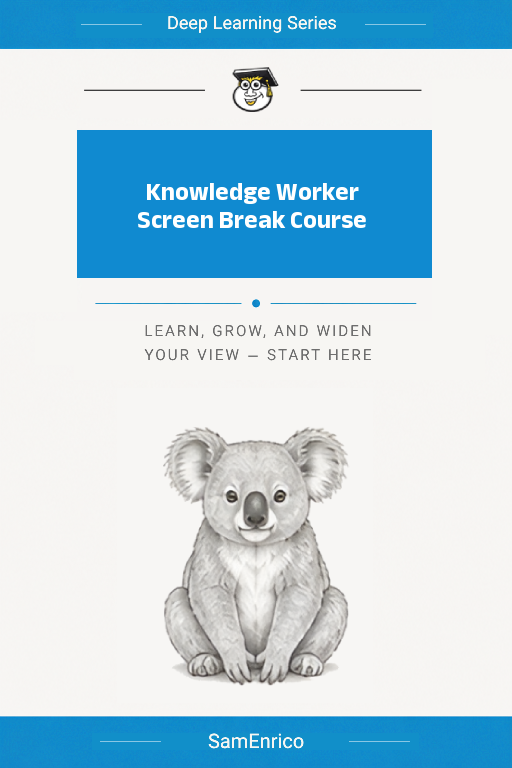
Non-FictionMental WealthWorkplace Wellness
Knowledge Worker Screen Break Course eBook
Schedule mandatory screen free blocks during creat
by Roman Leif
Schedule mandatory screen free blocks during creative work hours to prevent digital fatigue and burnout.
Formats
Free sample
Chapter 1: The Attention Theft--You have been robbed. Not of your wallet, your identity, or your data—though those can be stolen too. You have been robbed of something far more precious, far more irreplaceable, and far more foundational to your career as a knowledge worker. You have been robbed of your attention.Not once. Not occasionally.
But thousands of times today alone.By the time you finish reading this sentence, your brain will have processed approximately twelve separate impulses to look at something else. A notification badge on your email icon. A Slack message preview. The vibrating phantom of a phone you left in the other room. The habit is so deeply ingrained that you no longer notice the theft happening in real time.
You only notice the aftermath: the 5 PM exhaustion despite completing nothing important, the creative block that has lasted three weeks, the vague sense that you used to be smarter, faster, more imaginative.Here is the diagnosis that most productivity books are too polite to deliver: You are not tired because you are working too hard. You are exhausted because your attention is being strip-mined by trillion-dollar algorithms designed to extract it, package it, and sell it to the highest bidder. And the most insidious part? You volunteered for this arrangement.This chapter dismantles the comfortable lie that digital fatigue is your fault. It reveals the neuroscience of continuous partial attention, introduces the concept of the Attention Economy as an extraction industry, and provides the first step in your 12-week reclamation: the Unified Attention Audit.
By the end of this chapter, you will understand exactly how your attention is being stolen, who is stealing it, and—most importantly—how to measure the theft so you can stop it.The Knowledge Worker Paradox Let us begin with a contradiction so absurd that it would be funny if it were not destroying careers.We live in an era of unprecedented computational power. Your smartphone has more processing capability than the computers that guided astronauts to the moon. Your laptop can access the entirety of human knowledge in 1.2 seconds. Artificial intelligence can draft emails, summarize documents, and generate creative ideas faster than any human assistant in history. By every objective measure, knowledge workers today should be the most productive, most creative, most fulfilled cohort of professionals in human existence.But you are not.
And you know you are not.The average knowledge worker switches tasks every three minutes. After each interruption, it takes over twenty minutes to return to a state of deep focus. By simple arithmetic, a single hour containing four interruptions costs nearly eighty minutes of cognitive capacity—a mathematical impossibility that reveals the hidden tax of digital fragmentation. You cannot work for sixty minutes if you lose twenty minutes of refocusing time after each distraction. You are paying attention debt before you have earned attention income.This is the Knowledge Worker Paradox: unprecedented tools, diminishing returns.
More computational power, less creative output. Constant connectivity, chronic exhaustion.The culprit is not laziness. It is not poor time management. It is not a lack of discipline or a deficiency of character. The culprit is a state that neuroscientists call continuous partial attention—a perpetual low-grade cognitive alertness that never rises to the level of deep focus and never falls to the level of genuine rest.
You are not working. You are not resting. You are hovering in a neurological limbo that depletes your prefrontal cortex while convincing you that you are being productive.Worse, this state has been deliberately engineered.The Extraction Economy In 1971, economist Herbert Simon made a prediction that seemed hyperbolic at the time: "What information consumes is rather obvious: it consumes the attention of its recipients. Hence a wealth of information creates a poverty of attention."Fifty years later, Simon's prediction has become the business model of the twenty-first century.The companies that dominate the global economy—Google, Meta, Microsoft, Apple, Amazon, Tik Tok, X (formerly Twitter), Slack, Teams—do not sell information. They sell attention.
Every time you check a notification, scroll a feed, or reply to a message, you are not using a free service. You are paying with the currency of your focus. And unlike dollars or euros, attention is a non-renewable resource. Once spent, it cannot be earned back. The hour you lost to doomscrolling at 3 PM is gone forever.
The creative insight that would have arrived during that hour is not merely delayed; it is aborted.This is not a metaphor. This is the literal financial structure of the modern economy.Facebook (now Meta) generated over 130billioninadvertisingrevenuein2023.Thatmoneywaspaidbycompanieswhowantedaccesstoyourattention.Youdidnotseeacent.Google′sparentcompany Alphabetgeneratednearly130 billion in advertising revenue in 2023. That money was paid by companies who wanted access to your attention. You did not see a cent. Google's parent company Alphabet generated nearly 130billioninadvertisingrevenuein2023.Thatmoneywaspaidbycompanieswhowantedaccesstoyourattention.Youdidnotseeacent.Google′sparentcompany Alphabetgeneratednearly300 billion in advertising revenue.
Again, your attention was the product, and you were not the customer. You were the inventory.And the tools designed for workplace productivity have adopted the same model. Slack's default settings are optimized for engagement, not efficiency. Every notification, every @-mention, every status change triggers a dopamine loop that keeps you returning to the application. Microsoft Teams has been criticized by workplace psychologists for its "presence indicator"—the green dot that creates the expectation of instant response, transforming your availability into a performance metric.You are not using these tools.
These tools are using you.The Neurochemistry of Theft To understand how attention theft works, we must briefly enter the skull. Do not worry—the tour is short, and the vocabulary is manageable.Deep within your brain, beneath the layers responsible for language, logic, and self-control, lies a cluster of neurons called the nucleus accumbens. This is a component of your brain's reward circuitry. When something good happens—a delicious meal, a compliment, a solved problem—the nucleus accumbens releases dopamine, a neurotransmitter that creates feelings of pleasure and, more importantly, motivation to repeat the behavior.Notifications hijack this circuit.Every time your phone buzzes, your email icon shows a red badge, or your Slack window flashes, your brain receives a tiny dopamine hit. Not because the message is important.
Not because the notification contains valuable information. But because your brain has learned that something might be there. This is called a reward prediction error—the brain's way of saying "I guessed wrong about whether something good would happen, so I will release dopamine to make sure I pay attention next time."Slot machines operate on the exact same mechanism. Variable rewards (sometimes you win, sometimes you lose, but you never know when) are more addictive than fixed rewards precisely because they hijack the prediction error system. Your email inbox is a slot machine.
Your Slack notifications are a slot machine. Your phone's lock screen is a slot machine. And you are pulling the lever hundreds of times per day.The problem is not the dopamine itself. The problem is what dopamine costs.When your brain is in a state of high-alert anticipation—waiting for the next notification, the next badge, the next buzz—your prefrontal cortex (the region responsible for executive function, creativity, impulse control, and long-term planning) is partially suppressed. Your brain…
This is the end of the free sample. Get the eBook to keep going. Buy now
About this book
Details
- Author
- Roman Leif
- Publisher
- SamEnrico
- Language
- English
- Genre
- Non-Fiction, Mental Wealth, Workplace Wellness
- Released
- 2026-05-29
- Pages (approx.)
- 131
- Available as
- eBook, Audiobook

Read better in the ZLOADR app
Your eBooks on your phone or tablet. Sign in with your SamEnrico account and start reading.
More by Roman Leif
 Financial Scarcity Mindset ShiftRoman Leif$11.99
 Failure Support Network GuideRoman Leif$11.99
 Alternative Explanation GeneratorRoman Leif$11.99
 Sleep Growth Hormone ReleaseRoman Leif$11.99
 Letting Go of Ex PartnerRoman Leif$11.99
 Talking About Pregnancy LossRoman Leif$11.99
 HIIT for DepressionRoman Leif$11.99
 HIIT Metabolic AfterburnRoman Leif$11.99
 The Maestro of the Mississippi: William Grant Still and the Symphony of Black Classical BrillianceRoman Leif$11.99
 The Iron Spires of Prussia: Frederick the Great and the Birth of Modern WarfareRoman Leif$11.99
 Poppy Seed: Breadseed PoppyRoman Leif$11.99
 How to Start a Manganese Oxide Business (Beginners Guide)Roman Leif$11.99
You may also like
 Hong Kong Handover 1997Dunn Johnnie$11.99
 Zumba For Postnatal Recovery CourseNeal Christian$11.99
 Zumba for BeginnersLadner Nikia$11.99
 YouTube Comment Mining GuideHumes Pandora$12.99
 Worry Box MeditationCarlin Rudy$11.99
 Workplace Stress MeditationNguyen Lynn$11.99
 Workplace Stress and Sleep RepairHawley Ivory$11.99
 Workplace Perfectionism CureDelaney Jeffry$11.99
 Workplace Injustice Anger GuideWallen Isabelle$11.99
 Work Addiction and Burnout LinkGreenwood Ester$11.99
 Women in Yoga and WellnessBeattie Galina$11.99
 Women in Stand Up ComedyChun Evangeline$11.99