
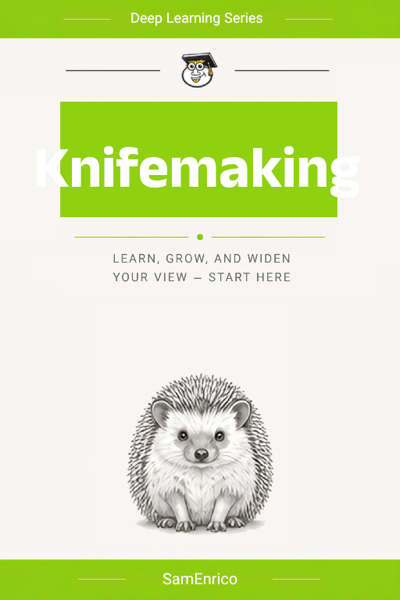
Non-FictionInformativeEducational
Knifemaking Audiobook
A Coursebook on Knifemaking
A Coursebook on Knifemaking
Formats
Free sample
Chapter 1: The Blade’s Silent Language--It begins not with a hammer, not with a forge, not with the scream of steel against a grinder’s belt. It begins with a question so simple that most beginners overlook it entirely, yet so profound that master smiths still ask it before every single blade they create.What is this knife for?Not “what would look cool.” Not “what did that You Tuber make.” Not “what sold for three thousand dollars at the last custom show.” Those are distractions. The only question that matters—the only question that separates a tool from a decoration—is the question of purpose.A knife is a conversation between three things. The human hand. The material being cut.
And the environment where the cutting happens. If you design without understanding all three, you are not making a knife. You are making a knife-shaped object. And the difference announces itself the first time someone tries to actually use your creation. The hand blisters.
The edge rolls. The tip snaps. The balance feels wrong.This chapter will teach you to listen to a conversation you have not yet learned to hear. You will learn the vocabulary of blades—not as abstract terms, but as living geometry that exists because someone, somewhere, needed to cut something in a specific way. You will learn why a skinner has a belly and a tanto does not.
You will learn why jimping exists and why too much of it will ruin your hand. You will learn why your index finger’s natural resting position is more important than any aesthetic choice you could ever make.And by the end of this chapter, you will have done something that most hobbyists never do: you will have designed a knife on paper before cutting a single millimeter of steel. Because paper is free. Mistakes on paper cost nothing. Mistakes in 1084 cost time, money, and the quiet death of enthusiasm.Let us begin.The First Principle: Form Follows Function In 1896, the architect Louis Sullivan wrote a short essay titled “The Tall Office Building Artistically Considered.” In it, he coined a phrase that would outlive every building he ever designed: “form ever follows function.”Sullivan was writing about skyscrapers.
He might as well have been writing about knives.Every curve on a well-made blade exists because the knife’s intended use demanded it. The skinner’s deep belly exists because…
This is the end of the free sample. Get the Audiobook to keep going. Buy now
About this book
Details
- Author
- Chestnut Versie
- Publisher
- SamEnrico
- Language
- English
- Genre
- Non-Fiction, Informative, Educational
- Released
- 2026-05-04
- Pages (approx.)
- 132
- Available as
- eBook, Audiobook

Listen in the VoxFlicks app
Audiobooks and audio dramas wherever you go. Sign in with your SamEnrico account and press play.
More by Chestnut Versie
 Emotion Differentiation TrainingChestnut Versie$11.99
 Brazilian Beauty Brand PioneerChestnut Versie$11.99
 The Post Injury Beginner GuideChestnut Versie$11.99
 Stress Cancer Progression LinkChestnut Versie$11.99
 The Butcher of Moscow: Copycat Killers and the Birth of Russian Organized CrimeChestnut Versie$11.99
 Learn to Play the Classical GuitarChestnut Versie$11.99
 India Raise Negotiation GuideChestnut Versie$12.99
 How to Become a Load CheckerChestnut Versie$11.99
You may also like
 Hong Kong Handover 1997Dunn Johnnie$11.99
 Zumba For Postnatal Recovery CourseNeal Christian$11.99
 Zumba for BeginnersLadner Nikia$11.99
 YouTube Comment Mining GuideHumes Pandora$12.99
 Worry Box MeditationCarlin Rudy$11.99
 Workplace Stress MeditationNguyen Lynn$11.99
 Workplace Stress and Sleep RepairHawley Ivory$11.99
 Workplace Perfectionism CureDelaney Jeffry$11.99
 Workplace Injustice Anger GuideWallen Isabelle$11.99
 Work Addiction and Burnout LinkGreenwood Ester$11.99
 Women in Yoga and WellnessBeattie Galina$11.99
 Women in Stand Up ComedyChun Evangeline$11.99