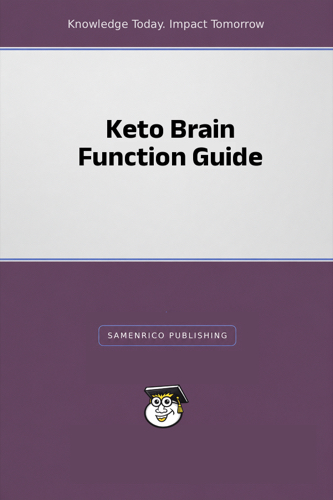
Keto Brain Function Guide Audiobook
Explains ketones as alternative brain fuel.
by Wasson Trinh
Explains ketones as alternative brain fuel.
Formats
Free sample
Chapter 1: The Starving Brain–- It was 2:47 on a Tuesday afternoon when Sarah, a 42-year-old graphic designer and mother of two, sat down at her kitchen table with a sandwich. Whole-grain bread. Turkey. Avocado. Lettuce.
By every conventional measure, it was a “healthy” lunch. Fifteen minutes later, she tried to remember her daughter’s birthday. Not the year—the actual date. June something? The 14th?
The 21st? She had signed the birthday card herself that morning. The memory wasn’t fuzzy. It was gone. Erased.
For thirty terrifying seconds, Sarah sat frozen, staring at the crumbs on her plate, wondering if this was early-onset Alzheimer’s at forty-two. Then, as suddenly as it had vanished, the memory returned. June 18th. Of course. She laughed it off as stress, exhaustion, the chaos of modern life.
But somewhere beneath that laugh, a question took root: What is happening to my brain?Sarah is not alone. She is not broken. She is not losing her mind. She is, however, starving.Not for food. She has plenty of that.
Sarah is starving for a specific kind of energy that her brain has forgotten how to access. And if you are reading this book, there is a very good chance that you are starving too.The Paradox of Plenty We live in the most food-abundant society in human history. Grocery stores overflow with options. Restaurants deliver anything imaginable to our doors within minutes. The average American consumes over 3,600 calories per day—nearly double what their body requires for basic function.
And yet, beneath this surface of plenty, something has gone terribly wrong with the way our brains access energy.Consider the numbers. Between 1990 and 2020, rates of diagnosed anxiety disorders in the United States increased by over 55 percent. Major depressive disorder now affects nearly 1 in 5 adults at some point in their lives. Diagnosis of attention deficit disorders have tripled. Alzheimer’s disease, which was so rare in 1970 that most medical textbooks devoted only a paragraph to it, now affects more than 6 million Americans and is projected to reach 14 million by 2060.
Brain fog—that vague, frustrating inability to think clearly—has become so ubiquitous that most people accept it as a normal part of aging or stress.But what if none of this is normal? What if the rising tide of cognitive dysfunction, mood disorders, and mental fatigue is not a collection of separate diseases but a single, shared symptom…
This is the end of the free sample. Get the Audiobook to keep going. Buy now
About this book
Details
- Author
- Wasson Trinh
- Publisher
- SamEnrico
- Language
- English
- Genre
- Non-Fiction, Health & Wellness, Neurological Health
- Released
- 2026-06-07
- Pages (approx.)
- 129
- Available as
- eBook, Audiobook

Listen in the VoxFlicks app
Audiobooks and audio dramas wherever you go. Sign in with your SamEnrico account and press play.
More by Wasson Trinh
 Self Doubt Networking GuideWasson Trinh$11.99
 Distraction Rehearsal Training GuideWasson Trinh$11.99
 Second Generation Cuisine FusionWasson Trinh$11.99
 Bessie Smith EmpressWasson Trinh$11.99
 Email Marketing Impact On ChurnWasson Trinh$11.99
 Sleep Memory For ADHDWasson Trinh$11.99
 Tax Efficient Withdrawal OrderWasson Trinh$11.99
 The Vanishing of Flight 19: The Bermuda Triangle’s Final WitnessWasson Trinh$11.99
 The Silk Road Pioneers: Venice's Merchant Princes and the Birth of Global TradeWasson Trinh$11.99
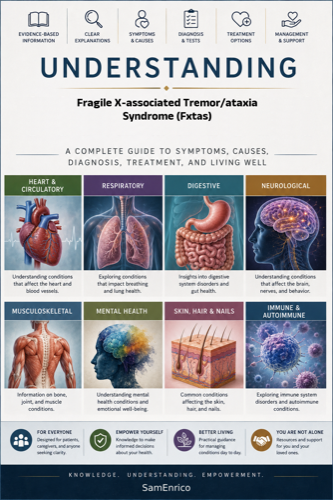 Understanding Fragile X-associated Tremor/ataxia Syndrome (Fxtas)Wasson Trinh$11.99
 How to Produce Skateboard TrucksWasson Trinh$11.99
 How to Produce Fruit MixesWasson Trinh$11.99