
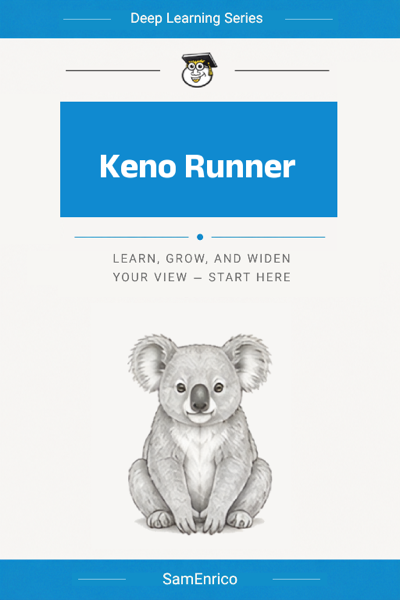
Non-FictionInformativeEducational
Keno Runner eBook
A Coursebook on Keno Runner
A Coursebook on Keno Runner
Formats
Free sample
Chapter 1: The Eighty-Ball Universe--The first time I held a Keno ticket, I thought it was a parking voucher. I was twenty-two years old, three months behind on rent, and desperate enough to take a job that paid in cash and required me to wear a polyester vest that smelled like the previous occupant’s cigarette smoke. The casino was the Silver Spur, a downtown Las Vegas relic that had seen better decades, let alone better years. The Keno manager—a woman named Delia who chewed ice constantly and had the calm of someone who had already survived everything—handed me a stack of used tickets and said, “Learn the difference between a straight ticket and a way ticket before lunch, or don’t bother coming back.”I didn’t know it then, but that stack of paper was my entrance into a world that was equal parts mathematics, psychology, and performance art. Keno is the oldest game in the casino, older than the slot machine, older than the poker table, older than the crap tables that draw crowds of screaming tourists.
It arrived in America with Chinese railroad workers in the nineteenth century, and it survived because it occupies a strange, quiet corner of the gambling universe. It is not fast. It is not loud. It does not promise instant wealth with a single pull of a lever. Instead, Keno offers something more patient: the slow burn of possibility, the ritual of marking numbers, the communal exhale when the last ball drops into place.This chapter is about that universe.
It is about the eighty numbered balls that define the game, the history that shaped it, and the mathematics that makes it work. But more than that, it is about why a runner—someone like the twenty-two-year-old version of me—needs to understand all of this before they ever pick up a customer’s ticket. Because Keno is not a game of luck. It is a game of probability disguised as luck. And the runner who does not know the difference is just another person in a polyester vest.The Ancient Origins of a Modern Game Keno’s history is disputed, which is fitting for a game built on chance.
The most widely accepted origin story begins in ancient China, during the Han Dynasty, roughly two thousand years ago. According to legend, a city called Cheung was under siege, and its defenders were running out of money. The city’s leader, a man whose name has been lost to history, devised a lottery to raise funds. The game was called baige piao—the “white pigeon ticket”—because results were reportedly sent by carrier pigeon to outlying villages. Players selected characters from a set of one hundred and twenty, and if their selections matched the drawn characters, they won prizes.
The proceeds funded the Great Wall’s construction, or so the story goes. Historians debate the details, but the core truth remains: lotteries financed public works in ancient China, and Keno is their direct descendant.When Chinese immigrants arrived in the United States during the nineteenth century to build the transcontinental railroad, they brought the game with them. It was called the “Chinese Lottery” then, and it was played in gambling houses that operated in the shadows of American cities. The game used Chinese characters instead of numbers, which made it exotic to white Americans but also kept it insular, a cultural touchstone for immigrant communities. That changed when the game moved to Nevada.
In 1931, when the state legalized gambling, casino operators needed games that would appeal to a broad audience. The Chinese Lottery was rebranded as “Keno”—a word derived from the Latin quini (five) or possibly from the French quine (five winning numbers), though no one agrees on the etymology. The Chinese characters were replaced with numbers 1 through 80. The white pigeon became a rotating cage of ping-pong balls. And Keno, as we know it, was born.The Mechanics of the Bowl Traditional Keno uses a physical device called a “Keno bowl.” It is a round, clear plastic or glass cage mounted on a rotating mechanism.
Inside are eighty numbered ping-pong balls, each painted with a number from 1 to 80. The bowl spins, agitating the balls, and then a mechanism releases twenty of them one by one through a tube. Those twenty numbers become the draw for that game. The entire process takes about thirty seconds. It is oddly hypnotic, like watching a laundry machine that might make you rich.Modern casinos increasingly use RNGs—Random Number Generators—instead of physical bowls.
An RNG is a computer algorithm that produces a sequence of numbers with no discernible pattern. For regulatory purposes, these RNGs are tested and certified by independent laboratories. They are statistically identical to physical draws, but they lack the theater. Players who grew up with physical bowls often complain that RNGs feel “cold” or “fake.” They are not wrong about the feeling, but they are wrong about the math. The probability of any given number appearing in an RNG draw is exactly the same as in a physical draw: one in four, or 25 percent, since twenty numbers are drawn from eighty.For the runner, the difference between a bowl and an RNG matters only in one way: how you talk to players.
Older players may ask, “Is it real balls or a computer?” The honest answer is, “We use an RNG, but it’s certified by the state and has the same odds as a physical bowl.” If you say, “It’s all random, don’t worry about it,” you will lose their trust. The runner’s job is not to defend the casino’s technology. The runner’s job is to make the player feel secure in their bet.The Spot System: Where Probability Lives Here is the single most important mathematical fact about Keno: a player chooses between one and twenty numbers—called “spots”—and then wins based on how many of those spots match the twenty numbers drawn. That is simple enough. But the probability of hitting all of your chosen spots drops dramatically as the number of spots increases.A player who marks a 1-spot is betting that a single number will appear in the draw.
The probability is 20 out of 80, or exactly 25 percent. The payout is typically 3 to 1. That means for every dollar bet, the player expects to lose about 25 cents over the long run. Not terrible, as casino games go.A player who marks a 2-spot must have both numbers appear. The probability is about 6 percent.
The payout is typically 12 to 1. The house edge climbs.A player who marks a 3-spot has a probability of about 1.4 percent. The payout is typically 45 to 1.A player who marks a 4-spot has a probability of about 0.3 percent. The payout is typically 200 to 1.And a player who marks a 10-spot—the classic “big win” ticket—has a probability of hitting all ten of roughly one in 2.5 million. The payout can be $100,000 or more on a $1 bet.Why does the probability drop so fast?
Because Keno draws without replacement. Once a ball is drawn, it cannot be drawn again in that same game. That means each additional spot…
This is the end of the free sample. Get the eBook to keep going. Buy now
About this book
Details
- Author
- Mckenna Shenita
- Publisher
- SamEnrico
- Language
- English
- Genre
- Non-Fiction, Informative, Educational
- Released
- 2026-06-02
- Pages (approx.)
- 99
- Available as
- eBook, Audiobook

Read better in the ZLOADR app
Your eBooks on your phone or tablet. Sign in with your SamEnrico account and start reading.
More by Mckenna Shenita
 Pre Speech Anxiety WorkbookMckenna Shenita$11.99
 Endocarditis Injection UseMckenna Shenita$11.99
 Nonverbal Cues at WorkMckenna Shenita$11.99
 Blood Flow Restriction TrainingMckenna Shenita$11.99
 The Crown of the Ocean: Portugal’s Golden Age of DiscoveryMckenna Shenita$11.99
 How to Start a Millstone and Grindstone Cutting Business (Beginners Guide)Mckenna Shenita$11.99
 How to Produce Canned and Prepared BeansMckenna Shenita$11.99
 Competitive Pricing Intelligence HandbookMckenna Shenita$12.99
You may also like
 Hong Kong Handover 1997Dunn Johnnie$11.99
 Zumba For Postnatal Recovery CourseNeal Christian$11.99
 Zumba for BeginnersLadner Nikia$11.99
 YouTube Comment Mining GuideHumes Pandora$12.99
 Worry Box MeditationCarlin Rudy$11.99
 Workplace Stress MeditationNguyen Lynn$11.99
 Workplace Stress and Sleep RepairHawley Ivory$11.99
 Workplace Perfectionism CureDelaney Jeffry$11.99
 Workplace Injustice Anger GuideWallen Isabelle$11.99
 Work Addiction and Burnout LinkGreenwood Ester$11.99
 Women in Yoga and WellnessBeattie Galina$11.99
 Women in Stand Up ComedyChun Evangeline$11.99