
Non-FictionHistory / Archaeology
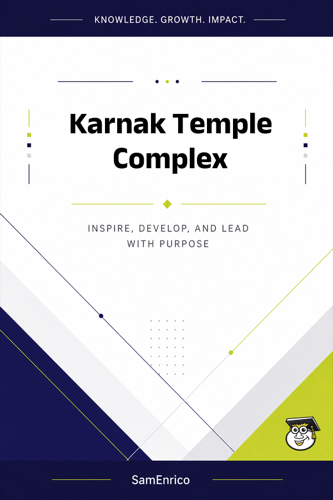
Karnak Temple Complex eBook
undefined
by Ferrer John
undefined
Formats
Free sample
Chapter 1: The Sacred Sand...--The first time you stand before the ruins of Karnak, the instinct is not to marvel but to disbelieve. Your eyes send signals to your brain that say this cannot be right — because no human civilization, no matter how powerful, should have been able to stack stone that high, that densely, that deliberately, and then walk away from it for two thousand years. The Great Hypostyle Hall alone, with its one hundred and thirty-four columns rising like a petrified forest, covers an area large enough to swallow Notre Dame Cathedral whole and still have room for the Roman Forum as a courtyard. And yet the Hypostyle Hall is only one room in a complex that stretched, at its peak, across nearly two hundred acres — larger than some ancient cities. Larger, in fact, than many modern cities if you measure by footprint alone.But size is not what makes Karnak astonishing.
What makes Karnak astonishing is that it was never finished. It was never even planned as a single structure. For over two thousand years — from the mud-brick chapels of the Middle Kingdom around 2000 BCE to the last Ptolemaic gates erected in the first century BCE — every pharaoh who held the crook and flail added something. Some added whole temples. Some added obelisks.
Some added only a single wall or a carved inscription. But they all added. The result is not a building in any conventional sense. It is a palimpsest of Egyptian history written in stone, where a Ramesside pylon stands in front of a Hatshepsutine chapel, which itself was built on the foundations of a Middle Kingdom shrine that replaced an Old Kingdom altar. To walk through Karnak is to walk through three thousand years of human ambition, piety, politics, and vandalism — often simultaneously.This book is the story of that place.
But before we can understand what Karnak became, we must understand the land on which it was built, the god for whom it was raised, and the strange, persistent belief that drove Egyptians for millennia to carry stones across rivers and drag them up ramps, all so that a statue hidden in a dark room could be woken each morning with incense and song.The River and the Floodplain The Nile does not merely flow through Egypt. It is Egypt. Without the Nile, the entire country would be indistinguishable from the Sahara that presses against its borders on both sides — an endless expanse of sand and rock where nothing lives and nothing grows. But the Nile, flooding each year with predictable regularity, deposits a layer of rich black silt across the floodplain, turning a narrow ribbon of desert into the most productive agricultural land in the ancient Mediterranean. The ancient Egyptians called their country Kemet, "the Black Land," after this soil.
The desert beyond was Deshret, "the Red Land" — the realm of chaos, death, and the setting sun.Thebes — modern Luxor — sits on a particularly generous bend of the Nile, approximately eight hundred kilometers south of the Mediterranean. In the Old Kingdom (c. 2686–2181 BCE), when the great pyramids were rising at Giza, Thebes was a provincial backwater. Its local god was a minor air deity named Amun, whose name meant "The Hidden One" — an appropriate title for a god who had, up to that point, remained largely hidden from history. But Thebes had two advantages that would eventually make it the religious capital of the ancient world.
The first was its location: far enough south to control access to Nubia's gold mines and the trade routes of the Red Sea, but far enough north to avoid the constant border wars with Kush. The second was its soil. The floodplain around Thebes was unusually wide and unusually fertile, capable of producing enough grain to feed not just a city but an army — and eventually an empire.There is no surviving record of the first human settlement at Thebes. But by the early Old Kingdom, a small shrine likely existed on the east bank of the Nile, near the modern village of Karnak (an Arabic name derived from Khornak, meaning "fortified village"). We know this not because any structure from that period remains standing — the oldest visible ruins at Karnak date to the 11th Dynasty (c.
2130–1991 BCE) — but because of pottery fragments and indirect textual references. An inscription from the 6th Dynasty mentions a "mansion of Amun" at Thebes, and excavators have found Old Kingdom ceramic ware in the deepest excavation levels beneath the later temple. But these are whispers, not evidence. The true story of Karnak begins when Thebes emerged from provincial obscurity during the political chaos of the First Intermediate Period (c. 2181–2055 BCE), when the Old Kingdom collapsed and local warlords fought for control of the Nile.The Rise of Thebes The First Intermediate Period was Egypt's dark age.
The central government dissolved. The pyramids were looted. Famine gripped the land, and the famous Admonitions of Ipuwer — a lamentation text from the period — describes a world turned upside down: "The poor have become rich, and the rich have become poor. The river is blood. Men shrink from tasting human beings, and thirst after water." It was into this chaos that the rulers of Thebes, originally just another local dynasty, began to expand their power.
By 2055 BCE, the Theban prince Mentuhotep II had reunified Egypt, overthrown the rival dynasty based in Heracleopolis, and established the Middle Kingdom (c. 2055–1650 BCE).With reunification came building. Mentuhotep II constructed a spectacular mortuary temple at Deir el-Bahri, on the west bank of the Nile opposite Karnak — but on the east bank, the future site of Karnak remained relatively modest. The pharaohs of the 12th Dynasty, particularly Senusret I (r. 1971–1926 BCE), began to invest in Thebes as a religious center.
They built the first stone structures at Karnak: small chapels, a courtyard, and the earliest known version of the barque shrine that would house the sacred boat of Amun. Most of these structures have not survived; later pharaohs dismantled them for their stone, a common practice in ancient Egypt where the past was often seen as a quarry rather than a heritage site. But one remarkable exception remains, and it is the oldest standing structure at Karnak today.The White Chapel It is a strange thing to stand before a building that is nearly four thousand years old and realize that it was never intended to survive. The White Chapel of Senusret I was discovered in pieces — dismantled, buried, and used as filler inside the Third Pylon, built by Amenhotep III some seven hundred years after Senusret's reign. In the 1920s, French archaeologists working at Karnak carefully extracted the blocks, cleaned them, and reassembled the chapel like a three-dimensional jigsaw puzzle.
Today it sits in the open-air museum at Karnak, a small structure of gleaming white limestone that is easy to overlook among the giants around it.But the White Chapel is worth lingering over because it tells us everything about how Karnak worked. The chapel is not large: approximately fifteen meters long and six meters wide, with a central corridor flanked by four rows of square pillars. Each pillar is carved from floor to ceiling with hieroglyphs, including the…
This is the end of the free sample. Get the eBook to keep going. Buy now
About this book
Details
- Author
- Ferrer John
- Publisher
- SamEnrico
- Language
- English
- Genre
- Non-Fiction, History / Archaeology
- Released
- 2026-06-08
- Pages (approx.)
- 144
- Available as
- eBook, Audiobook

Read better in the ZLOADR app
Your eBooks on your phone or tablet. Sign in with your SamEnrico account and start reading.
More by Ferrer John
 Self Esteem for Dads at WorkFerrer John$11.99
 Emotion Regulation HandoutsFerrer John$11.99
 Paramedic PTSD Prevention HandbookFerrer John$11.99
 Multiple Language PalacesFerrer John$11.99
 The Breath Sensations WorkbookFerrer John$11.99
 Anger Management for Neurodivergent WorkersFerrer John$11.99
 Midnight Zone Diver's LogFerrer John$11.99
 Vacation Without BurnoutFerrer John$11.99
 The Fox of the Desert: Erwin Rommel's North African CampaignFerrer John$11.99
 Bloodlines of Power: The Bush Dynasty’s Shadow WarsFerrer John$11.99
 The Bone Whisperers of Timbuktu: Unlocking the Secrets of the Human Body in the Age of DiscoveryFerrer John$11.99
 Facebook Ad Audience InsightsFerrer John$12.99
You may also like
 Hong Kong Handover 1997Dunn Johnnie$11.99
 Zumba For Postnatal Recovery CourseNeal Christian$11.99
 Zumba for BeginnersLadner Nikia$11.99
 YouTube Comment Mining GuideHumes Pandora$12.99
 Worry Box MeditationCarlin Rudy$11.99
 Workplace Stress MeditationNguyen Lynn$11.99
 Workplace Stress and Sleep RepairHawley Ivory$11.99
 Workplace Perfectionism CureDelaney Jeffry$11.99
 Workplace Injustice Anger GuideWallen Isabelle$11.99
 Work Addiction and Burnout LinkGreenwood Ester$11.99
 Women in Yoga and WellnessBeattie Galina$11.99
 Women in Stand Up ComedyChun Evangeline$11.99