
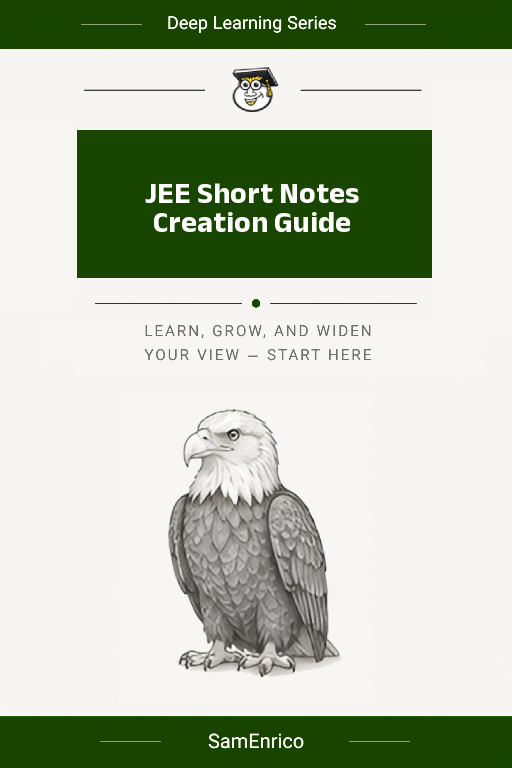
JEE Short Notes Creation Guide
Make concise revision notes that capture only what
by Craig Devin
Make concise revision notes that capture only what you frequently forget.
Formats
About this book
Free sample
Fixed Edition: "JEE Short Notes Creation Guide"Revised In-Depth Chapter Summaries Choose Your Path Flowchart (New Front Matter)Before Chapter 1, the book opens with a decision flowchart that directs readers based on their time remaining until the exam:6+ months remaining: Start at Chapter 1 and progress sequentially through all 12 chapters. Build the complete Short Note System from the ground up.60 days remaining: Begin with Chapter 10 (The 60-Day Crash Strategy), then reference Chapters 2, 7, and 11 as needed. Do not spend time on foundational chapters.3 days remaining: Read only Chapters 7 (Error Log), 10 (final 72-hour section), and 11 (High-Yield Surgeries). Ignore all note-creation chapters entirely.This flowchart resolves the contradiction between the "No-New-Notes" rule in Chapter 10 and the note-creation instruction in earlier chapters, ensuring every reader knows exactly where to start based on their unique timeline.Section 1: The Foundation Chapter 1: The Forgetting Curve & The JEE Aspirant In-Depth Summary (285 words):This chapter establishes the scientific and psychological rationale for why conventional note-taking fails JEE aspirants. It introduces Hermann Ebbinghaus's Forgetting Curve, which demonstrates that without active intervention, students forget nearly 50% of newly learned material within 24 hours, and up to 70% within one week.
This is not a personal failing—it is a universal feature of human memory that successful JEE toppers have learned to exploit rather than fight.The chapter then dismantles the "Familiarity Trap"—the dangerous illusion that recognizing a formula while reading a textbook equates to being able to recall it under exam pressure. Using a vivid analogy: passive re-reading is like watching someone lift weights; active recall is doing the lift yourself. The former feels productive but builds no strength; the latter is uncomfortable but produces real results.The chapter introduces active recall as the foundational solution to the Forgetting Curve, explaining that retrieval practice (forcing yourself to remember) is up to 300% more effective than re-reading. This concept will be explored in depth in Chapter 8 (The Feynman Technique for JEE), where readers will learn the most powerful active recall method.Finally, the chapter introduces the "Second Brain" concept: a tactical system where notes are not a reference library (which students rarely revisit), but a lean, dynamic tool engineered…
This is the end of the free sample. Get the eBook to keep going. Buy now
Contents
- Chapter 1
- Chapter 2
- Chapter 3
- Chapter 4
- Chapter 5
- Chapter 6
- Chapter 7
- Chapter 8
- Chapter 9
- Chapter 10
- Chapter 11
- Chapter 12
Details
- Author
- Craig Devin
- Publisher
- SamEnrico
- Language
- English
- Genre
- Non-Fiction, Student's Shortcut
- Released
- 2026-05-29
- Pages (approx.)
- 149
- Available as
- eBook, Audiobook

Read better in the ZLOADR app
Your eBooks on your phone or tablet. Sign in with your SamEnrico account and start reading.
More by Craig Devin
 Recovery Sleep for AthletesCraig Devin$11.99
 Immigrant Pest Control Business SuccessCraig Devin$11.99
 Designer Block BusterCraig Devin$11.99
 Nonverbal Active Listening GuideCraig Devin$11.99
 Wholesaling Text Message SystemCraig Devin$11.99
 Bullying Recovery Self EsteemCraig Devin$11.99
 Calm Driver Anger WorkbookCraig Devin$11.99
 The Photo BurnCraig Devin$11.99
 Baldwin DynastyCraig Devin$11.99
 The Unlikely Comeback: How a Single Tweet Revived a Dying IndustryCraig Devin$11.99
 The Alchemist of Timbuktu: Love, Science, and the Golden Age of MaliCraig Devin$11.99
 Ragnarok's Last Laugh: Loki's Trickster TriumphCraig Devin$11.99
You may also like
 Hong Kong Handover 1997Dunn Johnnie$11.99
 Zumba For Postnatal Recovery CourseNeal Christian$11.99
 Zumba for BeginnersLadner Nikia$11.99
 YouTube Comment Mining GuideHumes Pandora$12.99
 Worry Box MeditationCarlin Rudy$11.99
 Workplace Stress MeditationNguyen Lynn$11.99
 Workplace Stress and Sleep RepairHawley Ivory$11.99
 Workplace Perfectionism CureDelaney Jeffry$11.99
 Workplace Injustice Anger GuideWallen Isabelle$11.99
 Work Addiction and Burnout LinkGreenwood Ester$11.99
 Women in Yoga and WellnessBeattie Galina$11.99
 Women in Stand Up ComedyChun Evangeline$11.99