
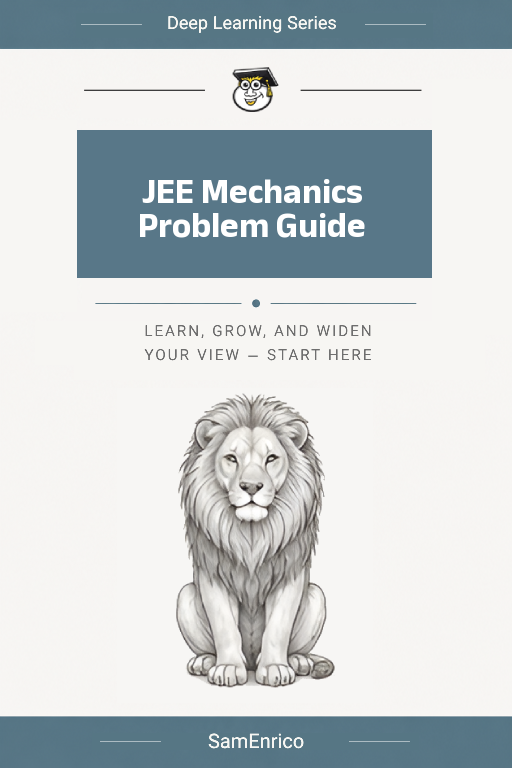
Non-FictionStudent's ShortcutMechanics
JEE Mechanics Problem Guide Audiobook
Solve kinematics, Newton's laws, work-energy, and
Solve kinematics, Newton's laws, work-energy, and rotational motion problems systematically.
Formats
Free sample
Chapter 1: The Silent Prerequisite--–- Before you solve a single physics problem, before you draw your first free-body diagram, before you even think about Newton or energy or rotation, you must master a silent prerequisite. It is silent because textbooks rarely announce its importance. It is a prerequisite because without it, every equation you write becomes a guess. This chapter is not about mechanics. It is about the language mechanics speaks: vectors and calculus.Most JEE aspirants fail not because they cannot recall F = ma or τ = Iα.
They fail because they cannot add two forces correctly, cannot find the angle between a velocity and a displacement, cannot integrate acceleration to get velocity when the acceleration is not constant. These are not physics failures. These are mathematical failures disguised as physics confusion.Consider this: every JEE Advanced paper in the last decade has contained at least four problems that require vector resolution or calculus operations as their first step. Without these tools, the problem is dead on arrival. With them, the problem becomes algebra.This chapter builds those tools from the ground up.
It assumes you have seen vectors and calculus before but never used them fluently in physics. By the end of this chapter, vector addition will feel like addition of ordinary numbers. Differentiation and integration will feel like natural operations, not mysterious rituals. And you will never again lose marks because you could not resolve a force on an incline or find velocity from a non-uniform acceleration.The chapter is organized into five sections. First, we cover vectors: addition, subtraction, components, dot product, and cross product.
Second, we cover differentiation applied to motion: velocity, acceleration, and higher derivatives. Third, we cover integration: finding position from velocity, velocity from acceleration, and the role of initial conditions. Fourth, we cover the marriage of vectors and calculus: position, velocity, and acceleration as vectors. Fifth, we provide a "Calculus Refresher" for variable acceleration problems that appear in later chapters.Every section ends with a "Checkpoint" – three quick problems to verify understanding before moving on. Do not skip them.
They are the difference between passive reading and active learning.Let us begin.1.1 Vectors: The Arrows That Rule Mechanics A vector is any quantity that has both magnitude and direction. Displacement, velocity, acceleration, force, torque, momentum, angular momentum – all vectors. A scalar has only magnitude: mass, time, energy, temperature.Why does direction matter? Because pushing a…
This is the end of the free sample. Get the Audiobook to keep going. Buy now
About this book
Details
- Author
- Gaddis Micaela
- Publisher
- SamEnrico
- Language
- English
- Genre
- Non-Fiction, Student's Shortcut, Mechanics
- Released
- 2026-06-01
- Pages (approx.)
- 158
- Available as
- eBook, Audiobook

Listen in the VoxFlicks app
Audiobooks and audio dramas wherever you go. Sign in with your SamEnrico account and press play.
More by Gaddis Micaela
 The Remote Task Prioritization GuideGaddis Micaela$11.99
 Core Beliefs About Love GuideGaddis Micaela$11.99
 Alcohol Medical Detox GuideGaddis Micaela$11.99
 Crisis Management BrandGaddis Micaela$11.99
 Layoff Delivery GuideGaddis Micaela$11.99
 Ghost Army Deception UnitGaddis Micaela$11.99
 Warehouse Legal LiabilityGaddis Micaela$11.99
 Executive Control TrainingGaddis Micaela$11.99
 The Saltwater Pioneers: Australia's Forgotten Swimming Revolution (1850s-1890s)Gaddis Micaela$11.99
 The Architect of the Cosmos: Imhotep and the Birth of EngineeringGaddis Micaela$11.99
 A Collector's Handbook to the Aston Martin Db2Gaddis Micaela$11.99
 How to Produce Tung Oil FinishGaddis Micaela$11.99
You may also like
 Hong Kong Handover 1997Dunn Johnnie$11.99
 Zumba For Postnatal Recovery CourseNeal Christian$11.99
 Zumba for BeginnersLadner Nikia$11.99
 YouTube Comment Mining GuideHumes Pandora$12.99
 Worry Box MeditationCarlin Rudy$11.99
 Workplace Stress MeditationNguyen Lynn$11.99
 Workplace Stress and Sleep RepairHawley Ivory$11.99
 Workplace Perfectionism CureDelaney Jeffry$11.99
 Workplace Injustice Anger GuideWallen Isabelle$11.99
 Work Addiction and Burnout LinkGreenwood Ester$11.99
 Women in Yoga and WellnessBeattie Galina$11.99
 Women in Stand Up ComedyChun Evangeline$11.99