
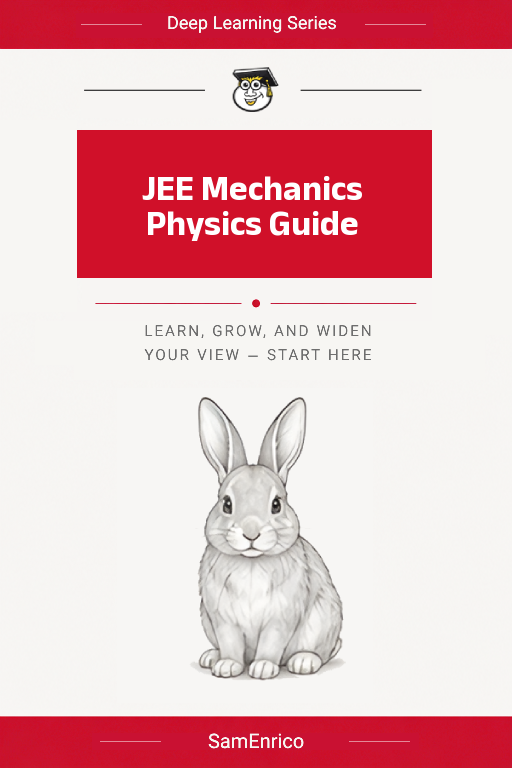
Non-FictionStudent's ShortcutMechanics Prep
JEE Mechanics Physics Guide
Solve kinematics, Newton's laws, work-energy, and
Solve kinematics, Newton's laws, work-energy, and rotational motion using free-body diagrams and vector resolution.
Formats
About this book
Free sample
Chapter 1: The Vector Compass--–- Every aspiring JEE aspirant has felt it: the sinking sensation when a seemingly simple mechanics problem explodes into a confusing tangle of directions, angles, and forces. You know the physics. You have memorized F=ma F = ma F=ma. Yet, when a block sits on an inclined plane, a string pulls it from one side, and friction pushes from another, the equations refuse to write themselves. The culprit is almost always the same: a lack of a systematic way to handle direction.
Mechanics, at its heart, is not just physics; it is applied vector mathematics. This chapter is not a review. It is the construction of your mental compass—the single most important tool you will use in every subsequent chapter of this book. Master the material here, and the rest of mechanics becomes an exercise in clear, methodical translation from a diagram to an equation. Ignore it, and you will spend the next eleven chapters fighting a losing battle against sign errors and trigonometric confusion.1.1 The Language of Direction: Vectors vs.
Scalars Physics divides quantities into two fundamental types. Scalars are fully described by a single number (and a unit). Mass (5 kg), time (10 s), temperature (300 K), and energy (100 J) are scalars. They have no direction. Vectors, however, carry both a magnitude and a direction.
Displacement ("5 meters north"), velocity ("20 m/s downward"), acceleration, force, and momentum are vectors. Saying a force is "10 N" is incomplete; you must specify which way it pushes. This directional information is the source of both the power and the difficulty of mechanics. We represent vectors graphically as arrows: the arrow’s length indicates the magnitude, and the arrowhead points in the direction. We will primarily use the algebraic representation: A⃗\vec{A}A or A\mathbf{A}A.
In print, the arrow distinguishes a vector from its scalar magnitude, A=∣A⃗∣A = |\vec{A}|A=∣A∣.1.2 Your Cartesian Companions: Unit Vectors i^,j^,k^\hat{i}, \hat{j}, \hat{k}i^,j^,k^To describe vectors mathematically, we need a fixed reference frame. The Cartesian coordinate system provides this. The unit vectors i^,j^,k^\hat{i}, \hat{j}, \hat{k}i^,j^,k^ are dimensionless arrows of exactly length 1, pointing along…
This is the end of the free sample. Get the eBook to keep going. Buy now
Contents
- Chapter 1
- Chapter 2
- Chapter 3
- Chapter 4
- Chapter 5
- Chapter 6
- Chapter 7
- Chapter 8
- Chapter 9
- Chapter 10
- Chapter 11
- Chapter 12
Details
- Author
- Goodson Vesta
- Publisher
- SamEnrico
- Language
- English
- Genre
- Non-Fiction, Student's Shortcut, Mechanics Prep
- Released
- 2026-06-01
- Pages (approx.)
- 82
- Available as
- eBook, Audiobook

Read better in the ZLOADR app
Your eBooks on your phone or tablet. Sign in with your SamEnrico account and start reading.
More by Goodson Vesta
 Remote Retreats for Executive AssistantsGoodson Vesta$11.99
 The Eating Disorder TalkGoodson Vesta$11.99
 Seasonal Snowbird Housing Strategy WorkbookGoodson Vesta$11.99
 French Resistance Fake ID GuideGoodson Vesta$11.99
 Deep Work for Marketing DirectorsGoodson Vesta$11.99
 Shadows Over the Silk Road: The Forgotten War of 1969Goodson Vesta$11.99
 The Unseen Split: How a Hollywood Marriage Crashed Like a BlockbusterGoodson Vesta$11.99
 Understanding Choroideremia HypopituitarismGoodson Vesta$17.99
 10 Ways to Use Cheese Sauce (Recipe Book)Goodson Vesta$11.99
 Contingency Budget Planning GuideGoodson Vesta$12.99
 Polysomnographic TechnologyGoodson Vesta$11.99
You may also like
 Hong Kong Handover 1997Dunn Johnnie$11.99
 Zumba For Postnatal Recovery CourseNeal Christian$11.99
 Zumba for BeginnersLadner Nikia$11.99
 YouTube Comment Mining GuideHumes Pandora$12.99
 Worry Box MeditationCarlin Rudy$11.99
 Workplace Stress MeditationNguyen Lynn$11.99
 Workplace Stress and Sleep RepairHawley Ivory$11.99
 Workplace Perfectionism CureDelaney Jeffry$11.99
 Workplace Injustice Anger GuideWallen Isabelle$11.99
 Work Addiction and Burnout LinkGreenwood Ester$11.99
 Women in Yoga and WellnessBeattie Galina$11.99
 Women in Stand Up ComedyChun Evangeline$11.99