
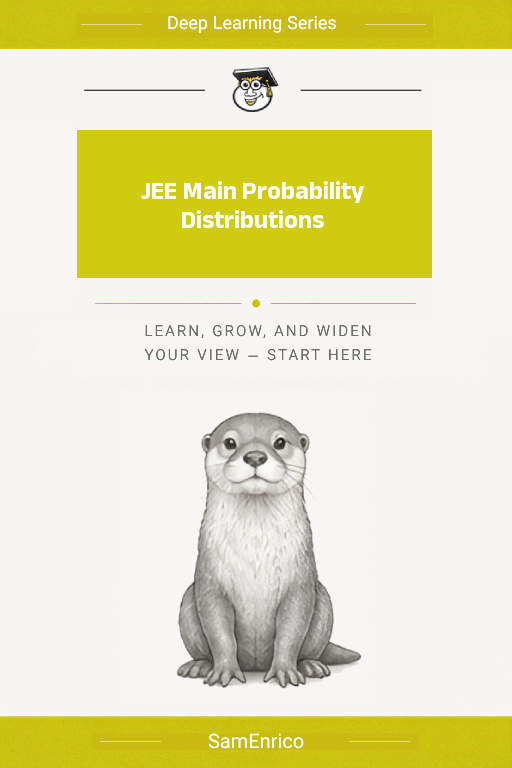
JEE Main Probability Distributions
Solve binomial Poisson and normal distribution pro
by Stout Kelle
Solve binomial Poisson and normal distribution problems for advanced probability questions.
Formats
About this book
Free sample
Chapter 1: The Mindset Shift--–- Most JEE aspirants lose marks on probability distributions not because the mathematics is difficult, but because they are thinking about the problem incorrectly. They approach a distribution question the same way they approach a coin-and-dice problem from Class 11—listing outcomes, counting favorable cases, dividing by total possibilities. And then they stare at the answer options, confused why none of their calculations match.The problem is not your algebra. The problem is not your ability to compute combinations or factorials. The problem is that you are trying to solve a distribution question using event-based thinking.
And those two paradigms do not mix any better than oil and water.This chapter engineers the single most important shift in your probability preparation: moving from “What is the probability of this event?” to “What is the probability distribution of this random variable?” Master this shift, and every subsequent chapter—Binomial, Poisson, Normal, approximations, mixtures—will feel like a natural extension of a single unified framework. Miss this shift, and you will spend the next six months memorizing formulas that never seem to fit the problems you actually face in the exam.Let us begin.1.1 The Fundamental Problem with Event-Based Thinking In Class 11, you learned probability in its classical form. For an experiment with equally likely outcomes, the probability of an event E was:P(E)=Number of outcomes favorable to ETotal number of possible outcomes P(E) = \frac{\text{Number of outcomes favorable to E}}{\text{Total number of possible outcomes}}P(E)=Total number of possible outcomes Number of outcomes favorable to EThis works beautifully for dice, coins, cards, and balls drawn from urns. The sample space is finite, the outcomes are symmetric, and you can count everything explicitly. A typical problem: “Two dice are thrown.
Find the probability that the sum is 7.” Total outcomes = 36. Favorable outcomes = 6 (1+6,2+5,3+4,4+3,5+2,6+1). Answer = 6/36 = 1/6.Now consider a different problem: “A factory produces light bulbs. The probability that a bulb lasts more than 1000 hours is 0.3. Five bulbs are tested.
What is the probability that exactly two bulbs last more than 1000 hours?”Stop. Try to solve this using only event-based…
This is the end of the free sample. Get the eBook to keep going. Buy now
Contents
- Chapter 1
- Chapter 2
- Chapter 3
- Chapter 4
- Chapter 5
- Chapter 6
- Chapter 7
- Chapter 8
- Chapter 9
- Chapter 10
- Chapter 11
- Chapter 12
Details
- Author
- Stout Kelle
- Publisher
- SamEnrico
- Language
- English
- Genre
- Non-Fiction, Student's Shortcut
- Released
- 2026-05-30
- Pages (approx.)
- 132
- Available as
- eBook, Audiobook

Read better in the ZLOADR app
Your eBooks on your phone or tablet. Sign in with your SamEnrico account and start reading.
More by Stout Kelle
 Drug Dependency and Sober Living HomesStout Kelle$11.99
 The Medicine Nobel Hepatitis CStout Kelle$11.99
 Phone Checking as DisinterestStout Kelle$11.99
 Nobel Laureates In Virology GuideStout Kelle$11.99
 Rapid Body Scan RelaxationStout Kelle$11.99
 Evan Williams BloggerStout Kelle$11.99
 Haleakala Missing CasesStout Kelle$11.99
 Meditation For Grief BeginnersStout Kelle$11.99
 The Timbuktu Codebreakers: The Great Mathematical Heist of the SaharaStout Kelle$11.99
 The Shield and the Rune: Harald Fairhair and the Birth of NorwayStout Kelle$11.99
 The Mineral Guide to AfghaniteStout Kelle$11.99
 How to Produce BucklesStout Kelle$11.99
You may also like
 LSE Online Program LengthAgee Letisha$11.99
 Harvard Extension School for Working AdultsRoush Yer$11.99
 LSE Online Reading ListAshford Ludivina$11.99
 LSE Online Language RequirementsWhitten Daphine$11.99
 LSE Online Class SizeHughey Garret$11.99
 LSE Online Alumni MentorshipWild Lyla$11.99
 London School of Economics Alumni NetworkDutton Chantal$11.99
 Harvard Extension School Student SupportCantrell Christene$11.99
 Harvard Extension School Library AccessSantana Adah$11.99
 Harvard Extension School Degree CompletionBray Wyatt$11.99
 Harvard Extension School Course AuditingAbbott Craig$11.99
 Harvard Extension School Extension DiplomaNew Joane$11.99