
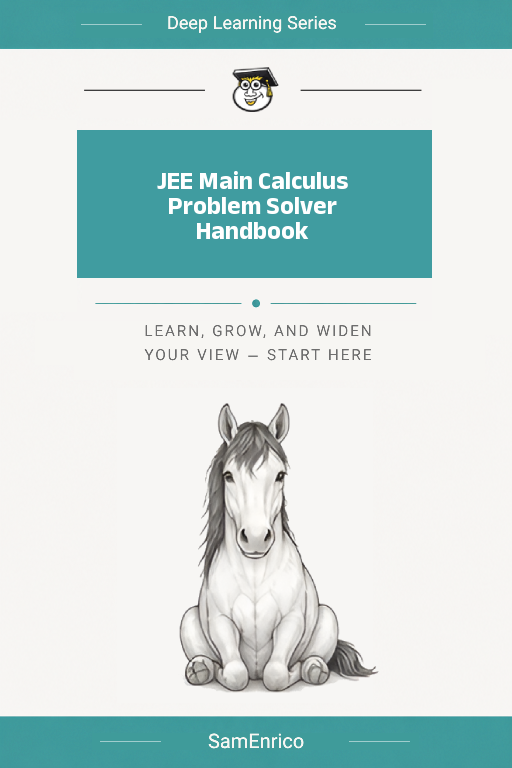
JEE Main Calculus Problem Solver Handbook eBook
Master differentiation integration and differentia
by Andre Maye
Master differentiation integration and differential equations with 200 solved JEE level problems and shortcuts.
Formats
Free sample
Chapter 1: The Chain Breaker...--The first time you stare at a nested derivative like ddxsin2(1+ex3)\frac{d}{dx} \sin^2(\sqrt{1+e^{x^3}})dxdsin2(1+ex3), something happens. Your hand freezes. Your mind starts drawing little boxes. You begin writing dydu⋅dudv⋯\frac{dy}{du} \cdot \frac{du}{dv} \cdotsdudy⋅dvdu⋯ and three lines later, you have lost track of which prime belongs to which function. This is not a personal failing.
This is a design flaw in the way chain rule is traditionally taught.Most textbooks present the chain rule as a theorem: if y=f(u)y = f(u)y=f(u) and u=g(x)u = g(x)u=g(x), then dydx=dydu⋅dudx\frac{dy}{dx} = \frac{dy}{du} \cdot \frac{du}{dx}dxdy=dudy⋅dxdu. Mathematically impeccable. Practically useless for speed. Because in JEE Main, you are not asked to prove the chain rule. You are asked to apply it to functions like sin(ln(tan−1(ex)))\sin(\ln(\tan^{-1}(e^{\sqrt{x}})))sin(ln(tan−1(ex))) in under ninety seconds.
The traditional step-by-step substitution method will kill your time and your accuracy.This chapter is called The Chain Breaker because it breaks the habit of writing intermediate variables. Instead, you will learn to read a composite function like a sentence, moving from the outermost operation inward, writing the derivative in one continuous line. You will also master implicit differentiation in three mechanical steps, eliminating the algebraic drift that causes sign errors. And you will discover a JEE-specific trick: finding derivatives at a point without differentiating at all.By the end of this chapter, nested derivatives will feel like second nature. The JEE Angle shows that chain rule appears in approximately one to two questions per year, and implicit differentiation in another zero to one question.
These are not the highest-frequency topics, but they are the ones that separate average scorers from top ranks. A single chain rule problem solved in forty-five seconds instead of two minutes gives you seventy-five seconds for a difficult integral elsewhere. That is the margin of victory.Let us begin.The JEE Angle: Why This Chapter Matters Before any shortcut, understand the landscape. In the last five JEE Main papers (2021–2025), chain rule appeared in at least one question each year, often disguised inside limit problems or as part of a larger differentiation. Implicit differentiation appeared approximately every other year, usually paired with tangents and normals.
The exam does not ask "differentiate sin(x2)\sin(x^2)sin(x2)" in isolation. It embeds the chain rule inside word problems: rates of change, parametric curves, or functional equations.The typical student spends ninety seconds on a nested derivative, writing three to four intermediate substitutions. The shortcut in this chapter reduces that to thirty seconds. Over the entire calculus section, saving one minute per chain rule problem and one minute per implicit problem adds up to a buffer of three to four minutes. That buffer is where you double-check your answers.Toolbox: What You Must Know Before Starting You cannot break the chain unless you already hold the links.
Memorize these derivatives cold. No hesitation. No "let me think."Elementary derivatives (absolute minimum):ddxxn=nxn−1(for any real n)\frac{d}{dx} x^n = n x^{n-1} \quad \text{(for any real \( n \))}dxdxn=nxn−1(for any real n)ddxsinx=cosx,ddxcosx=−sinx,ddxtanx=sec2x\frac{d}{dx} \sin x = \cos x, \quad \frac{d}{dx} \cos x = -\sin x, \quad \frac{d}{dx} \tan x = \sec^2 xdxdsinx=cosx,dxdcosx=−sinx,dxdtanx=sec2xddxex=ex,ddxlnx=1x\frac{d}{dx} e^x = e^x, \quad \frac{d}{dx} \ln x = \frac{1}{x}dxdex=ex,dxdlnx=x1ddxsin−1x=11−x2,ddxtan−1x=11+x2\frac{d}{dx} \sin^{-1} x = \frac{1}{\sqrt{1-x^2}}, \quad \frac{d}{dx} \tan^{-1} x = \frac{1}{1+x^2}dxdsin−1x=1−x21,dxdtan−1x=1+x21Chain rule formula (theorem form):ddxf(g(x))=f′(g(x))⋅g′(x)\frac{d}{dx} f(g(x)) = f'(g(x)) \cdot g'(x)dxdf(g(x))=f′(g(x))⋅g′(x)Implicit differentiation principle:If yyy is defined implicitly as a function of xxx by an equation F(x,y)=0F(x, y) = 0F(x,y)=0, differentiate both sides with respect to xxx, treating yyy as y(x)y(x)y(x), then solve for dydx\frac{dy}{dx}dxdy.That is all the theory you need. The rest is pattern recognition.The Shortcut: Outer-Inner Cancellation (One Line, No Boxes)Here is the revelation: you do not need to write u=somethingu = \text{something}u=something and v=something elsev = \text{something else}v=something else. The derivative of a composite function is simply the derivative of the outermost function, evaluated at the inner function, multiplied by the derivative of the inner function, evaluated at the next inner function, and so on.For y=f(g(h(x)))y = f(g(h(x)))y=f(g(h(x))):dydx=f′(g(h(x)))⋅g′(h(x))⋅h′(x)\frac{dy}{dx} = f'(g(h(x))) \cdot g'(h(x)) \cdot h'(x)dxdy=f′(g(h(x)))⋅g′(h(x))⋅h′(x)Write it in one line from left to right.
Read the function from the outside in, differentiate each layer, multiply.Example 1 (Basic nesting):y=sin(x2)y = \sin(x^2)y=sin(x2)Outermost: sine. Derivative of sine is cosine. Keep the inside: cos(x2)\cos(x^2)cos(x2). Multiply by derivative of inside: 2x2x2x. Done.y′=cos(x2)⋅2x=2xcos(x2)y' = \cos(x^2) \cdot 2x = 2x \cos(x^2)y′=cos(x2)⋅2x=2xcos(x2)Example 2 (Three layers):y=esin(x2)y = e^{\sin(x^2)}y=esin(x2)Layer 1 (outermost): exponential.
Derivative is einsidee^{\text{inside}}einside. Keep inside: esin(x2)e^{\sin(x^2)}esin(x2). Multiply by derivative of layer 2 (sine of x2x^2x2): cos(x2)\cos(x^2)cos(x2). Multiply by derivative of layer 3 (x2x^2x2): 2x2x2x.y′=esin(x2)⋅cos(x2)⋅2x=2xesin(x2)cos(x2)y' = e^{\sin(x^2)} \cdot \cos(x^2) \cdot 2x = 2x e^{\sin(x^2)} \cos(x^2)y′=esin(x2)⋅cos(x2)⋅2x=2xesin(x2)cos(x2)Notice: we never wrote u=sin(x2)u = \sin(x^2)u=sin(x2). We never wrote v=x2v = x^2v=x2.
We just read the function and wrote derivatives in sequence.Example 3 (Four layers – JEE level):y=sin2(1+ex3)y = \sin^2(\sqrt{1+e^{x^3}})y=sin2(1+ex3)Wait. This is [sin(1+ex3)]2[\sin(\sqrt{1+e^{x^3}})]^2[sin(1+ex3)]2. Outermost: square function. Derivative: 2⋅inside2 \cdot \text{inside}2⋅inside. Keep inside: 2sin(1+ex3)2\sin(\sqrt{1+e^{x^3}})2sin(1+ex3).
Multiply by derivative of layer 2 (sine): cos(1+ex3)\cos(\sqrt{1+e^{x^3}})cos(1+ex3). Multiply by derivative of layer 3 (square root): 121+ex3\frac{1}{2\sqrt{1+e^{x^3}}}21+ex31. Multiply by derivative of layer 4 (1+ex31+e^{x^3}1+ex3): ex3⋅3x2e^{x^3} \cdot 3x^2ex3⋅3x2. Combine:y′=2sin(1+ex3)⋅cos(1+ex3)⋅121+ex3⋅ex3⋅3x2y' = 2\sin(\sqrt{1+e^{x^3}}) \cdot \cos(\sqrt{1+e^{x^3}}) \cdot \frac{1}{2\sqrt{1+e^{x^3}}} \cdot e^{x^3} \cdot 3x^2y′=2sin(1+ex3)⋅cos(1+ex3)⋅21+ex31⋅ex3⋅3x2Simplify: 2⋅12=12 \cdot \frac{1}{2} = 12⋅21=1, and 2sinAcosA=sin(2A)2\sin A \cos A = \sin(2A)2sin Acos A=sin(2A). So:y′=3x2ex3sin(21+ex3)21+ex3y' = \frac{3x^2 e^{x^3} \sin(2\sqrt{1+e^{x^3}})}{2\sqrt{1+e^{x^3}}}y′=21+ex33x2ex3sin(21+ex3)Fifteen seconds if you practice.…
This is the end of the free sample. Get the eBook to keep going. Buy now
About this book
Details
- Author
- Andre Maye
- Publisher
- SamEnrico
- Language
- English
- Genre
- Non-Fiction, Student's Shortcut
- Released
- 2026-05-28
- Pages (approx.)
- 137
- Available as
- eBook, Audiobook

Read better in the ZLOADR app
Your eBooks on your phone or tablet. Sign in with your SamEnrico account and start reading.
More by Andre Maye
 Drug Dependency and Vein HealthAndre Maye$11.99
 German Nobel Scientific Genius GuideAndre Maye$11.99
 Rewire Anger Self TalkAndre Maye$11.99
 Vocal Pitch as Emotion CueAndre Maye$11.99
 The Nobel Laureate MentorsAndre Maye$11.99
 Acadia National Park MysteriesAndre Maye$11.99
 Client Bankruptcy First ResponseAndre Maye$11.99
 Beginner Mindfulness JournalAndre Maye$11.99
 The Shot Heard 'Round the World: Kirk Gibson's Impossible HomerAndre Maye$11.99
 The Last Broadcast of the Great PyramidAndre Maye$11.99
 Crowns and Code: The Digital Reign of Queen RaniaAndre Maye$11.99
 How to Produce Brazil NutsAndre Maye$11.99
You may also like
 Hong Kong Handover 1997Dunn Johnnie$11.99
 Zumba For Postnatal Recovery CourseNeal Christian$11.99
 Zumba for BeginnersLadner Nikia$11.99
 YouTube Comment Mining GuideHumes Pandora$12.99
 Worry Box MeditationCarlin Rudy$11.99
 Workplace Stress MeditationNguyen Lynn$11.99
 Workplace Stress and Sleep RepairHawley Ivory$11.99
 Workplace Perfectionism CureDelaney Jeffry$11.99
 Workplace Injustice Anger GuideWallen Isabelle$11.99
 Work Addiction and Burnout LinkGreenwood Ester$11.99
 Women in Yoga and WellnessBeattie Galina$11.99
 Women in Stand Up ComedyChun Evangeline$11.99