
Non-FictionStudent's ShortcutTest Taking
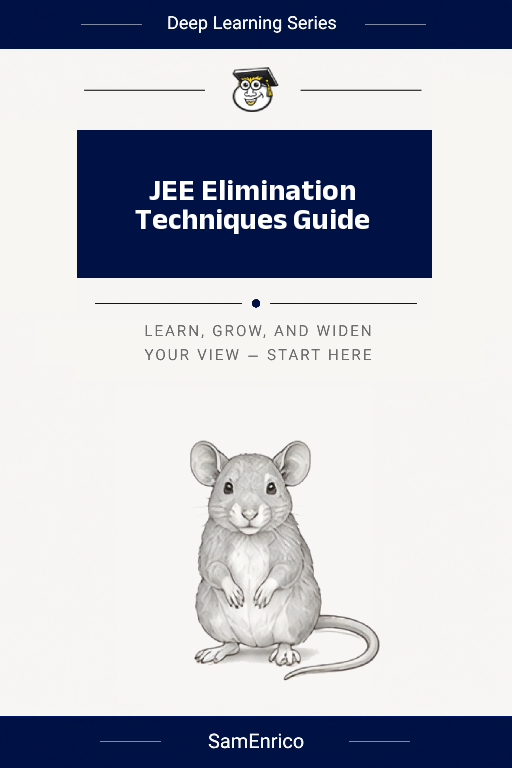
JEE Elimination Techniques Guide eBook
Use unit analysis, dimension checking, and option
Use unit analysis, dimension checking, and option elimination to guess correctly when stuck.
Formats
Free sample
Chapter 1: The 60-Second Truth--Every year, over a million students sit for the JEE Main examination. They have studied for two years, memorized thousands of formulas, solved tens of thousands of problems, and attended countless coaching classes. Yet when the results are announced, only a fraction secure a seat in their desired college. The difference between those who succeed and those who fall short is rarely a matter of knowledge. Both groups know the formulas.
Both groups have solved similar problems. The difference is something far more practical, far more immediate, and far more trainable than intelligence.The difference is knowing when to stop solving and start eliminating.This chapter will fundamentally change how you approach every question on the JEE paper. By the time you finish reading it, you will have a clear, actionable decision framework that tells you exactly what to do in the first sixty seconds of encountering any problem. You will learn to recognize the questions that are designed to trap students who solve mechanically, and you will learn to exploit those traps for your own advantage.Let me begin with a confession that might surprise you. In my own JEE preparation, I was not the smartest student in my coaching class.
There were students who could derive complex formulas faster than I could write them down. There were students who remembered every reaction mechanism in organic chemistry without ever needing to review. There were students who could solve calculus problems in their heads while I was still setting up the equation.But I consistently scored higher than most of them in mock tests.Not because I knew more. Because I wasted less time. Because I learned to recognize when a question was asking me to solve something that could be eliminated in ten seconds.
Because I developed a mental stopwatch that told me exactly when to abandon the solving path and switch to elimination mode.This chapter is about giving you that same mental stopwatch.The Fundamental Insight That Changes Everything The first thing you must understand is that the JEE is not a test of your ability to solve problems. It is a test of your ability to select correct answers under time pressure. These are two completely different skills.Solving a problem requires you to execute a sequence of steps correctly, from interpreting the problem statement to applying the appropriate formula to performing arithmetic without error. It is a linear, time-consuming process that rewards patience and precision.Selecting a correct answer from four options requires none of that. It requires pattern recognition, logical filtering, and strategic elimination.
It is a parallel process that rewards speed and judgment.Here is the insight that separates toppers from average students: In multiple-choice examinations, the answer is always in front of you. You do not need to generate it from scratch. You only need to identify it among four possibilities. This is fundamentally easier than solving from first principles, yet most students ignore this advantage and solve every question as if it were a blank sheet problem.Consider an analogy. If I asked you to find a specific person in a crowd of four people, would you close your eyes and describe that person from memory, then open your eyes and look for someone matching your description?
Of course not. You would look at the four people and eliminate the three who do not match. The answer is right there. You just need to recognize it.The JEE is exactly the same. The correct answer is printed on the page.
Your job is not to solve. Your job is to recognize.The Psychology of the JEE Paper Setter To eliminate effectively, you must understand who writes the questions and how they think. JEE paper setters are not random question generators. They are experienced educators who know exactly where students make mistakes. In fact, they design the options specifically to trap those mistakes.Every wrong option in a well-constructed JEE question is a common student error.
Let me give you a concrete example.Suppose a question asks for the moment of inertia of a solid sphere about its diameter. The correct formula is (2/5)MR². The paper setter knows that students often:Confuse solid sphere with spherical shell (which is 2/3 MR²)Forget the 2/5 factor entirely and write MR²Use the radius as diameter (giving MR²/4 or similar)Confuse moment of inertia about diameter with about tangent (which is 7/5 MR²)So the four options will likely include the correct answer and these three common errors. The student who solves from scratch and makes any of these mistakes will happily select a wrong option, convinced it is correct because it matches their calculation.But the student who eliminates sees something different. They see that three of the options correspond to known error patterns.
They recognize the shell formula, the missing factor, and the diameter confusion. And they select the fourth option without ever performing the derivation.This is the power of understanding paper setter psychology. When you know the traps, you stop falling into them. Instead, you use them as clues.The 60-Second Rule: Your New Best Friend Here is the single most practical takeaway from this entire book. I want you to memorize it, internalize it, and apply it to every question you encounter from this moment forward.The 60-Second Rule: If you have not made significant progress toward an answer within sixty seconds of first reading a question, stop solving and start eliminating.That is it.
Sixty seconds. One minute. A relatively short amount of time in a three-hour examination but an eternity when you are stuck on a problem.Why sixty seconds? Because research on JEE topper performance shows that successful students spend an average of 90 to 120 seconds on questions they eventually answer correctly. If you have spent sixty seconds without a clear path, you are unlikely to find that path in the next sixty seconds.
Your time is better spent switching strategies.But here is where the 60-Second Rule becomes powerful. It does not mean you give up after sixty seconds. It means you change your approach. Instead of solving, you eliminate. Instead of calculating, you compare.
Instead of deriving, you verify.The Elimination Hierarchy: A Decision Timeline for Every Question The sixty-second window is not a single block of time. It is divided into specific tiers, each with its own elimination technique. This hierarchy ensures you always use the fastest technique first and only move to slower techniques when necessary.Let me lay out the complete timeline.Tier 1: 0 to 10 seconds – Dimensional Analysis In the first ten seconds, you do not read the problem carefully. You do not reach for your calculator. You do not start writing equations.
You scan the options and ask one question: Do the units match?If the question asks for force, the answer must have units of kg·m/s². Any option with units of energy (kg·m²/s²) or pressure (kg/m·s²) is instantly eliminated. This takes two seconds, not ten. You can often eliminate one or two options before you even understand what the question is asking.If all options have the correct units, you check for dimensional homogeneity within each option. If an option adds a length…
This is the end of the free sample. Get the eBook to keep going. Buy now
About this book
Details
- Author
- Schiller Ingeborg
- Publisher
- SamEnrico
- Language
- English
- Genre
- Non-Fiction, Student's Shortcut, Test Taking
- Released
- 2026-05-29
- Pages (approx.)
- 156
- Available as
- eBook, Audiobook

Read better in the ZLOADR app
Your eBooks on your phone or tablet. Sign in with your SamEnrico account and start reading.
More by Schiller Ingeborg
 Meal Prep for Kidney DiseaseSchiller Ingeborg$11.99
 Personal Brand CollaborationSchiller Ingeborg$11.99
 Jobs On Camera PersonaSchiller Ingeborg$11.99
 The Remote Pomodoro GuideSchiller Ingeborg$11.99
 Cognitive Remediation WorkbookSchiller Ingeborg$11.99
 VJ Day Times Square CelebrationSchiller Ingeborg$11.99
 Tech Imposter Syndrome GuideSchiller Ingeborg$11.99
 Product Liability BasicsSchiller Ingeborg$11.99
 The Bare-Knuckle Brawls of Renaissance England: The Birth of Boxing's First ChampionsSchiller Ingeborg$11.99
 The Vishing King: The Billion-Dollar Phone Scam That Fooled the WorldSchiller Ingeborg$11.99
 How to Trade Orange JuiceSchiller Ingeborg$11.99
 A Collector's Handbook to the Aston Martin 2-litre Speed ModelSchiller Ingeborg$11.99
You may also like
 Hong Kong Handover 1997Dunn Johnnie$11.99
 Zumba For Postnatal Recovery CourseNeal Christian$11.99
 Zumba for BeginnersLadner Nikia$11.99
 YouTube Comment Mining GuideHumes Pandora$12.99
 Worry Box MeditationCarlin Rudy$11.99
 Workplace Stress MeditationNguyen Lynn$11.99
 Workplace Stress and Sleep RepairHawley Ivory$11.99
 Workplace Perfectionism CureDelaney Jeffry$11.99
 Workplace Injustice Anger GuideWallen Isabelle$11.99
 Work Addiction and Burnout LinkGreenwood Ester$11.99
 Women in Yoga and WellnessBeattie Galina$11.99
 Women in Stand Up ComedyChun Evangeline$11.99