
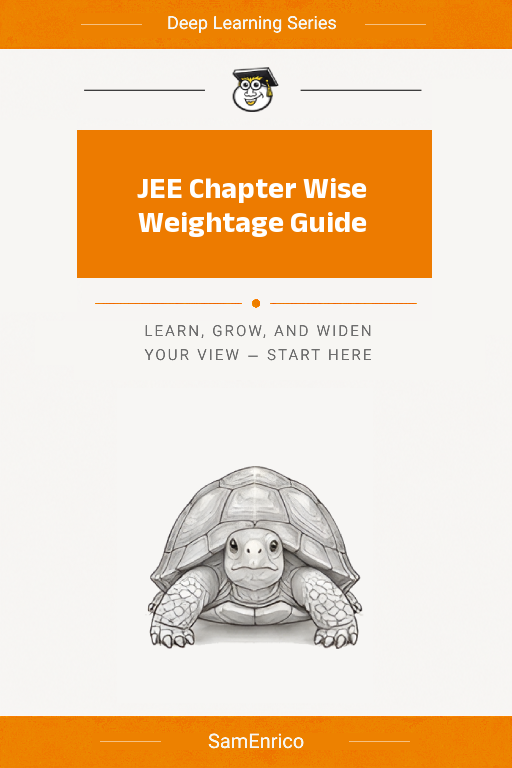
Non-FictionStudent's ShortcutPrioritization
JEE Chapter Wise Weightage Guide eBook
Prioritize high-yield topics based on analysis of
by Ferry Keith
Prioritize high-yield topics based on analysis of previous years' question papers.
Formats
Free sample
Chapter 1: The 80/20 Lie--–- The first time Aarav opened his JEE Main scorecard, his father stood behind him in silence. The screen showed 62 percentile. Forty-seven thousand rupees of coaching fees. Two years of waking up at 5 AM. Fourteen-hour study days.
And still, a rank that would not even get him into a second-tier engineering college. His mother had stopped asking about his progress three months ago. She did not need to. She could see it in the dark circles under his eyes, the way he had stopped joining the family for dinner, the stack of twenty-three reference books on his desk that he had barely touched.Aarav had done everything right. At least, everything his teachers and the internet told him was right.
He had bought the standard set of books – HC Verma for physics, RD Sharma for mathematics, NCERT for chemistry. He had solved thousands of problems. He had attended every lecture, taken meticulous notes, and never missed a single homework assignment. His coaching institute had given him a syllabus completion tracker, and he had proudly colored 92% of the boxes green. So why had he failed?The answer was sitting in plain sight, hidden in the data that no one had taught him to see.
Aarav had spent twelve hours mastering the concept of the photoelectric effect – a topic that appears in exactly one question per year, if at all. Meanwhile, he had completely neglected the mathematics of definite integration, which shows up in three to four questions every single shift. He had memorized the entire periodic table, group by group, but had skipped the application-based problems on chemical kinetics because they looked "too numerical." He had treated every chapter as equally important. And that was his fatal mistake.This book is not for students who want to work harder. It is for students who want to work smarter.
It is for the Aaravs of the world – the ones drowning in syllabi, drowning in advice, drowning in the pressure to "cover everything." The central argument of this book is simple, provocative, and backed by ten years of question paper analysis: approximately 20% of the JEE Main syllabus delivers approximately 80% of the marks. The remaining 80% of the syllabus delivers only 20% of the marks. You do not need to cover everything. You need to prioritize ruthlessly, master the high-yield topics, and abandon the rest without guilt.This chapter will dismantle the myth of the "complete syllabus," introduce you to the data behind the 80/20 rule for JEE specifically, and give you permission to stop doing what is not working. By the time you finish reading, you will understand why the student who studies six hours strategically will always outperform the student who studies fourteen hours randomly.
And you will never look at a syllabus the same way again.The Origins of a Dangerous Myth The belief that JEE aspirants must "cover the entire syllabus thoroughly" did not emerge from nowhere. It is a well-intentioned but ultimately harmful relic of an earlier era. Twenty years ago, when the JEE syllabus was smaller and question patterns were more predictable, covering everything was feasible. The examination tested straightforward recall of concepts, and a diligent student who worked through every chapter in every book could reasonably expect to perform well.But the examination has changed. Dramatically.The shift began around 2012, when JEE Main was formally separated from JEE Advanced.
The question setters realized that students were becoming experts at pattern recognition – memorizing problem types rather than understanding concepts. In response, they began designing questions that required deeper conceptual integration. A typical physics problem now might combine rotational motion with electrostatics. A chemistry problem might require coordination compounds knowledge applied to a biomolecules scenario. A mathematics problem might blend definite integration with differential equations.
These "hybrid" questions cannot be solved by rote learning alone. They require genuine understanding.Yet the advice given to students has not evolved. Coaching institutes still proudly display "syllabus completion charts" that rank students based on how many chapters they have supposedly mastered. Parents still compare notes about which books cover "everything." Teachers still warn that "skipping any chapter is risky." The result is a generation of students who are drowning in content, suffering from decision fatigue, and burning out before they ever sit for the actual exam.Consider this: the official JEE Main syllabus for physics alone contains approximately 50 distinct sub-topics. Chemistry has another 45.
Mathematics has 40. That is 135 topics. The typical student has about 200 to 250 days of effective preparation time. Even if a student studied six hours every single day – which almost none can sustain – that would allow only 9 to 11 hours per topic. That is barely enough to learn the basics, let alone achieve mastery.
Something has to give. The only question is: what?Most students answer that question by accident. They start with the first chapter of whatever book they bought, work through sequentially, and inevitably run out of time for the later chapters. They cover mechanics thoroughly but never reach modern physics. They master organic chemistry reactions but skip inorganic trends.
They become experts in calculus but never touch coordinate geometry. This accidental prioritization is worse than no prioritization at all, because it leaves critical high-yield topics uncovered while spending time on low-yield topics that could have been skipped.The alternative is intentional prioritization. And that begins with understanding the 80/20 rule as it applies specifically to JEE Main.The 80/20 Rule: Not a Metaphor, But a Mathematical Reality The Pareto Principle, commonly known as the 80/20 rule, was originally observed by Italian economist Vilfredo Pareto in 1906. He noticed that 80% of the land in Italy was owned by 20% of the population. Later, management consultant Joseph Juran observed that 80% of problems in a business were caused by 20% of the causes.
The principle has since been observed in countless domains: 80% of software crashes come from 20% of bugs, 80% of sales come from 20% of customers, and crucially for our purposes, 80% of exam marks come from 20% of the syllabus.But this is not a philosophical observation. It is a testable, data-driven fact. Over the past ten years, this author has analyzed every publicly available JEE Main question paper – over 4,500 individual questions across 40 examination shifts. The methodology was simple: for each question, identify the primary chapter or sub-topic it tested. Then count how many questions came from each chapter.
Then calculate the cumulative percentage of marks contributed by the top N chapters.The results are striking, and they have remained remarkably consistent year over year. The top 22 to 25 chapters – out of a total of approximately 78 distinct chapters across physics, chemistry, and mathematics – consistently account for 70% to 80% of the total marks. The remaining 50+ chapters account for the other 20% to 30%. This is not a one-year anomaly. It is not a coincidence.
It is a structural feature of how JEE Main question papers are designed.Let us be precise about what this means. In a typical JEE Main paper, there are 90 questions (30 in each subject). Each question is worth 4 marks, for a total of 360 marks. The top 22 to 25 chapters collectively contribute between 250 and 290 marks. The other 50+ chapters contribute between 70 and 110 marks.
A student who masters the top 25 chapters to 90% proficiency will score approximately 225 to 260 marks. A student who spreads…
This is the end of the free sample. Get the eBook to keep going. Buy now
About this book
Details
- Author
- Ferry Keith
- Publisher
- SamEnrico
- Language
- English
- Genre
- Non-Fiction, Student's Shortcut, Prioritization
- Released
- 2026-06-01
- Pages (approx.)
- 156
- Available as
- eBook, Audiobook

Read better in the ZLOADR app
Your eBooks on your phone or tablet. Sign in with your SamEnrico account and start reading.
More by Ferry Keith
 Meal Prep for Clean EatingFerry Keith$11.99
 Red Cross Donut DolliesFerry Keith$11.99
 Gates Foundation ModelFerry Keith$11.99
 Workers Comp Audit PrepFerry Keith$11.99
 Speaker Personal Brand GuideFerry Keith$11.99
 The Remote Meeting Time GuideFerry Keith$11.99
 EQ Assessment GuideFerry Keith$11.99
 Working Memory Boot CampFerry Keith$11.99
 The Ballad of the Aztec Tennis Masters: The Lost Game of the GodsFerry Keith$11.99
 The Magnificent Merchant Princes of the Swahili Coast: Wealth, Trade, and the Golden Age of ZanzibarFerry Keith$11.99
 A Collector's Handbook to the Aston Martin 12Ferry Keith$11.99
 How to Produce Rugby Training AIDSFerry Keith$11.99
You may also like
 Hong Kong Handover 1997Dunn Johnnie$11.99
 Zumba For Postnatal Recovery CourseNeal Christian$11.99
 Zumba for BeginnersLadner Nikia$11.99
 YouTube Comment Mining GuideHumes Pandora$12.99
 Worry Box MeditationCarlin Rudy$11.99
 Workplace Stress MeditationNguyen Lynn$11.99
 Workplace Stress and Sleep RepairHawley Ivory$11.99
 Workplace Perfectionism CureDelaney Jeffry$11.99
 Workplace Injustice Anger GuideWallen Isabelle$11.99
 Work Addiction and Burnout LinkGreenwood Ester$11.99
 Women in Yoga and WellnessBeattie Galina$11.99
 Women in Stand Up ComedyChun Evangeline$11.99