
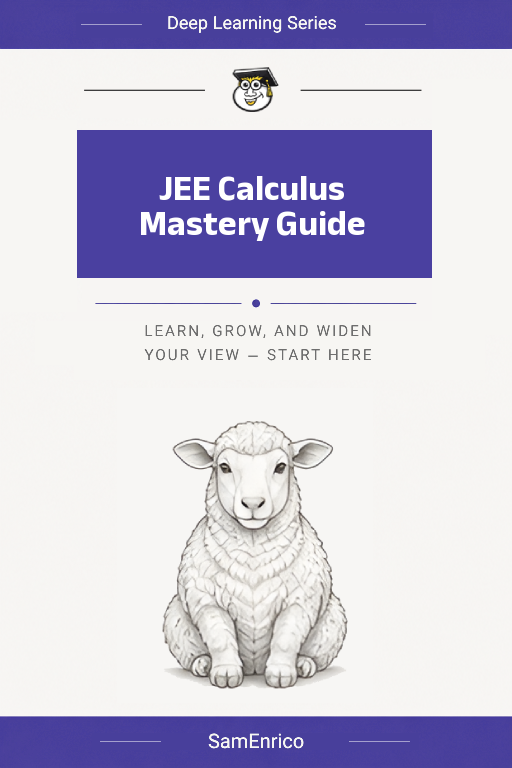
Non-FictionStudent's ShortcutCalculus Prep
JEE Calculus Mastery Guide eBook
Differentiation and integration techniques includi
Differentiation and integration techniques including limits, continuity, and applications for JEE mathematics problems.
Formats
Free sample
Chapter 1: The Hidden Toolkit--Most students believe calculus begins with limits. They are wrong.Calculus begins the moment you realize that every limit, every derivative, and every integral is built upon a foundation of seemingly simple algebraic and trigonometric tools. The difference between a student who struggles through calculus and one who masters it is rarely about understanding the derivative itself. It is about whether they can solve an inequality without sign errors, find a domain without missing restrictions, or expand a binomial without confusion. These are the hidden tools—the skills that textbooks assume you already know, but which most JEE aspirants have never truly mastered.This chapter is your diagnostic and remedial foundation.
It assumes you have studied basic algebra and trigonometry in Class XI, but it systematically strengthens the precise areas that cause the most errors in calculus problems. By the end of this chapter, you will not only have reviewed essential tools—you will understand exactly how each tool fits into the larger architecture of JEE Calculus. More importantly, you will never again lose marks on a calculus problem because of a pre-calculus mistake.1.1 The Wavy Curve Method: Your Inequality Compass Inequalities are the silent killers of JEE Calculus. They appear in domain finding, monotonicity analysis, and even in limit evaluation. The Wavy Curve Method (also called the Method of Intervals) is the most systematic way to solve polynomial and rational inequalities.
If you cannot execute this method flawlessly, you will struggle in Chapter 8 when analyzing where derivatives are positive or negative.The Core Principle For an inequality of the form P(x)Q(x)≥0\frac{P(x)}{Q(x)} \ge 0Q(x)P(x)≥0 or ≤0\le 0≤0, where P(x)P(x)P(x) and Q(x)Q(x)Q(x) are polynomials, the sign of the expression changes only at points where either the numerator or denominator equals zero. These points are called critical points. Between consecutive critical points, the sign of the expression remains constant. This principle is not a trick—it is a consequence of the Intermediate Value Theorem applied to continuous functions.Step-by-Step Procedure Step 1: Rewrite the inequality so that all terms are on one side and zero on the other. This means moving every term to the left-hand side and simplifying to a single rational expression.Step 2: Factorize the numerator and denominator completely into linear factors.
Irreducible quadratics that are always positive (like x2+1x^2 + 1x2+1) can be ignored because they do not affect the sign. However, you must check that they are indeed always positive—do not assume.Step 3: Find all critical points by setting each linear factor in the numerator and denominator equal to zero. Mark these points on a number line. Remember that points from the denominator are never included in the solution set because the expression is undefined there.Step 4: Arrange critical points in increasing order on the number line. This creates intervals from negative infinity to the smallest critical point, between consecutive critical points, and from the largest critical point to positive infinity.Step 5: Determine the sign in the rightmost interval (beyond the largest critical point) by substituting a convenient test value.
Any value greater than the largest critical point will work—choose one that is easy to compute.Step 6: Move leftwards across the number line, changing the sign each time you cross a critical point with an odd multiplicity. If the multiplicity is even, the sign does not change. This is the "wavy" part of the method—the curve alternates sign only at odd-multiplicity roots.Step 7: Select the intervals that satisfy the original inequality. Be meticulous about whether critical points are included (for ≥\ge≥ or ≤\le≤) or excluded (for >>> or 3x > 3x>3. Choose x=4x = 4x=4:Numerator: (4−1)(4−2)3=(3)(8)=24>0(4-1)(4-2)^3 = (3)(8) = 24 > 0(4−1)(4−2)3=(3)(8)=24>0Denominator: (4−3)2=12=1>0(4-3)^2 = 1^2 = 1 > 0(4−3)2=12=1>0The fraction is positive.
Sign: +++Now move leftward across each critical point:Crossing x=3x = 3x=3 (even multiplicity 2): the sign does NOT change. Remains +++ for 2 0a>0)Exponential functions are defined everywhere Sine and cosine sinf(x),cosf(x)\sin f(x), \cos f(x)sinf(x),cosf(x)All real numbers Trigonometric functions are defined everywhere Tangent tanf(x)\tan f(x)tanf(x)f(x)≠π2+nπ,n∈Zf(x) \neq \frac{\pi}{2} + n\pi, n \in \mathbb{Z}f(x)=2π+nπ,n∈ZTangent has vertical asymptotes Secant secf(x)\sec f(x)secf(x)f(x)≠π2+nπ,n∈Zf(x) \neq \frac{\pi}{2} + n\pi, n \in \mathbb{Z}f(x)=2π+nπ,n∈ZSame as tangent Cotangent cotf(x)\cot f(x)cotf(x)f(x)≠nπ,n∈Zf(x) \neq n\pi, n \in \mathbb{Z}f(x)=nπ,n∈ZCotangent has vertical asymptotes at multiples of πCosecant cscf(x)\csc f(x)cscf(x)f(x)≠nπ,n∈Zf(x) \neq n\pi, n \in \mathbb{Z}f(x)=nπ,n∈ZSame as cotangent Inverse sine arcsinf(x)\arcsin f(x)arcsinf(x)−1≤f(x)≤1-1 \le f(x) \le 1−1≤f(x)≤1Range of sine is [-1, 1]Inverse cosine arccosf(x)\arccos f(x)arccosf(x)−1≤f(x)≤1-1 \le f(x) \le 1−1≤f(x)≤1Same as arcsine Inverse tangent arctanf(x)\arctan f(x)arctanf(x)All real numbers Range of tangent is all real numbers Solved Example 1.2Find the domain of logsinx(cosx)\log_{\sin x} (\cos x)logsinx(cosx).Solution:This problem combines three different restrictions: base of logarithm, argument of logarithm, and the implicit domain of trigonometric functions.Restriction 1: Base of logarithm must be positive and not equal to 1.The base is sinx\sin xsinx. Therefore:sinx>0andsinx≠1\sin x > 0 \quad \text{and} \quad \sin x \neq 1sinx>0andsinx=1Restriction 2: Argument of logarithm must be positive.The argument is cosx\cos xcosx. Therefore:cosx>0\cos x > 0cosx>0Restriction 3: No additional restrictions from trigonometry (sine and cosine are defined for all real numbers).Now solve each restriction:Solve sinx>0\sin x > 0sinx>0: Sine is positive in the first and second quadrants. In general:x∈(2nπ,(2n+1)π)for n∈Zx \in (2n\pi, (2n+1)\pi) \quad \text{for } n \in \mathbb{Z}x∈(2nπ,(2n+1)π)for n∈ZExclude sinx=1\sin x = 1sinx=1: sinx=1\sin x = 1sinx=1 occurs at x=π2+2nπx = \frac{\pi}{2} + 2n\pix=2π+2nπ.
Within the intervals from above, these are isolated points that must be removed.Solve cosx>0\cos x > 0cosx>0: Cosine is positive in the first and fourth quadrants. In general:x∈(2nπ−π2,2nπ+π2)for n∈Zx \in (2n\pi - \frac{\pi}{2}, 2n\pi + \frac{\pi}{2}) \quad \text{for } n \in \mathbb{Z}x∈(2nπ−2π,2nπ+2π)for n∈ZFind the intersection: We need xxx to satisfy both conditions simultaneously.For n=0n = 0n=0:From sinx>0\sin x > 0sinx>0: x∈(0,π)x \in (0, \pi)x∈(0,π)From cosx>0\cos x > 0cosx>0: x∈(−π2,π2)x \in (-\frac{\pi}{2}, \frac{\pi}{2})x∈(−2π,2π)Intersection: x∈(0,π2)x \in (0, \frac{\pi}{2})x∈(0,2π)Remove x=π2x = \frac{\pi}{2}x=2π (where sinx=1\sin x = 1sinx=1): x∈(0,π2)x \in (0, \frac{\pi}{2})x∈(0,2π) (the point π2\frac{\pi}{2}2π is already excluded because the interval is open at π2\frac{\pi}{2}2π)For n=1n = 1n=1:From sinx>0\sin x > 0sinx>0: x∈(2π,3π)x \in (2\pi, 3\pi)x∈(2π,3π)From cosx>0\cos x > 0cosx>0: x∈(2π−π2,2π+π2)=(3π2,5π2)x \in (2\pi - \frac{\pi}{2}, 2\pi + \frac{\pi}{2}) = (\frac{3\pi}{2}, \frac{5\pi}{2})x∈(2π−2π,2π+2π)=(23π,25π)Intersection: x∈(2π,5π2)x \in (2\pi, \frac{5\pi}{2})x∈(2π,25π) — wait, careful: (2π,3π)∩(3π2,5π2)=(2π,5π2)(2\pi, 3\pi) \cap (\frac{3\pi}{2}, \frac{5\pi}{2}) = (2\pi, \frac{5\pi}{2})(2π,3π)∩(23π,25π)=(2π,25π)Remove x=2π+π2=5π2x = 2\pi + \frac{\pi}{2} = \frac{5\pi}{2}x=2π+2π=25π (where sinx=1\sin x = 1sinx=1): the interval…
This is the end of the free sample. Get the eBook to keep going. Buy now
About this book
Details
- Author
- Perreault Joe
- Publisher
- SamEnrico
- Language
- English
- Genre
- Non-Fiction, Student's Shortcut, Calculus Prep
- Released
- 2026-06-01
- Pages (approx.)
- 149
- Available as
- eBook, Audiobook

Read better in the ZLOADR app
Your eBooks on your phone or tablet. Sign in with your SamEnrico account and start reading.
More by Perreault Joe
 Meeting Reduction for Deep WorkPerreault Joe$11.99
 Study Motivation and Focus GuidePerreault Joe$11.99
 Remote Retreats for Engineering TeamsPerreault Joe$11.99
 Probate and Heirs Property BriefPerreault Joe$11.99
 French Resistance Maquis GuidePerreault Joe$11.99
 The Ballot That Broke the InternetPerreault Joe$11.99
 The Ancestral Code: Unlocking Australia’s Deep Genetic PastPerreault Joe$11.99
 Plan Chest CraftPerreault Joe$11.99
 Budget Approval Workflow GuidePerreault Joe$12.99
 How to Become a Mobile-lounge DriverPerreault Joe$11.99
 Understanding Choroid Plexus NeoplasmsPerreault Joe$17.99
You may also like
 Hong Kong Handover 1997Dunn Johnnie$11.99
 Zumba For Postnatal Recovery CourseNeal Christian$11.99
 Zumba for BeginnersLadner Nikia$11.99
 YouTube Comment Mining GuideHumes Pandora$12.99
 Worry Box MeditationCarlin Rudy$11.99
 Workplace Stress MeditationNguyen Lynn$11.99
 Workplace Stress and Sleep RepairHawley Ivory$11.99
 Workplace Perfectionism CureDelaney Jeffry$11.99
 Workplace Injustice Anger GuideWallen Isabelle$11.99
 Work Addiction and Burnout LinkGreenwood Ester$11.99
 Women in Yoga and WellnessBeattie Galina$11.99
 Women in Stand Up ComedyChun Evangeline$11.99