
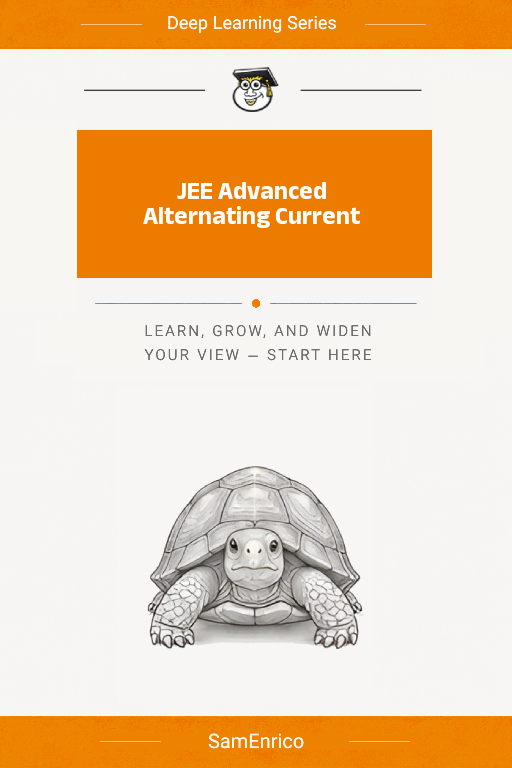
JEE Advanced Alternating Current eBook
Solve AC circuits with impedance phase angle and r
by Ginn Cathi
Solve AC circuits with impedance phase angle and resonance using phasor diagram methods.
Formats
Free sample
Chapter 1: The Silent Revolution...--–- Every time you flip a light switch, charge your phone, or plug in a laptop charger, you are witnessing a silent revolution. It is not the revolution of motors or microchips, but something more fundamental: the triumph of Alternating Current over Direct Current. In the late 19th century, Thomas Edison championed DC, while Nikola Tesla fought for AC. The “War of the Currents” ended with AC as the undisputed backbone of modern civilization. Why?
Because AC can be transformed easily to high voltages for efficient long-distance transmission, then stepped down for safe household use. DC cannot. This chapter is not just about understanding AC—it is about mastering the language that powers the world, and more immediately, about building the toolkit you need for JEE Advanced.Before you can solve a single AC circuit problem, you must speak its language fluently. Unlike DC, where voltages and currents are constant, AC quantities oscillate. They breathe.
They change direction. And they carry hidden information in their amplitude, frequency, and phase. This chapter establishes every foundational concept you will need: the sinusoidal representation, the meaning of RMS values, and the critical distinction between peak and RMS that most students forget under exam pressure. By the end of this chapter, you will not only define these terms—you will compute average and RMS values for both sinusoidal and non-sinusoidal waveforms, a frequent JEE Advanced trap. Let us begin.1.1 Why AC?
The Invisible Backbone of Modern Life Alternating Current is called “alternating” because its polarity reverses periodically. In India, the standard household supply reverses direction 50 times every second—a frequency of 50 Hz. In the United States, it is 60 Hz. This constant reversal is not a flaw; it is a feature. A transformer, which works only with changing magnetic fields, cannot operate on DC.
By using AC, power plants can step up voltage to hundreds of kilovolts for transmission across hundreds of kilometers, drastically reducing resistive losses (Ploss=I2RP_{loss} = I^2RPloss=I2R). Near your home, transformers step the voltage back down to safe levels (240V in India). This elegant scalability made AC the global standard.For JEE Advanced, you do not need to memorize historical battles. You need to recognize that AC problems always involve time-varying quantities. That means calculus.
That means phase. And that means you cannot treat voltages and currents as simple numbers—they are functions. The most common mistake among aspirants is carrying DC habits into AC problems. Do not fall into that trap.1.2 The Mathematical Heartbeat: Sinusoidal Representation Every AC voltage or current in JEE Advanced can be written in the form:V(t)=Vmsin(ωt+ϕ)V(t) = V_m \sin(\omega t + \phi)V(t)=Vmsin(ωt+ϕ)I(t)=Imsin(ωt+ϕ)I(t) = I_m \sin(\omega t + \phi)I(t)=Imsin(ωt+ϕ)Let us break this down piece by piece, because each symbol carries meaning that exam problems exploit.Amplitude (Vm V_m Vm or Im I_m Im): This is the peak value, the maximum deviation from zero. For a standard household outlet in India, Vm=2402≈340V_m = 240\sqrt{2} \approx 340Vm=2402≈340 volts.
Do not confuse amplitude with RMS—that confusion will cost you points.Angular Frequency (ω\omegaω): Measured in radians per second. It tells you how fast the sine wave oscillates. The relationship with ordinary frequency fff (in Hz, cycles per second) is:ω=2πf\omega = 2\pi fω=2πf For f=50f = 50f=50 Hz, ω=100π\omega = 100\piω=100π rad/s. The time period T=1/f=2π/ωT = 1/f = 2\pi/\omega T=1/f=2π/ω. In problems, you may be given fff or ω\omegaω or TTT.
Convert freely.Phase Constant (ϕ\phiϕ): This is the horizontal shift. When t=0t = 0t=0, V(0)=Vmsin(ϕ)V(0) = V_m \sin(\phi)V(0)=Vmsin(ϕ). If ϕ=0\phi = 0ϕ=0, the wave starts at zero and rises. If ϕ=π/2\phi = \pi/2ϕ=π/2, it starts at Vm V_m Vm. If ϕ=−π/2\phi = -\pi/2ϕ=−π/2, it starts at −Vm-V_m−Vm.
Phase differences between voltage and current are the entire reason we have concepts like impedance and power factor.Why sine and not cosine? It does not matter. Sine and cosine are the same function with a phase shift: sin(ωt+ϕ)=cos(ωt+ϕ−π/2)\sin(\omega t + \phi) = \cos(\omega t + \phi - \pi/2)sin(ωt+ϕ)=cos(ωt+ϕ−π/2). JEE problems may use either. Be comfortable converting between them.Trap Alert: Never add two sinusoids of the same frequency by adding their amplitudes.
That only works if they are in phase. You must use phasor addition—which we will cover in Chapter 3. For now, simply remember: AC quantities are functions of time, not numbers.1.3 The Concept of RMS: Why Meters Read What They Read If you connect an AC voltmeter across a household outlet, it reads 240V, not 340V. Why? Because AC meters are calibrated to read the Root Mean Square (RMS) value—the DC-equivalent voltage that would produce the same average power in a resistor.Derivation of RMS for a Sinusoidal Waveform:Consider a resistor RRR carrying a sinusoidal current I(t)=Imsin(ωt)I(t) = I_m \sin(\omega t)I(t)=Imsin(ωt).
Instantaneous power is:P(t)=I(t)2R=Im2Rsin2(ωt)P(t) = I(t)^2 R = I_m^2 R \sin^2(\omega t)P(t)=I(t)2R=Im2Rsin2(ωt)The average power over one complete cycle is:Pavg=1T∫0TIm2Rsin2(ωt)dt P_{avg} = \frac{1}{T} \int_0^T I_m^2 R \sin^2(\omega t) dt Pavg=T1∫0TIm2Rsin2(ωt)dt Using the identity sin2(ωt)=1−cos(2ωt)2\sin^2(\omega t) = \frac{1 - \cos(2\omega t)}{2}sin2(ωt)=21−cos(2ωt), the integral becomes:Pavg=Im2RT∫0T12dt−Im2RT∫0Tcos(2ωt)2dt P_{avg} = \frac{I_m^2 R}{T} \int_0^T \frac{1}{2} dt - \frac{I_m^2 R}{T} \int_0^T \frac{\cos(2\omega t)}{2} dt Pavg=TIm2R∫0T21dt−TIm2R∫0T2cos(2ωt)dt The cosine term averages to zero over a full period. Thus:Pavg=Im2R2P_{avg} = \frac{I_m^2 R}{2}Pavg=2Im2RNow, if a DC current Irms I_{rms}Irms flows through the same resistor, the power is Irms2RI_{rms}^2 RIrms2R. Equating the two:Irms2R=Im2R2⇒Irms=Im2I_{rms}^2 R = \frac{I_m^2 R}{2} \quad \Rightarrow \quad I_{rms} = \frac{I_m}{\sqrt{2}}Irms2R=2Im2R⇒Irms=2ImSimilarly, Vrms=Vm/2V_{rms} = V_m / \sqrt{2}Vrms=Vm/2. This factor of 1/21/\sqrt{2}1/2 appears constantly in AC power problems.CRITICAL CONSISTENCY RULE FOR THIS BOOK:⚠️ Phasors in this book are drawn using peak amplitude (Vm,Im V_m, I_m Vm,Im) unless stated otherwise. Power calculations require RMS values.
Convert using Vrms=Vm/2V_{rms} = V_m/\sqrt{2}Vrms=Vm/2. Never mix the two in the same equation.Write this rule on a sticky note and place it on your study desk. Most JEE Advanced errors in AC problems come from forgetting this distinction.1.4 Average Values: A Different Game The average value of a pure sinusoidal AC voltage over a full cycle is zero. That is because the positive half cancels the negative half. But JEE Advanced rarely asks for the average over a full cycle of a pure sine wave—that is too trivial.…
This is the end of the free sample. Get the eBook to keep going. Buy now
About this book
Details
- Author
- Ginn Cathi
- Publisher
- SamEnrico
- Language
- English
- Genre
- Non-Fiction, Student's Shortcut
- Released
- 2026-06-01
- Pages (approx.)
- 159
- Available as
- eBook, Audiobook

Read better in the ZLOADR app
Your eBooks on your phone or tablet. Sign in with your SamEnrico account and start reading.
More by Ginn Cathi
 Chiropractor Patient Load StressGinn Cathi$11.99
 Disrespect Trigger GuideGinn Cathi$11.99
 Aging Planning HandbookGinn Cathi$11.99
 Healing From Eating Disorders Body Image GuideGinn Cathi$11.99
 Aaron Levie BoxGinn Cathi$11.99
 Pinnacles DisappearancesGinn Cathi$11.99
 Antarctic Traverse SoloGinn Cathi$11.99
 Beginner Meditation For KidsGinn Cathi$11.99
 The Martian Surgeon: Dr. Christian Barnard’s Heart Transplant RevolutionGinn Cathi$11.99
 The Iron Discipline: Frederick the Great and the Birth of the Prussian War MachineGinn Cathi$11.99
 The Mineral Guide to AluminiumGinn Cathi$11.99
 How to Start a Crop Drying and Disinfecting for Primary Market Business (Beginners Guide)Ginn Cathi$11.99
You may also like
 LSE Online Program LengthAgee Letisha$11.99
 Harvard Extension School for Working AdultsRoush Yer$11.99
 LSE Online Reading ListAshford Ludivina$11.99
 LSE Online Language RequirementsWhitten Daphine$11.99
 LSE Online Class SizeHughey Garret$11.99
 LSE Online Alumni MentorshipWild Lyla$11.99
 London School of Economics Alumni NetworkDutton Chantal$11.99
 Harvard Extension School Student SupportCantrell Christene$11.99
 Harvard Extension School Library AccessSantana Adah$11.99
 Harvard Extension School Degree CompletionBray Wyatt$11.99
 Harvard Extension School Course AuditingAbbott Craig$11.99
 Harvard Extension School Extension DiplomaNew Joane$11.99