
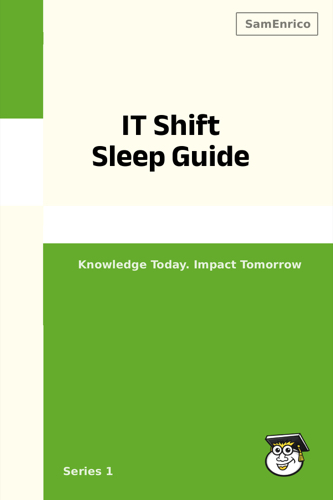
Non-FictionHealth & WellnessTech Industry
IT Shift Sleep Guide eBook
Manages overnight maintenance and on-call schedule
Manages overnight maintenance and on-call schedules.
Formats
Free sample
Chapter 1: The Hero’s Sedation--–- The first time Raj’s pager went off at 2:17 AM, he bolted upright so fast he knocked his glasses off the nightstand. His heart hammered against his ribs like a trapped animal. His wife groaned and rolled over, long since resigned to this ritual. By the time he found his glasses and squinted at the screen, his hands were shaking. The alert was for a disk space warning on a dev server that nobody used after midnight.
The issue auto-resolved four minutes later. Raj lay back down, but his heart didn’t slow for another hour. He did not fall back asleep until 4:30 AM. His alarm went off at 6:45 AM. He dragged himself through the day in a fog, snapped at a junior engineer for a minor mistake, and drank four cups of coffee just to appear functional.
That night, he told his manager he was “fine.” He was not fine. He was the hero his team relied on, and the hero was falling apart.This is not a story about a weak engineer. It is a story about a broken system.Raj is fictional, but his experience is the industry standard. Across thousands of IT teams—from startups to Fortune 500s—engineers are waking up at 2 AM for alerts that should have been automated, lying awake anxious about pages that never come, and dragging themselves through workdays with the cognitive capacity of someone who is legally drunk. The National Sleep Foundation estimates that being awake for 17 hours impairs performance equivalent to a blood alcohol concentration of 0.05%.
Being awake for 24 hours is equivalent to 0.10%—well over the legal driving limit in every US state. Yet IT professionals are routinely expected to perform complex troubleshooting, security analysis, and system recovery at 3 AM after weeks of fragmented sleep. And we call them heroes.This book will argue that the hero model is not sustainable, not ethical, and not even effective. The engineer who sacrifices sleep for uptime is not a martyr; they are a symptom of organizational failure. And the first step to fixing the problem is understanding how we got here.The Myth of the Indispensable Engineer Every IT team has a Raj.
He is the one who knows the legacy authentication service that no one else will touch. He remembers the obscure configuration flag that fixed the database two years ago. When something breaks at 3 AM, he is the first person management calls. He is the “bus factor”—if he were hit by a bus, the company would grind to a halt. And for a while, he wears this label as a badge of honor.
Being indispensable feels good. It means job security. It means respect. It means you are the wizard who holds the kingdom together.But there is a dark side to indispensability that no one talks about. The bus factor is not a measure of your value; it is a measure of your organization’s fragility.
When a team relies on a single wizard, that wizard cannot take a vacation without anxiety. They cannot get sick without guilt. They cannot sleep through the night because they know, deep down, that if the system fails, no one else can fix it. This is not heroism. This is a prison.The psychological term for this state is hyper-vigilance.
It is a condition most commonly associated with trauma survivors and combat veterans—people whose nervous systems have been trained to constantly scan for threats because the cost of missing one is catastrophic. For the on-call engineer, the threat is the page. And because pages arrive randomly, unpredictably, and often in the middle of deep sleep, the brain cannot relax. It learns to stay partially awake, listening for the specific frequency of the alert tone. This is not a skill.
It is a pathology.The research on hyper-vigilance and sleep is unequivocal. A 2018 study in the Journal of Occupational Health Psychology found that employees who were on-call overnight had significantly higher levels of cortisol (the stress hormone) upon waking, regardless of whether they were actually paged. The mere anticipation of being interrupted was enough to dysregulate their sleep architecture. In other words, the expectation of the 3 AM page ruins your sleep even if the page never comes.This is the hidden cost of the hero model. It is not just the nights you are woken up.
It is every night you lie awake wondering if you will be.Presenteeism: The Opposite of Productivity There is a word for showing up to work physically present but mentally absent: presenteeism. It is the mirror image of absenteeism, and it is far more expensive. When an engineer calls in sick, the company loses one day of labor. When an engineer shows up exhausted, the company loses the entire day of labor plus the cost of the mistakes they will make, the patience they will fail to extend to colleagues, and the judgment they will impair during critical decisions.Consider the math. A senior site reliability engineer earns approximately $150,000 per year.
If they are operating at 60% cognitive capacity due to chronic sleep deprivation, the company is effectively wasting $60,000 of salary per year—more than the cost of hiring a dedicated night shift. Yet most organizations continue to rely on exhausted heroes rather than building sustainable systems.The cognitive effects of sleep deprivation are well documented. After 24 hours without sleep (or the equivalent cumulative fragmentation over several nights), reaction time slows by 50%. Working memory capacity drops to that of a sleep-deprived medical intern—a group known to make 36% more serious medication errors than their well-rested colleagues. Risk assessment becomes skewed toward immediate threats while ignoring long-term consequences.
Emotional regulation deteriorates, leading to outbursts, defensiveness, and damaged team relationships.In IT operations, where a single mis-typed command can take down a production database, these impairments are not just inconvenient. They are dangerous. The 2017 AWS S3 outage that took down a significant portion of the internet was exacerbated by an engineer who, working under time pressure and exhaustion, entered a command slightly incorrectly. The post-mortem did not blame the engineer, but it also did not ask the crucial question: why was that engineer working at that hour in that state?The answer is the hero myth. And the hero myth is a leadership failure.Why Leaders Love Heroes (Until They Burn Out)Managers are not malicious.
They are under pressure to maintain uptime, control costs, and deliver results. The hero engineer who answers every page at 3 AM is, in the short term, a very convenient solution. The manager does not have to hire additional staff. They do not have to invest in automation. They do not have to restructure the on-call rotation.
They simply have to thank Raj for being such a team player and give him a $50 gift card at the annual holiday party.This is not management. This is exploitation disguised as appreciation.The problem is that the hero model has a shelf life. Burnout is not a vague feeling of tiredness; it is a clinical syndrome characterized by emotional exhaustion, depersonalization (treating colleagues or customers as objects), and reduced personal accomplishment. The World Health Organization officially recognized burnout as an…
This is the end of the free sample. Get the eBook to keep going. Buy now
About this book
Details
- Author
- Mcnamara Joesph
- Publisher
- SamEnrico
- Language
- English
- Genre
- Non-Fiction, Health & Wellness, Tech Industry
- Released
- 2026-06-06
- Pages (approx.)
- 148
- Available as
- eBook, Audiobook

Read better in the ZLOADR app
Your eBooks on your phone or tablet. Sign in with your SamEnrico account and start reading.
More by Mcnamara Joesph
 Design Thinking for Impact MeasurementMcnamara Joesph$11.99
 Teresas Meditations on the PassionMcnamara Joesph$11.99
 NVC Flashcard Deck GuideMcnamara Joesph$11.99
 Grandparent Legacy ProjectMcnamara Joesph$11.99
 Cleopatra Egypt First PolicyMcnamara Joesph$11.99
 Group Norms SettingMcnamara Joesph$11.99
 Parent Morning Routine GuideMcnamara Joesph$11.99
 The Great Gin Scandal: How a Celebrity Tycoon Outwitted the LawMcnamara Joesph$11.99
 The Defector Who Changed a Nation: The Case of Jorge Videla and the Dirty WarMcnamara Joesph$11.99
 Service Providers Guide to General HospitalsMcnamara Joesph$11.99
 Portfolio Career for StudentsMcnamara Joesph$12.99
 Executive Calendar Color CodingMcnamara Joesph$12.99
You may also like
 Hong Kong Handover 1997Dunn Johnnie$11.99
 Zumba For Postnatal Recovery CourseNeal Christian$11.99
 Zumba for BeginnersLadner Nikia$11.99
 YouTube Comment Mining GuideHumes Pandora$12.99
 Worry Box MeditationCarlin Rudy$11.99
 Workplace Stress MeditationNguyen Lynn$11.99
 Workplace Stress and Sleep RepairHawley Ivory$11.99
 Workplace Perfectionism CureDelaney Jeffry$11.99
 Workplace Injustice Anger GuideWallen Isabelle$11.99
 Work Addiction and Burnout LinkGreenwood Ester$11.99
 Women in Yoga and WellnessBeattie Galina$11.99
 Women in Stand Up ComedyChun Evangeline$11.99