
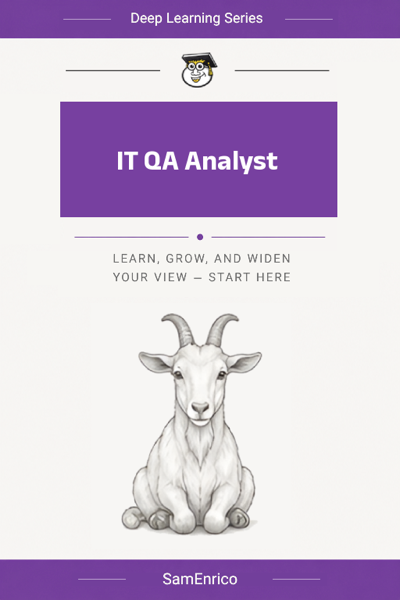
Non-FictionInformativeEducational
IT QA Analyst eBook
A Coursebook on IT QA Analyst
by Sykes Annita
A Coursebook on IT QA Analyst
Formats
Free sample
Chapter 1: The Risk Detective...--The first bug you ever find changes you. Not because the bug is technically impressive—it might be a simple typo, a missing validation, or a button that does nothing when clicked. The change happens because in that moment, you realize something unsettling: you saw what dozens of other people missed. The product manager didn't see it. The developer didn't see it.
The users certainly didn't see it. But you did. That feeling—the quiet thrill of spotting the invisible flaw before it causes real damage—is the seed of everything this book will grow.But here is the truth that most junior QA analysts learn the hard way: if you define yourself as a "bug hunter," you will burn out. Bug hunting is reactive. It is endless.
For every bug you find, ten more lurk in the darkness. Worse, the developers will eventually resent you because your success looks like their failure. The product managers will ignore you because you speak only of problems, never of solutions. And your career will plateau because companies do not promote people who only find what is broken; they promote people who prevent the breakage in the first place.This chapter will dismantle that outdated identity. By the time you finish reading, you will no longer think of yourself as a bug hunter.
You will think of yourself as a risk detective—someone who assesses, communicates, and mitigates risk before it becomes a crisis. You will learn the psychological reframing that separates senior analysts from juniors, the context-driven philosophy that adapts to any industry, and the economic model that proves your value in dollars and cents. Most importantly, you will build a Risk Matrix—a reusable tool that will guide every decision in this book, from designing test cases to prioritizing bugs to acing your job interview.Let us begin with a story. Not a textbook example, but a real one.The $460 Million Typo On August 1, 2012, the software company Knight Capital installed a new trading algorithm. The algorithm was meant to execute stock trades.
A developer reused old code, but a flag that should have been set to "yes" remained at "no." That is it. One flag. One binary value. The company ran a single automated test—not a test of the code itself, but a test of whether the code could be deployed. That test passed.
The algorithm went live.Within 45 minutes, Knight Capital had lost $460 million. The company collapsed and was forced to sell itself to survive. A single missing test. A single flag. Four hundred and sixty million dollars.Here is what most people miss about that story.
The developers did not write bad code. The testers did not make a stupid mistake. The failure happened because no one asked the right risk question before deployment: "What is the worst thing that could happen if this piece of code is wrong?"If a QA analyst had asked that question, they would have realized that a trading algorithm has asymmetric risk. A bug that prevents a trade costs nothing. A bug that executes the wrong trade costs millions.
That simple insight—the asymmetry of risk—would have demanded different testing. More rigorous testing. More skeptical testing. But the team was not thinking about risk. They were thinking about features.
About velocity. About whether the deployment script ran without errors.That is why this book exists. Every chapter, every technique, every tool is designed to make you the person who asks the risk question before the $460 million typo happens.The Psychological Shift: Breaking vs. Building Let me tell you about the two most common ways testers fail. The first is the Adversarial Trap.
You walk into the office convinced that your job is to prove the developers wrong. You write bug reports with phrases like "this is broken" and "this fails to work." You take pride in finding the most embarrassing failures. You are the police officer of the software world, and everyone else is a suspect.This approach feels satisfying. It gives you a clear identity. But it poisons your relationships.
Developers begin hiding work from you. Product managers stop inviting you to early meetings. You become the person everyone fears, not the person everyone trusts. And eventually, you will miss the most important bugs because the team learned to work around you.The second failure is the Politeness Trap. You worry about hurting feelings, so you soften every bug report.
You say "minor observation" when the system cannot save user data. You mark critical bugs as "medium priority" to avoid conflict. You convince yourself that being liked is the same as being effective. It is not. The polite tester finds fewer bugs because they stop looking where the answers are uncomfortable.
Worse, they train the organization to ignore quality because quality never comes with a consequence.There is a third path. I call it the Risk Detective.A risk detective does not care about winning arguments. They care about answering one question: "What could go wrong, and how bad would it be?" When they find a bug, they do not say "you broke this." They say "I discovered that when a user does X, the system does Y. The requirement says it should do Z. Can we check which is correct?"Do you hear the difference?
The risk detective speaks in observations, not accusations. They treat bugs as shared discoveries, not personal failures. They align themselves with the developer's goal—shipping reliable software—rather than against it.The risk detective also knows when to stop being polite. When a bug threatens user safety, data loss, or financial liability, they escalate with clarity and urgency. They do not apologize for being right.
They simply state the facts: "This bug will cause failed login attempts for 10,000 users per day. Here is my evidence. What do we do?"This psychological shift is the foundation of everything else in this book. If you master only one thing from Chapter 1, master this: you are not a bug hunter. You are a risk detective.The Context-Driven Approach: Why Best Practices Are Mostly Lies The software testing industry loves best practices.
You will find hundreds of blog posts, conference talks, and certification courses promising "the five best practices for agile testing" or "the seven habits of effective QA analysts." Most of these are lies. Not malicious lies, but dangerous oversimplifications.Here is the truth: there is no best practice. There are only good practices for a specific situation.Consider two products. The first is a fitness tracking app for casual runners. If the app fails to record a run, the user is annoyed.
They might switch to a competitor. The second is a pacemaker programmer used in heart surgery. If the software fails to deliver the correct electrical pulse, the patient dies.Testing these two products requires completely different approaches. The fitness app needs rapid iteration, lightweight test cases, and automated regression suites. The pacemaker programmer needs exhaustive validation, third-party audits, regulatory sign-offs, and tests that take weeks to execute.
A best practice from one context is malpractice in the other.This is called Context-Driven Testing, a school of thought developed by testing luminaries…
This is the end of the free sample. Get the eBook to keep going. Buy now
About this book
Details
- Author
- Sykes Annita
- Publisher
- SamEnrico
- Language
- English
- Genre
- Non-Fiction, Informative, Educational
- Released
- 2026-05-09
- Pages (approx.)
- 158
- Available as
- eBook, Audiobook

Read better in the ZLOADR app
Your eBooks on your phone or tablet. Sign in with your SamEnrico account and start reading.
More by Sykes Annita
 Death Figure Dream Interpretation GuideSykes Annita$11.99
 Opioid Craving Management GuideSykes Annita$11.99
 Indonesian Electric Vehicle DecreeSykes Annita$11.99
 Email Marketing For AgenciesSykes Annita$11.99
 The Invisible Line: How a Forgotten War Over a River Nearly Split Two NationsSykes Annita$11.99
 The Golden Pen of Leopold Sedar Senghor: Poet, Philosopher, and Architect of African RenaissanceSykes Annita$11.99
 Healthtech Compliance WorkbookSykes Annita$12.99
 Attention Tracking WearablesSykes Annita$12.99
 How to Start a Primary and Pre-primary Education Business (Beginners Guide)Sykes Annita$11.99
You may also like
 Hong Kong Handover 1997Dunn Johnnie$11.99
 Zumba For Postnatal Recovery CourseNeal Christian$11.99
 Zumba for BeginnersLadner Nikia$11.99
 YouTube Comment Mining GuideHumes Pandora$12.99
 Worry Box MeditationCarlin Rudy$11.99
 Workplace Stress MeditationNguyen Lynn$11.99
 Workplace Stress and Sleep RepairHawley Ivory$11.99
 Workplace Perfectionism CureDelaney Jeffry$11.99
 Workplace Injustice Anger GuideWallen Isabelle$11.99
 Work Addiction and Burnout LinkGreenwood Ester$11.99
 Women in Yoga and WellnessBeattie Galina$11.99
 Women in Stand Up ComedyChun Evangeline$11.99