
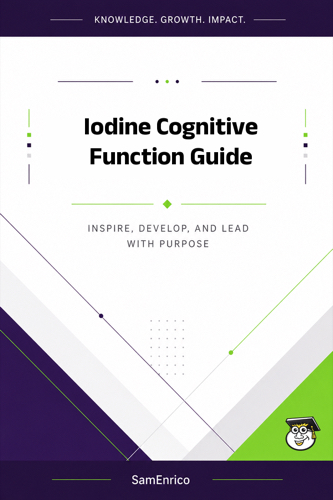
Iodine Cognitive Function Guide eBook
Prevent goiter and support fetal brain development
Prevent goiter and support fetal brain development with adequate iodine.
Formats
Free sample
Chapter 1: The Intelligence Nutrient--–- Maria never thought about her thyroid. Like most people, she couldn’t have pointed to its location on a diagram—that butterfly-shaped gland nestled just below her Adam’s apple, wrapped around her trachea like a tiny bow tie. She was thirty-four years old, six weeks pregnant with her first child, and she felt fine. A little tired, perhaps, but that was normal for pregnancy, wasn’t it? She had passed her initial blood work with flying colors.
Her obstetrician had smiled, handed her a prescription for prenatal vitamins, and told her to come back in a month.What Maria didn’t know was that her routine prenatal panel had not included a test for thyroid function. And what she didn’t feel—what no one had told her to feel for—was the quiet, invisible deficiency that had been building in her body for years. Maria ate a healthy diet. She used sea salt, because that was what the wellness influencers recommended. She avoided processed foods.
She drank almond milk instead of cow’s milk. By every conventional measure, she was doing everything right. But her iodine intake, unknown to her or her doctor, hovered at roughly 75 micrograms per day—half the amount recommended for a non-pregnant woman, and less than one-third of what her developing baby desperately needed.The story of Maria is not a tragedy. It is not a story of cretinism or severe brain damage. Maria’s baby, born at full term, will appear completely normal.
He will cry, nurse, sleep, and meet his early developmental milestones. But when he enters kindergarten, his teachers may notice that he struggles with certain tasks. His reading scores may lag slightly behind his peers. He may have trouble sitting still. His parents will wonder why he seems just a little bit slower than the other children.
And no one will ever connect it to the sea salt in Maria’s pantry.This is the hidden epidemic of iodine deficiency. It does not announce itself with dramatic symptoms. It does not appear on standard prenatal screening panels. It steals cognitive potential not in catastrophic strokes but in tiny, cumulative increments—a point or two of IQ here, a fraction of a second of reaction time there—until millions of children and adults are functioning measurably below their genetic potential. And the tragedy is that it is entirely preventable.The Most Misunderstood Nutrient Iodine occupies a strange and uncomfortable position in modern nutrition.
It is simultaneously essential and ignored, abundant in theory and deficient in practice, simple in concept and maddeningly complex in application. Unlike vitamin C or iron, which have entered the popular consciousness through decades of marketing and public health campaigns, iodine remains a biochemical footnote—something your grandmother mentioned in connection with “goiter” or “that swollen neck thing.” This perception is dangerously outdated.Let us begin with the fundamentals. Iodine is a chemical element, number 53 on the periodic table, a trace mineral that the human body cannot synthesize on its own. It must be obtained exclusively from diet. Every single cell in the human body requires iodine, but not directly.
The body’s demand for iodine is almost entirely mediated by the thyroid gland, a small, butterfly-shaped endocrine organ that uses iodine as its primary raw material to produce thyroid hormones. Without sufficient iodine, the thyroid cannot produce adequate amounts of thyroxine (T4) and triiodothyronine (T3)—the master regulators of metabolism, growth, and brain development.The scale of the problem is staggering. According to the World Health Organization, approximately 1.5 to 2 billion people worldwide have insufficient iodine intake. Of these, roughly 35 million suffer from some form of iodine deficiency disorder severe enough to cause visible symptoms. But these numbers, while dramatic, tell only part of the story.
They capture the tip of the iceberg—the cases of obvious goiter, the children born with cretinism, the adults with overt hypothyroidism. What they miss is the vast submerged mass of the iceberg: the millions of people with mild-to-moderate deficiency who will never receive a formal diagnosis but who will live their entire lives at a cognitive disadvantage.This is the central argument of this book: iodine is the intelligence nutrient, and its deficiency is the most common preventable cause of cognitive impairment in the world.The Three Faces of Iodine Deficiency To understand the full scope of the problem, we must distinguish between three distinct clinical presentations of iodine deficiency. They exist on a spectrum of severity, but they are not simply different degrees of the same condition. They represent fundamentally different biological responses to iodine scarcity.Goiter: The Visible Symptom The most familiar manifestation of iodine deficiency is goiter—the visible swelling of the thyroid gland in the front of the neck. For centuries, goiter was endemic in regions far from the sea, where soil and water contained little natural iodine.
The European Alps, the Himalayas, the Great Lakes region of North America—these “goiter belts” produced generations of individuals with bulging necks, the result of a thyroid gland desperately enlarging itself to trap every available iodine molecule from the bloodstream.Goiter is a compensatory mechanism, not a disease in itself. When iodine intake falls below approximately 50 micrograms per day—far below the recommended daily allowance of 150 micrograms—the thyroid gland responds by increasing its cell mass and vascularity. This hypertrophy and hyperplasia allow the gland to extract iodine more efficiently from the blood, maintaining normal thyroid hormone production for as long as possible. In this sense, a goiter is a sign of success: the thyroid is working overtime to protect the brain and body from the consequences of iodine scarcity.However, goiter is also a marker. It tells us that the system is under stress.
And critically, goiter can be completely absent even in the presence of significant cognitive impairment. This is the first and most important lesson of this chapter: the absence of goiter does not mean the absence of iodine deficiency.Cretinism: The Irreversible Catastrophe At the opposite end of the spectrum lies cretinism—the most severe and devastating consequence of iodine deficiency. Cretinism is not simply “extreme hypothyroidism.” It is a specific neurodevelopmental syndrome that occurs when the fetal brain is deprived of thyroid hormones during the first and second trimesters of pregnancy. The damage is irreversible, and it occurs before most women even know they are pregnant.Classical cretinism takes two forms. Neurological cretinism is characterized by severe mental retardation, deafness, spastic diplegia (stiffness and weakness in the legs), and characteristic abnormalities of posture and gait.
These children often cannot walk independently and may never develop language. Myxedematous cretinism, more common in certain regions of Africa, presents with severe growth retardation, delayed bone age, coarse facial features, and profound hypothyroidism. Both forms represent the complete failure of the developing brain to receive the thyroid hormone it requires for normal structure and function.The global prevalence of cretinism has fallen dramatically since the introduction of universal salt iodization programs in the 1980s and 1990s. But it has not disappeared. The WHO estimates that approximately 35 million people worldwide still suffer from some degree of iodine deficiency-related brain damage, with cretinism representing the…
This is the end of the free sample. Get the eBook to keep going. Buy now
About this book
Details
- Author
- Lunsford Hyon
- Publisher
- SamEnrico
- Language
- English
- Genre
- Non-Fiction, Health & Wellness, Endocrinology
- Released
- 2026-06-11
- Pages (approx.)
- 141
- Available as
- eBook, Audiobook

Read better in the ZLOADR app
Your eBooks on your phone or tablet. Sign in with your SamEnrico account and start reading.
More by Lunsford Hyon
 Mother Daughter CancerLunsford Hyon$11.99
 Empathetic Leadership HandbookLunsford Hyon$11.99
 NVC for Scrum MastersLunsford Hyon$11.99
 Focus Metrics TrackingLunsford Hyon$11.99
 Tension Headache and BruxismLunsford Hyon$11.99
 Hero Archetype Dream JourneyLunsford Hyon$11.99
 Lying Body Language IndicatorsLunsford Hyon$11.99
 Kirsten Dunst InterviewLunsford Hyon$11.99
 The Phantom of the 405: The Highway Killer Who VanishedLunsford Hyon$11.99
 The Glass Ceiling Cracked: The Untold Story of the First Female Supreme Court JusticeLunsford Hyon$11.99
 The Silk Road Warriors: The Untold Story of Persia's Renaissance ArchersLunsford Hyon$11.99
 Toptal Screening Process GuideLunsford Hyon$12.99
You may also like
 Dysthymia And Thyroid DisordersLinder Ashely$11.99
 Selenium Thyroid Health GuideGallo Kennith$11.99
 Micronutrients For Hormone Balance GuideWilloughby Twana$11.99
 Boron Hormone Regulation GuideKyle Hosea$11.99
 Birth Control And Thyroid FunctionEastman Nell$11.99
 Vitamin D Complete Science PrimerRobert Collene$11.99
 The Hormonal ED GuideQuick Alyse$11.99
 Postpartum Hormone ShiftFrazer Lon$11.99
 Human Growth Hormone Decline GuideRagsdale Audrie$11.99
 Hormonal Muscle Preservation PlanDeal Donnetta$11.99
 Progestin Types In HRT HandbookMeyer Celia$11.99
 PCOS Diagnosis Rotterdam CriteriaFogle Fredric$11.99