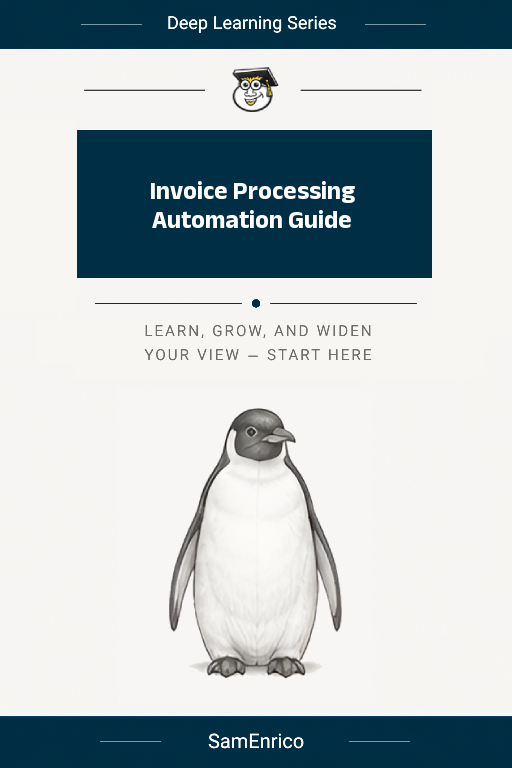
Invoice Processing Automation Guide eBook
Extract data from supplier invoices using OCR and
Extract data from supplier invoices using OCR and AI. Auto populate accounts payable fields and schedule payments for approval.
Formats
Free sample
Chapter 1: The $15 Lie--Every finance department in the world is paying a tax they do not see, a levy collected not by the government but by inefficiency, and the bill comes due with every single invoice that crosses the desk. The average cost to manually process a single supplier invoice ranges from 10to10 to 10to15 in fully loaded labor and overhead, yet most CFOs believe they are spending three to five dollars. This gap between perception and reality is what I call the $15 Lie, and it has quietly drained billions of dollars from otherwise well-run companies over the past three decades. The lie persists because the costs are hidden: they are buried in the time an AP clerk spends chasing down a missing approval, the hours a buyer loses reconciling a quantity discrepancy, the weekend a finance manager sacrifices to close the books because ten invoices remain unprocessed, and the late fee that gets coded to "miscellaneous expense" rather than traced back to its root cause. This chapter exposes the true economics of manual invoice processing, provides a rigorous framework for calculating your organization's real cost-per-invoice, and builds the financial case for automation that no rational CFO can ignore.The Hidden Factory of Manual Processing Every organization that processes invoices manually operates what manufacturing engineers would call a "hidden factory" – a parallel set of activities that consume resources but never appear on any org chart or process map.
Unlike a visible production line, this hidden factory thrives on fragmentation and invisibility. When an invoice arrives by email, someone must download it, rename the file, and save it to a shared drive. When the same invoice lacks a purchase order number, someone must email the requisitioner – not once, but often twice, then three times – to ask for the missing information. When the invoice contains a pricing discrepancy, someone must pull the original purchase order from a different system, compare line by line, and initiate a correction. When the approving manager is on vacation, the invoice sits.
When the approver returns and approves, someone must re-enter the data into the ERP because the initial entry was done by a different person on a different day. Each of these steps takes between two and twelve minutes, and each step carries a risk of error that will require rework.To understand the true cost of this hidden factory, we must break down the complete lifecycle of a single manual invoice. The clock starts when the invoice arrives, not when someone begins working on it. A typical mid-sized company receives between 5,000 and 20,000 supplier invoices per month, depending on industry and size. For each invoice, the following activities occur, whether tracked or not:First, receipt and sorting.
Someone must monitor the shared AP email inbox, separate invoices from other correspondence, identify the supplier, and route the document to the appropriate processor. This takes approximately one to three minutes per invoice, but because the work is batched, the actual elapsed time is often measured in hours or days. The invoice sits in an inbox, unseen, while more urgent tasks take priority.Second, data entry. An AP clerk opens the invoice – which may be a PDF, a scanned image, a paper document, or an email body – and manually types the supplier name, invoice number, invoice date, PO number (if present), line-item descriptions, quantities, unit prices, tax, and total amount into the ERP or accounting system. For a simple invoice with one to three lines, this takes five to eight minutes.
For a complex invoice with ten or more lines, this can take fifteen to twenty minutes. During this entry, the clerk makes mistakes. Studies of manual data entry across multiple industries consistently find error rates between one and four percent per keystroke. For a typical invoice with fifty data fields, the probability of at least one error exceeds sixty percent. Those errors become rework.Third, validation and matching.
If the invoice has a PO, the clerk must locate the corresponding PO in the ERP, locate the goods receipt if the company uses a receiving process, and compare quantities and prices. When discrepancies exist – and they exist in roughly twenty to thirty percent of PO-backed invoices – the clerk must investigate. This investigation involves emailing the buyer, calling the warehouse, checking the receiving log, or escalating to a supervisor. Each investigation adds five to fifteen minutes per exception.Fourth, approval routing. For invoices without a PO, or for PO invoices that exceed tolerance thresholds, an approval workflow must be executed.
In manual environments, this means the clerk prints the invoice or forwards the email to a series of managers, often with no tracking of who has seen it or who is responsible for the next step. An approval chain of three managers typically adds two to five business days of elapsed time, during which the invoice is neither processed nor scheduled for payment. The clerk spends an average of two to three minutes per invoice tracking down approvals, sending reminders, and following up.Fifth, payment scheduling. Once approved, the invoice enters the payment queue. In manual environments, someone must review all approved invoices, check available cash (often by calling Treasury or checking a separate spreadsheet), and schedule payments in batches.
This batch scheduling introduces delays: an invoice approved on the second of the month may wait until the twentieth to be paid, simply because that is when the next check run occurs. The time spent on payment scheduling averages one to two minutes per invoice, but the opportunity cost of delayed or missed early-payment discounts is far larger.Sixth, filing and audit preparation. After payment, the physical or digital invoice must be filed in a way that supports future audits. In paper environments, this means printing, stamping, hole-punching, and placing in binders. In digital environments, this means saving to the correct folder structure and updating a tracking spreadsheet.
This final step takes one to two minutes per invoice but is almost never included in cost-per-invoice calculations.When we sum these activities across a representative sample, the fully loaded labor time per manual invoice ranges from fifteen to thirty minutes, depending on complexity and the presence of exceptions. At a fully burdened labor rate of thirty to sixty dollars per hour for AP staff, the direct labor cost alone ranges from 7.50to7.50 to 7.50to30 per invoice. Add the cost of physical storage (binders, filing cabinets, offsite storage facilities), the cost of software licenses for multiple systems (email, ERP, spreadsheets, document storage), and the cost of rework from errors, and the 10to10 to 10to15 per invoice figure becomes conservative.The Invisible Problem: Working Capital Trapped in Queues The direct labor costs of manual processing are painful but visible. The far larger cost is invisible: working capital tied up in invoices that sit in queues instead of being scheduled for payment on optimal terms. Every day an invoice spends waiting for data entry, waiting for approval, or waiting for a check run is a day that cash could have remained in the company's bank account or could have been used to capture an early-payment discount.Consider the timeline of a typical manual invoice.
On day one, the invoice arrives by email. It sits in the shared AP inbox for two days because the…
This is the end of the free sample. Get the eBook to keep going. Buy now
About this book
Details
- Author
- Sander Caridad
- Publisher
- SamEnrico
- Language
- English
- Genre
- Non-Fiction, Business Brief, Accounts Payable
- Released
- 2026-06-01
- Pages (approx.)
- 153
- Available as
- eBook, Audiobook

Read better in the ZLOADR app
Your eBooks on your phone or tablet. Sign in with your SamEnrico account and start reading.
More by Sander Caridad
 Difficult Conversations Complete WorkbookSander Caridad$11.99
 IBS Post Infectious GuideSander Caridad$11.99
 Dark Side Persuasion DefenseSander Caridad$11.99
 Teen Self Esteem After FailureSander Caridad$11.99
 The Freelance Referral Source GuideSander Caridad$11.99
 Managing Interruptions for Students CourseSander Caridad$11.99
 Time Blocking for Fitness GoalsSander Caridad$11.99
 Frozen Shoulder Rehabilitation WorkoutSander Caridad$11.99
 Toll Payment Tech FrustrationSander Caridad$11.99
 Code Red: The Y2K Blackout That Almost Wasn'tSander Caridad$11.99
 The Bloodied Fields of Antioch: The Crusaders' NightmareSander Caridad$11.99
 Summits and Storms: The Pacific Pioneers Who Conquered the PeaksSander Caridad$11.99