
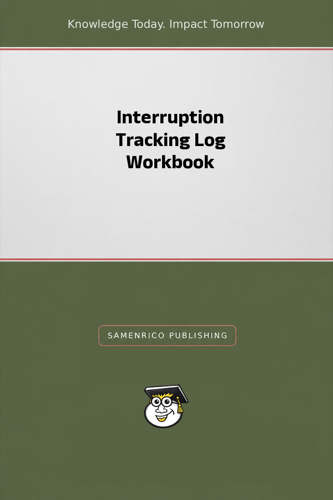
Interruption Tracking Log Workbook eBook
Measure and analyze your daily distractions using
by Weed Ula
Measure and analyze your daily distractions using this practical interruption awareness journal.
Formats
Free sample
Chapter 1: The Fragmentation Epidemic--–- You are not lazy. You are not undisciplined. You are not broken.Let me say that again, because you have probably spent years believing the opposite.You are not lazy.Every morning, you sit down with good intentions. You have a list. You have deadlines.
You have every intention of finally finishing that project that has been hanging over your head for weeks. And then, somewhere between 9:15 AM and 9:17 AM, it happens. A ping. A tap on the shoulder. A sudden, urgent memory that you forgot to reply to your sister’s text from three days ago.
And just like that, your day is no longer yours.You spend the next eight hours feeling busy, productive, exhausted—and yet, at 5 PM, you look at your list and nothing is crossed off. The big thing remains undone. You stay late. You skip the gym. You eat dinner in front of your laptop.
You tell your partner, “I’ll be right there,” and then two hours disappear into a vortex of email, Slack, and anxiety.This is not a character flaw. This is the Fragmentation Epidemic.And it is the single most expensive problem in modern work that nobody is talking about.The Quiet Theft No One Measures Let me tell you about a woman named Priya. Priya is a senior marketing manager at a mid-sized tech company. She is smart, driven, and genuinely cares about her work. When I met her, she was on the verge of burnout.
She was working 55 hours a week, missing her daughter’s soccer games, and still getting feedback from her boss that she seemed “scattered.”Priya agreed to track her interruptions for one week. Just one week. She used a simple paper log—the same one you will use in this book. And what she found horrified her.In a single week, Priya logged 127 interruptions. That is an average of 25 per day.
Most of them were small: an email notification, a coworker asking a “quick question,” a Slack message in a channel she didn’t even need to be in. But here is the math that changed everything for Priya.According to research conducted by Professor Gloria Mark at the University of California, Irvine, it takes an average of 23 minutes and 15 seconds to fully regain deep focus after an interruption. That is not the time it takes to notice the interruption or to switch tasks. That is the time it takes for your brain to re-engage with the original task at the same level of cognitive depth you had before the interruption.Now do the math.Twenty-five interruptions per day. Twenty-three minutes each.
That is 575 minutes per day—over 9.5 hours—spent in the “refocusing” state. Priya was not working 55 hours a week. She was working 55 hours a week while spending the equivalent of a full workday just trying to get back to where she started.When Priya saw this number, she cried. Not because she was sad. Because she finally understood that she was not the problem.
Her environment was.The Lie of Multitasking You have been told your entire life that multitasking is a skill. That the best employees can juggle five things at once. That being “busy” is the same as being valuable. That if you are not overwhelmed, you are not working hard enough.These are lies. And they are backed by bad neuroscience.The human brain is physically incapable of performing two cognitive tasks simultaneously.
What we call “multitasking” is actually rapid task-switching. Your brain slams the brakes on Task A, stores the context in short-term memory, loads the context for Task B, executes it, then slams the brakes again and reloads Task A. This process is metabolically expensive. It burns glucose. It exhausts your prefrontal cortex.
And it introduces what cognitive psychologists call “switch cost”—a measurable degradation in performance on both tasks.In fact, a study published in the Journal of Experimental Psychology found that even brief mental blocks created by shifting between tasks can cost you as much as 40 percent of your productive time. Forty percent. That means if you work an eight-hour day, you are losing over three hours not to the interruptions themselves, but to the invisible recovery time between them.Think about that. Three hours every day. Fifteen hours every week.
Sixty hours every month. Seven hundred and twenty hours every year.That is thirty full days of lost cognitive potential. A month of your life, every year, spent staring at a screen trying to remember what you were just doing.The Shame Spiral Here is what makes the Fragmentation Epidemic so insidious. When you are interrupted constantly, you do not blame the interruption. You blame yourself.You think: Why can’t I focus?
Why am I so slow? Everyone else seems to manage. What is wrong with me?This is the Shame Spiral, and it is the primary reason most productivity books fail. They tell you to “try harder,” to “be more disciplined,” to “just say no.” But you have already tried harder. You have been trying harder for years.
Trying harder is not the solution. Trying harder is the symptom.The truth is that your brain is not designed for the modern workplace. For 99.9 percent of human history, interruptions were survival threats. A sudden noise meant a predator. A tap on the shoulder meant danger.
Your brain evolved to drop everything and orient toward the interruption because the cost of ignoring it could be death.But now, the “predators” are email notifications. The “danger” is a Slack message about a catering order. Your brain cannot tell the difference. It reacts to every ping with the same biological urgency it would have used to flee a saber-toothed tiger. And then you spend the next twenty-three minutes calming down, re-orienting, and remembering that you were writing a quarterly report, not running for your life.This is not a willpower problem.
This is a design problem. And design problems require structural solutions, not moral ones.Why This Book Is Different You have probably read other productivity books. They promised to change your life. They gave you systems and frameworks and fancy acronyms. And maybe, for a week or two, you felt hopeful.
But then real life happened. Your boss interrupted you. Your phone buzzed. Your kid got sick. And the system collapsed because it was built on the assumption that you would never be interrupted.That is absurd.
You will be interrupted. Today, tomorrow, and forever. The question is not how to eliminate interruptions. The question is how to measure, understand, and manage them so they stop controlling you.This book is different for five reasons.First, it is a workbook, not a textbook. You will not read for 200 pages and then start “someday.” You will begin tracking in Chapter 2.
Within 24 hours, you will have data about your own attention. That data will shock you. It will also set you free.Second, it is neutral. We are not here to judge your distractions. We are here to count them.
You will become a scientist studying your own behavior, and scientists do not beat themselves up for the data they collect. They…
This is the end of the free sample. Get the eBook to keep going. Buy now
About this book
Details
- Author
- Weed Ula
- Publisher
- SamEnrico
- Language
- English
- Genre
- Non-Fiction, Self-Help, Self Tracking
- Released
- 2026-06-06
- Pages (approx.)
- 138
- Available as
- eBook, Audiobook

Read better in the ZLOADR app
Your eBooks on your phone or tablet. Sign in with your SamEnrico account and start reading.
More by Weed Ula
 Chunking for Creative BrainstormingWeed Ula$11.99
 Self Hypnosis For Confidence Building WorkbookWeed Ula$11.99
 The Anger Script RewriteWeed Ula$11.99
 Naked in Public Dream CourseWeed Ula$11.99
 Midnight Glitch: The Last Broadcast of Radio Free Y2KWeed Ula$11.99
 The Unstoppable Comeback: How a 1998 Underdog Team Defied All OddsWeed Ula$11.99
 Gas Shutoff Valve Location TrainingWeed Ula$11.99
 SAFe for Boeing StartupsWeed Ula$12.99
 Understanding Englemann DiseaseWeed Ula$17.99
 How to Start a Dairy Machinery and Plant (not Agricultural) Business (Beginners Guide)Weed Ula$11.99
You may also like
 Flow State Measurement GuideBunn Setsuko$11.99
 Working Memory Journal LogDockery Elfreda$11.99
 The Stress Diary Couples MethodCain Thelma$11.99
 Apathy Tracking WorkbookSasser Arcelia$11.99
 Trigger Tracking JournalBeers Hae$11.99
 Interruption Log MethodHerrington Jarvis$11.99
 Flow State Journaling LogDickerson Ardis$11.99
 Screen Time Report ShockPetrie Awilda$11.99