
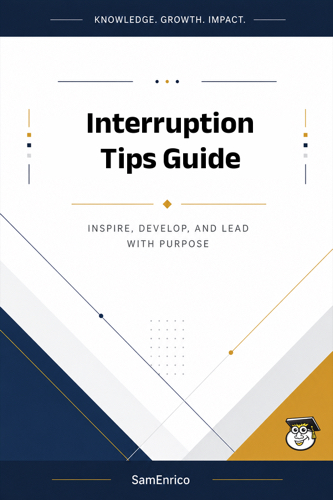
Interruption Tips Guide eBook
undefined
by Tobin Hobert
undefined
Formats
Free sample
Chapter 1: The $35,000 Habit--–- It begins with a sound you barely notice. A soft ding from your pocket. A chime from your laptop. A colleague’s voice suddenly appearing at your shoulder: “Got a sec?” You look up, answer, return to your screen. Thirty seconds have passed.
Maybe a minute. No big deal.Except it is a very big deal. And the price tag on that tiny, seemingly harmless moment is far larger than you ever imagined.This is not a book about time management. Time management assumes you know where your time goes and simply need to organize it better. The truth is more disturbing: you don’t know where your time goes because it is being stolen in small, invisible increments by something you have been conditioned to treat as normal.
Interruptions. Not the dramatic, crisis-driven emergencies that command attention. The small ones. The quick questions. The email notifications.
The Slack pings. The drop-in visits. The “just one thing” requests that arrive exactly when you have finally, mercifully, found your focus.Each one costs you far more than the minute it consumes. Each one resets a cognitive clock you didn’t know you had. And together, they are quietly robbing you of tens of thousands of dollars per year, not to mention your sanity, your creativity, and your capacity to do the work that actually matters.This chapter is a reckoning.
Before we can build defenses, before we can learn the tactics of focus, you must first understand the true nature of your enemy. You have been told that interruptions are annoying. They are not merely annoying. They are economically devastating, neurologically expensive, and emotionally exhausting. By the time you finish this chapter, you will never hear that little ding the same way again.The Math of Destruction Let us begin with a simple exercise.
Take your annual salary. Divide it by two thousand. That is your approximate hourly wage. Now divide that number by sixty. That is your per-minute rate.
A software engineer earning $120,000 per year has an hourly rate of roughly $60 and a per-minute rate of $1. A senior manager earning $180,000 has a per-minute rate of $1.50. A consultant billing $300 per hour has a per-minute rate of $5.Now consider this: research drawn from The Time Bandit Solution and corroborated by multiple workplace productivity studies reveals that the average knowledge worker experiences between fifty-six and eighty-seven interruptions per day. That is one interruption every nine to fifteen minutes. Most last less than two minutes.
Most seem trivial. And most are costing you far more than the two minutes on the clock.Why? Because the interruption itself is only the first of five distinct time-loss factors. Together, they form what we will call throughout this book the Five Time-Loss Factors:Factor One: The Interruption Itself. This is the direct time stolen.
The thirty-second question. The two-minute chat. The ten-second glance at a notification. On its own, this factor is small. That is why we tolerate it.
But small things, multiplied across two hundred working days per year, become very large. Fifty daily interruptions at an average of ninety seconds each equals seventy-five minutes per day. That is 250 hours per year. That is six full forty-hour workweeks spent only on the direct time of interruptions, not counting the aftermath.Factor Two: The Restart. This is where the real damage begins.
When you are interrupted, your brain does not simply pause and resume like a video file. It must disengage from the current task, shift attention to the interruption, handle it, and then—critically—reorient to the original task. This reorientation is not instantaneous. It requires recalling what you were doing, where you left off, what your next step was, and the mental context surrounding the work. Research on task-switching demonstrates that the restart period consumes anywhere from fifteen to twenty-five minutes depending on the complexity of the original task.
We will explore this in depth in Chapter 3, but for now, understand this: a ninety-second interruption typically costs an additional fifteen to twenty-five minutes of restart time. That ninety-second interruption is actually a sixteen- to twenty-six-minute event.Factor Three: Momentum Loss. Even after you have restarted, you are not operating at full capacity. Flow state—that effortless, absorbed condition where work feels almost automatic—requires sustained, uninterrupted attention to achieve. The research psychologist Mihaly Csikszentmihalyi found that it takes approximately fifteen minutes of focused work to enter flow.
An interruption does not just end flow; it destroys the runway required to achieve it again. If you achieve flow twice per day and lose it to interruptions, you have lost not only the time but the quality of work that only flow can produce. Momentum loss is difficult to quantify in dollars, but any creative professional will tell you: an interrupted flow state produces work that is shallower, less original, and more error-prone.Factor Four: The Do-Over. Interruptions cause mistakes. When you are pulled away from a task, you may forget a critical step, skip a verification, or lose track of a variable.
This is not a moral failing; it is a neurological reality. Working memory, the brain’s temporary scratchpad, can hold only a small amount of information at once. An interruption flushes that scratchpad. When you return, you may not realize what you have forgotten. The result is errors that require rework—what we call the Do-Over.
A report sent with an incorrect calculation. A line of code with a missing semicolon that breaks the build. An email sent to the wrong person. The time required to catch and correct these errors is additional and unplanned.Factor Five: Distress Manifestations. This is the hidden cost that shows up not in your timesheet but in your body and mood.
Constant interruptions produce measurable physiological stress. Cortisol levels rise. Heart rate variability decreases. Fatigue accumulates faster than it should. By three o’clock in the afternoon, the interrupted worker is not merely tired; they are dysregulated—irritable, unfocused, and prone to poor decisions.
Distress Manifestations include the mental exhaustion that makes you stare at a screen without typing, the irritability that spills over into a curt reply to a colleague, and the low-grade burnout that makes Sunday evening feel like a countdown to punishment. These costs are real, and they compound daily.When you add these five factors together, the math becomes staggering. The $120,000 software engineer experiencing sixty daily interruptions loses not seventy-five minutes to the interruptions themselves but closer to three and a half hours per day when factoring in restarts, momentum loss, do-overs, and distress. That is seventeen hours per week. That is nearly nine hundred hours per year.
At an hourly rate of $60, the direct productivity cost exceeds $50,000 annually. The frequently cited figure of $35,000 per knowledge worker is actually conservative.This is the $35,000 habit. Not a drug habit. Not a gambling habit. The habit of allowing interruptions.
The habit of treating every ding as worthy of your immediate attention. The habit of believing that “just a minute” costs just a minute.Why We Tolerate the Unacceptable If interruptions are so costly, why do we tolerate them? Why do we not simply refuse them, block them, or design them out of our…
This is the end of the free sample. Get the eBook to keep going. Buy now
About this book
Details
- Author
- Tobin Hobert
- Publisher
- SamEnrico
- Language
- English
- Genre
- Non-Fiction, Self-Help / Tips
- Released
- 2026-06-06
- Pages (approx.)
- 132
- Available as
- eBook, Audiobook

Read better in the ZLOADR app
Your eBooks on your phone or tablet. Sign in with your SamEnrico account and start reading.
More by Tobin Hobert
 The Visualization Memory MethodTobin Hobert$11.99
 Postpartum Guilt ReleaseTobin Hobert$11.99
 Mindfulness Sobriety Training GuideTobin Hobert$11.99
 Negotiation Power Dynamics GuideTobin Hobert$11.99
 Financial Legacy GuideTobin Hobert$11.99
 Divorce Support Groups OnlineTobin Hobert$11.99
 Social Media Relationship ComparisonTobin Hobert$11.99
 The Marshals of Napoleon: Genius, Rivalry, and the Fall of an EmpireTobin Hobert$11.99
 The Art of War: Machiavelli and the Military Genius of the Italian WarsTobin Hobert$11.99
 How to Become a Prototype-deicer AssemblerTobin Hobert$11.99
 How to Produce Motor Vehicle Window Parts and AccessoriesTobin Hobert$11.99
 How to Produce Linear GuidesTobin Hobert$11.99
You may also like
 Scripting TipsGass Lynnette$11.99
 Difficult Conversation TipsButts Antonetta$11.99
 Pattern Recognition TipsMatos Melonie$11.99
 Parent Time Tips GuideHardesty Asuncion$11.99
 Nightmare Tips GuideGates Rossana$11.99
 Anticipatory Grief TipsHamilton Kristy$11.99
 Resilience Tips GuideAvalos Lovella$11.99
 Remote Work Tips GuideGlory Sharkey$11.99
 Memory Palace TipsCambell Julianna$11.99Memory Palace TipsCambell Julianna$11.99
 Pain Meditation TipsLiles Hassie$11.99
 Habit Tips GuideLister Lekisha$11.99