
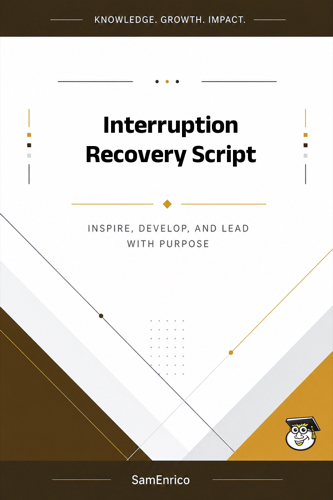
Interruption Recovery Script eBook
Teaches rapid re-focus routine after being interru
Teaches rapid re-focus routine after being interrupted to minimize productivity loss.
Formats
Free sample
Chapter 1: The 23-Minute Heist--–- The email arrived at 9:47 AM on a Tuesday. It was from a colleague, two sentences long, asking for a document. The woman who received it—let’s call her Sarah—had been deep in a financial model for exactly fourteen minutes. She glanced at the notification, clicked over to Outlook, read the email, typed a three-word reply ("In your inbox shortly"), and clicked back to her spreadsheet. Total time away: thirty-one seconds.
A blink. A breath. Nothing.Sarah sat staring at her screen for the next twelve minutes, unable to remember which cell she had been editing, which formula she had been testing, or what insight she had been chasing. She scrolled. She clicked.
She sighed. She opened a second window to compare numbers, then closed it because she couldn’t remember what she was comparing. At 10:02 AM, she gave up and started a new task. At 10:17 AM, she remembered—suddenly, painfully—the exact line of analysis she had been pursuing before the email arrived. Forty-seven minutes had passed.
Thirty-one seconds of interruption. Forty-seven minutes of lost time. And Sarah is not lazy, not distracted, not bad at her job. Sarah is you, and me, and every knowledge worker who has ever felt the strange, disorienting fog that settles over the brain after a tiny, seemingly harmless disruption.This chapter is about that fog. It is about the single most expensive asset in the modern economy—an asset more valuable than your time, your energy, or even your skill.
That asset is your cognitive recovery. And until you understand how it is stolen, you will continue to lose it dozens of times per day, every single day, for your entire career.The Myth of the Thirty-Second Interruption Let us begin with a simple question that most productivity books never ask: How long does an interruption actually cost you? If you ask the average professional, they will guess somewhere between one and five minutes. If you ask a manager, they will guess thirty seconds to two minutes. If you ask a CEO, they will wave their hand and say, "It’s fine—people just need to focus better." All of them are wrong by a staggering margin.In 2013, a team of researchers at the University of California, Irvine, did something unusual.
They followed real knowledge workers in their actual offices—not students in a lab, not simulated tasks, but real people doing real work. The researchers tracked every interruption, logged every task switch, and measured exactly how long it took workers to return to their original task at the same level of cognitive intensity. The results were published in a paper titled "Resuming the Flow of Work" and they have been cited over two thousand times, yet almost no one outside of academic psychology knows the headline number.It takes an average of twenty-three minutes and fifteen seconds to return to a task after an interruption.Let that number land. Twenty-three minutes. Not thirty seconds.
Not two minutes. Not even ten minutes. Twenty-three minutes and fifteen seconds of cognitive friction, reorientation, memory retrieval, and focus rebuilding—all triggered by a distraction that may have lasted only a few seconds. The UC Irvine study found that even when the interruption was trivial (a quick question, a notification badge, a colleague saying "got a sec?"), the recovery time remained stubbornly high. The brain does not care whether the interruption was important or not.
It only cares that the interruption happened.The researchers also discovered something even more disturbing. When workers were interrupted, they didn't just lose time on the original task. They also made more errors, skipped steps, and often abandoned the task entirely. In thirty-seven percent of cases, workers never returned to the interrupted task at all—at least not within the observation window. They simply moved on, leaving a trail of half-finished work, forgotten insights, and slowly accumulating debt.
That document Sarah was writing? That code she was debugging? That strategy she was outlining? In more than one out of three cases, the interruption didn't just delay the work. It killed it.The Switch Penalty: Why Your Brain Is Not a Computer To understand why the cost is so high, we need to understand how the brain actually works—not how we wish it worked, not how it feels like it works, but the messy, biological reality of human cognition.
Let us begin with a foundational truth that every neuroscientist knows and almost every professional ignores: the human brain is not a multitasking organ. It is a sequential processing machine with a very small working memory buffer and a very expensive context-switching overhead.Imagine you are reading a novel. You are deep in a chapter, immersed in the story, visualizing the characters, anticipating the plot. Then someone taps your shoulder and asks for the time. You look at your watch, say "2:30," and turn back to the book.
What happens? You do not simply resume reading where you left off. You have to find the last sentence you remember. You have to recall who was speaking. You have to re-establish the emotional tone of the scene.
You have to suppress the distraction of the interruption itself. This takes time—not much, maybe ten or fifteen seconds for a novel. But now imagine that instead of a novel, you are writing a legal brief with thirty-seven cross-references. Or debugging a software function with twelve nested conditionals. Or analyzing a patient's chart with a history of conflicting symptoms.
The cost of reorientation scales with the complexity of the task, and for knowledge work—which is almost by definition complex—the cost is enormous.Researchers call this the "switch penalty." Every time you shift from Task A to Task B and back to Task A, you pay a toll. That toll has two components. The first is the cost of loading Task B into working memory, which is relatively small. The second is the cost of unloading Task A from working memory so that Task B has room, and then reloading Task A when you return. This second cost is where the minutes disappear.
Your brain has to retrieve the context of Task A from long-term memory, reconstruct the mental state you were in, and verify that nothing has changed. This is not a conscious process—you cannot speed it up by trying harder—and it consumes cognitive resources that could otherwise be used for actual work.The UC Irvine team measured this penalty in real time using a combination of observation and self-report. They found that the switch penalty alone accounted for approximately eight of the twenty-three minutes. The remaining fifteen minutes were consumed by what Dr. Sophie Leroy would later call "attention residue"—a concept so important that it deserves its own chapter (and gets one in Chapter 2).
For now, understand this: every interruption forces your brain to perform a series of expensive operations that you never notice and cannot control. The cost is baked into your biology. You cannot wish it away, outwork it, or compensate with caffeine. The only solution is to change how you respond to interruptions—not by eliminating them (impossible) but by recovering from…
This is the end of the free sample. Get the eBook to keep going. Buy now
About this book
Details
- Author
- Castleberry Santina
- Publisher
- SamEnrico
- Language
- English
- Genre
- Non-Fiction, Self-Help, Recovery Technique
- Released
- 2026-06-10
- Pages (approx.)
- 138
- Available as
- eBook, Audiobook

Read better in the ZLOADR app
Your eBooks on your phone or tablet. Sign in with your SamEnrico account and start reading.
More by Castleberry Santina
 Talking About SuicideCastleberry Santina$11.99
 Loneliness Improv Comedy ClassCastleberry Santina$11.99
 Construction Industry Relationship BuildingCastleberry Santina$11.99
 Agoraphobia HypnosisCastleberry Santina$11.99
 Senior Sleep Esteem GuideCastleberry Santina$11.99
 Stage Four SurvivorCastleberry Santina$11.99
 Burnout Recovery for LawyersCastleberry Santina$11.99
 Antwerp Heist Evidence RoomCastleberry Santina$11.99
 Xochiquetzal and Tezcatlipoca: The Flowered Serpent's Forbidden LoveCastleberry Santina$11.99
 The Iron Spine of Asia: How a Forgotten Engineer Defied Colonial Powers to Build the Godavari BridgeCastleberry Santina$11.99
 The Great Space Race: How Two Nations Split the CosmosCastleberry Santina$11.99
 The Mineral Guide to TanzaniteCastleberry Santina$11.99