
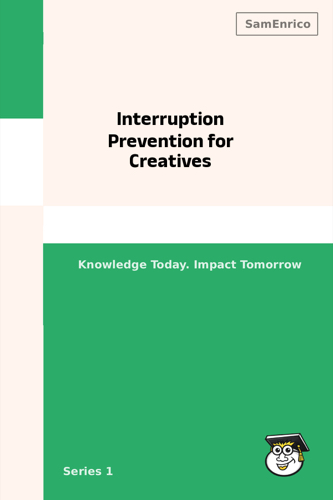
Interruption Prevention for Creatives eBook
Tailors distraction management to creative workflo
Tailors distraction management to creative workflows like writing, design, and coding, where flow state is critical.
Formats
Free sample
Chapter 1: The 25-Minute Graveyard--The notification arrived at 10:14 AM on a Tuesday. Maria, a senior UX designer at a mid-sized software company, had been in flow for forty-seven minutes. That rare, floating state where the interface was designing itself. She knew where every button should go. The color palette was singing in a way she couldn't have planned on paper.
She had just discovered a navigation structure that would solve a problem her team had debated for two weeks—a solution that existed nowhere in the meeting notes, nowhere in the research documents, nowhere except in the delicate, temporary architecture of her own mind.Ping.She glanced at the corner of her screen. Slack. Her manager. "Quick question when you have a sec?"Maria looked back at her design. The pixels were still there.
The layers panel showed exactly the same arrangement of shapes and colors. But something was gone. The knowing was gone. The invisible thread that connected the pieces—the felt sense of why the button belonged there and not there—had snapped. She stared at the screen for twenty minutes, trying to find it again.
She tried to retrace her mental steps. She tried to reconstruct the logic that had felt so obvious just moments ago.She never found it.That specific, unrepeatable configuration of pixels, logic, and emergent understanding—the one that would have saved her team two weeks of debate and delivered a more elegant solution than any wireframe created from scratch—died at 10:14 AM on a Tuesday. It wasn't killed by malice. It wasn't killed by a server crash or a toddler pulling the plug. It was killed by three words in a Slack message: "Quick question when you have a sec?"This is not a book about productivity hacks.
This is not a book about time management. This is a book about why your best ideas are dying before they reach the page, the canvas, the terminal, or the prototype—and how to make it stop.The Productivity Lie You've Been Sold For the past decade, the productivity industry has told you a comforting lie. The lie is this: interruptions are merely delays. They cost you time—maybe fifteen minutes, maybe thirty—but once you return to your desk, you pick up where you left off and continue. The spreadsheet is still there.
The email draft is still there. The to-do list is still there. According to this logic, the damage of an interruption is measured in minutes lost. And minutes, as any productivity guru will tell you, can be recovered. Wake up earlier.
Work faster. Batch your tasks. Use the Pomodoro Technique.This lie sells a lot of books, apps, and planners. It also fundamentally misunderstands how creative work happens.For administrative or analytical tasks—filling out a spreadsheet, responding to emails, categorizing expenses, even debugging code that has already been written—the "interruption as delay" model is roughly accurate. You can stop mid-row on a spreadsheet, answer a question, and return to the exact same cell without losing much.
The context is explicit. The data is on the screen. The next step is obvious.But creative work is different. Creative work—writing a novel, designing an interface, composing a piece of code that has never existed before, painting a canvas, structuring a presentation that will persuade a skeptical audience—does not live on the screen. It lives in your head.
More specifically, it lives in the temporary neural assembly that your brain constructs when you are in a state of emergent discovery.This is not metaphor. This is neuroscience.The Neuroscience of Emergent Discovery When you engage in creative work, your brain does not simply retrieve stored information like a hard drive. It builds new connections between disparate concepts—connections that did not exist before and will not persist after you stop thinking about them. This process is called transient neural assembly. Different regions of your brain (the default mode network for generating ideas, the executive control network for evaluating them, the salience network for determining what matters) fire together in patterns that are unique to that specific moment of creation.These patterns are fragile.
They require sustained attention to maintain. And when that attention is broken—by a notification, a question, a phone call, or even your own impulse to check email—the neural assembly begins to dissolve. Not slowly, like melting ice. Quickly, like a sandcastle hit by a wave.Here is what the research actually says. A study from the University of California, Irvine, found that after a typical digital interruption—an email, a Slack message, a phone notification—it takes an average of twenty-three minutes and fifteen seconds to return to the same level of focus on the original task.
That is the famous "twenty-five minute graveyard" that gives this chapter its name. Twenty-three minutes of context recovery before your brain is back where it was before the interruption.But that number, while widely cited, actually understates the damage for creative professionals. Here's why.The UC Irvine study measured "focus" as the ability to perform a task that required attention—things like data entry, document editing, or following a set of instructions. These are tasks with explicit context. The next step is visible on the screen.
The rules are known. Recovery means remembering what you were doing, not reconstructing how you were thinking.Creative work requires implicit context. The next step is not on the screen; it is in the emergent understanding you were building. Recovery for a creative professional is not about remembering that you were writing paragraph three of a chapter. It is about reconstructing the voice of that paragraph—the specific rhythm, the precise word choice, the emotional temperature that made it work.
It is about remembering not just what the code was supposed to do, but the architectural insight that made the elegant solution possible. It is about finding not just the visual hierarchy you were building, but the felt sense of why the user would feel delighted at that particular moment.Explicit context can be written down. Implicit context cannot.This is why a spreadsheet can survive an interruption and a poem often cannot. This is why a bug fix can be resumed and a novel's breakthrough moment is lost forever. The spreadsheet's context is on the screen.
The poem's context is in the fragile architecture of your mind at 10:14 AM on a Tuesday.The Three Ways Interruptions Kill Creative Work Let me be precise about the damage. When an interruption hits a creative professional, it does not cause one problem. It causes three distinct problems, each worse than the last.First: The Cost of Resumption The first problem is the one everyone talks about: the time it takes to get back into flow. This is the twenty-three minutes from the UC Irvine study. But for creative work, that number is closer to twenty-five to thirty minutes because the context is implicit, not explicit.
You don't just need to remember what you were doing. You need to rebuild how you were thinking.During this resumption period, you are not doing creative work. You are staring at the screen, trying to reconstruct the thread you…
This is the end of the free sample. Get the eBook to keep going. Buy now
About this book
Details
- Author
- Zeller Cristine
- Publisher
- SamEnrico
- Language
- English
- Genre
- Non-Fiction, Self-Help, Creative Process
- Released
- 2026-06-09
- Pages (approx.)
- 132
- Available as
- eBook, Audiobook

Read better in the ZLOADR app
Your eBooks on your phone or tablet. Sign in with your SamEnrico account and start reading.
More by Zeller Cristine
 Senior Support Group GuideZeller Cristine$11.99
 Self Hypnosis for Young AthletesZeller Cristine$11.99
 Destiny 2 Weekly Reset CompulsionZeller Cristine$11.99
 The Unlikely Mogul: How a Tea Shop Defied the Odds and Built a Global EmpireZeller Cristine$11.99
 Succession Planning for Global TeamsZeller Cristine$12.99
 A Beginners Guide to Kick the can (Volume 1)Zeller Cristine$11.99
 How to Produce Advertising Light BoxesZeller Cristine$11.99
 Sales Development ManagerZeller Cristine$11.99
You may also like
 Pomodoro for Creative WorkBuckley Christena$11.99
 Mindful Walking For CreativityQueen Stacee$11.99
 Dealing With Creative DisappointmentNeely Luisa$11.99
 Creative Imposter Syndrome FixHaller Sherita$11.99
 Recurring Dreams and CreativityHager Shalonda$11.99
 Managing Interruptions for CreativesTerry Alonzo$11.99
 Sober Creative Recovery GuideKendall Regenia$11.99
 Self Talk for Creativity BlocksRoman Elinor$11.99
 The Sober Creative Unblocking ManualValenzuela Sanjuana$11.99
 Morning Routine For CreativesCorrigan Taneka$11.99
 The Sober Creative Unblocking WorkbookBarrios Matilda$11.99