
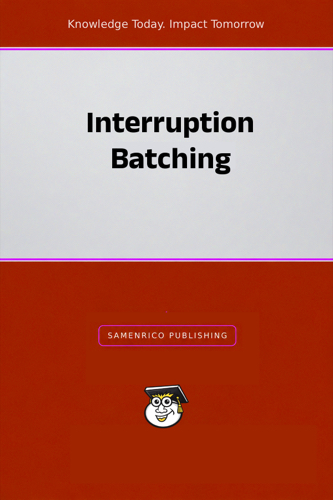
Interruption Batching eBook
Group all interruptions into set times and respond
Group all interruptions into set times and respond in scheduled batches.
Formats
Free sample
Chapter 1: The 23-Minute Thief--I want you to try something before you read another sentence.Look at the top right corner of your screen. Find the clock. Write down the exact time—hour and minute—on a sticky note or in a blank document. Now close your email tab. Close Slack, Teams, or any other messaging app.
Put your phone face-down on your desk, not in your pocket, not in your bag, but face-down where you can see it but not its screen.Now start reading.I will tell you when to check the clock again.The year was 2004. Gloria Mark, a professor at the University of California, Irvine, was watching people work in their cubicles. She had video cameras, heart rate monitors, and a small army of graduate students with clipboards. She was not looking for productivity tips or management fads. She was looking for something far more specific: the exact moment when a human being stops doing one thing and starts doing another.What she found would take nearly two decades to fully understand, and it would eventually force a complete rethink of how knowledge work actually functions—not how we pretend it functions, not how managers wish it functioned, but how the neurological, emotional, and practical reality of work actually operates.She discovered that the average knowledge worker switches tasks every three minutes and five seconds.Let that number sit with you.
Three minutes and five seconds. That is less time than it takes to brew a single cup of coffee. That is less time than it takes to listen to one song. That is less time than it takes to read the first two pages of this chapter.But that was not the shocking part. The shocking part came next.Mark and her team continued watching.
They wanted to know how long it took for a person to fully return to their original task after being interrupted—not just to look at the screen again, not just to put their hands back on the keyboard, but to actually re-engage at the same level of cognitive depth they had before the interruption.The answer: twenty-three minutes and fifteen seconds.Not two minutes. Not five minutes. Not even ten minutes. Twenty-three minutes and fifteen seconds.Think about what happens in twenty-three minutes. You could write a full email.
You could review a short document. You could walk around the block. You could eat lunch. You could—and this is the cruel irony—complete an entire three-minute interruption cycle seven times over, losing your place again and again before you ever find your way back.Mark named this phenomenon the "context switching penalty." It is the cognitive tax you pay every time you shift your attention from one task to another and then back again. And unlike financial taxes, which take a percentage of what you earn, the context switching penalty takes a percentage of what you could have earned—the work you would have completed if you had simply been left alone.The Anatomy of a Switch Let me walk you through what actually happens inside your brain during an interruption.
This is not metaphor. This is neurology.You are writing a report. You have been working for forty-five minutes. You are in what psychologists call "flow"—that effortless state where words appear on the screen almost before you think them, where the external world fades away, where time becomes irrelevant. Your prefrontal cortex, the part of your brain responsible for complex planning and decision-making, has assembled a mental model of the report.
You know where you are, where you are going, and what needs to happen in between.Then a Slack message appears. Or your phone buzzes. Or a coworker taps your shoulder. Or—most insidiously—you remember that you forgot to send an email and you check your inbox "just in case."The interruption lasts seven seconds. You read the message, realize it is not urgent, and close it.
Seven seconds. Barely a breath.But here is what you do not see: your brain has just performed three massive cognitive operations in those seven seconds, and it will need twenty-three minutes to clean up the mess.Operation One: Goal Shifting. Your brain must disengage from the report. This sounds simple, but it is not. Your prefrontal cortex has been holding the report's goal—"finish the quarterly analysis section"—as its top priority.
To look at the Slack message, it must demote that goal from "active" to "suspended." This demotion process alone takes several seconds and consumes measurable amounts of glucose, the brain's primary fuel.Operation Two: Rule Activation. Your brain must load the rules for the interruption task. What is the context of this Slack message? Who is the sender? What project does it relate to?
What is the appropriate response? Your brain must retrieve all of this information from distributed memory networks and assemble it into a coherent framework. This is not instantaneous. It is more like starting a computer program than flipping a light switch.Operation Three: Attention Residue. This is the killer.
Sophie Leroy, a researcher at the University of Washington, discovered that when you switch away from Task A to Task B, a portion of your attention remains stuck on Task A. She called this "attention residue." Even after you return to Task A, the residue from Task B now lingers. You are never fully present in either task. You are haunted by the ghost of the task you left behind.Now multiply this by six interruptions per day. That is a conservative estimate.
Most knowledge workers experience fifteen to twenty interruptions daily. Some experience forty or more. Each interruption triggers the same three operations. Each interruption leaves attention residue behind. Each interruption costs you twenty-three minutes of recovery time, not because the interruption itself is long, but because your brain is not designed to switch contexts efficiently.It is designed to focus.The Math of Fragmentation Let us do the math together.
I want you to see the numbers, not as abstract statistics, but as the actual shape of your workday.Assume you are a typical knowledge worker. You experience six interruptions during your deep work hours—not during lunch, not during meetings, not during the fifteen minutes you spend making coffee, but during the time you have specifically set aside for difficult, important, focused work.Six interruptions.Each interruption costs you twenty-three minutes of recovery time.Six times twenty-three equals one hundred thirty-eight minutes.That is two hours and eighteen minutes. Every single day. Not the interruption time itself, which might total ten minutes. Not the direct cost of reading messages.
The recovery cost. The cost of finding your way back to focus. The cost of rebuilding the mental model you had before you were pulled away.Two hours and eighteen minutes per day.Over a five-day workweek: eleven hours and thirty minutes.Over a forty-eight-week working year (accounting for vacation and holidays): five hundred fifty-two hours.Five hundred fifty-two hours is twenty-three full days. Three entire workweeks. A month of your working life, vaporized not by laziness, not by incompetence, not by a lack of discipline, but by the simple, relentless, biological fact that…
This is the end of the free sample. Get the eBook to keep going. Buy now
About this book
Details
- Author
- Seifert Kyoko
- Publisher
- SamEnrico
- Language
- English
- Genre
- Non-Fiction, Self-Help
- Released
- 2026-06-08
- Pages (approx.)
- 145
- Available as
- eBook, Audiobook

Read better in the ZLOADR app
Your eBooks on your phone or tablet. Sign in with your SamEnrico account and start reading.
More by Seifert Kyoko
 Stress and TMJ DisorderSeifert Kyoko$11.99
 Migraine and Heat TherapySeifert Kyoko$11.99
 Team Energy Management CreativitySeifert Kyoko$11.99
 Shirley Temple CurlsSeifert Kyoko$11.99
 Food Addiction Journal WorkbookSeifert Kyoko$11.99
 NVC for NonprofitsSeifert Kyoko$11.99
 Reading Microexpressions HandbookSeifert Kyoko$11.99
 Brain Cancer SurvivorSeifert Kyoko$11.99
 The Sultan and the Scrum: A Royal Rugby Romance in Renaissance PersiaSeifert Kyoko$11.99
 Quetzalcoatl's Last Flight: The Feathered Serpent's VanishingSeifert Kyoko$11.99
 The Last Flight of Apollo 17: NASA's Secret Moon Mission FilesSeifert Kyoko$11.99
 The Mineral Guide to NahcoliteSeifert Kyoko$11.99
You may also like
 Hong Kong Handover 1997Dunn Johnnie$11.99
 Zumba For Postnatal Recovery CourseNeal Christian$11.99
 Zumba for BeginnersLadner Nikia$11.99
 YouTube Comment Mining GuideHumes Pandora$12.99
 Worry Box MeditationCarlin Rudy$11.99
 Workplace Stress MeditationNguyen Lynn$11.99
 Workplace Stress and Sleep RepairHawley Ivory$11.99
 Workplace Perfectionism CureDelaney Jeffry$11.99
 Workplace Injustice Anger GuideWallen Isabelle$11.99
 Work Addiction and Burnout LinkGreenwood Ester$11.99
 Women in Yoga and WellnessBeattie Galina$11.99
 Women in Stand Up ComedyChun Evangeline$11.99